

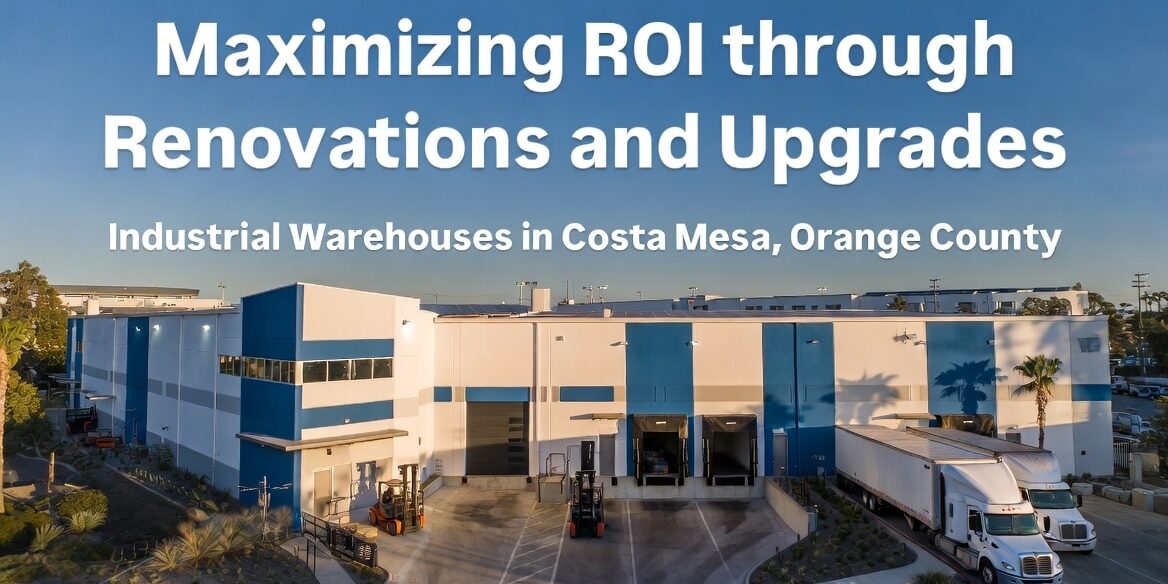
In the heart of Orange County, California, Costa Mesa stands as a strategic hub for industrial and warehouse operations. With its proximity to major transportation corridors like the 405 and 55 freeways, access to the Port of Long Beach, and a thriving ecosystem of logistics, light manufacturing, e-commerce fulfillment, and distribution businesses, Costa Mesa’s industrial properties command premium attention from investors and tenants alike. As of late 2025 and into 2026, the broader Orange County industrial market has seen vacancy rates hover around 5.0% to 5.63%, up from historic lows but still well below national averages. This tightness, combined with elevated asking rents averaging near $1.49 per square foot (PSF) in recent quarters, creates a compelling environment for property owners to invest in targeted renovations and upgrades.
The key to unlocking superior returns lies not in speculative new construction but in strategic retrofits and value-add improvements to existing warehouse facilities. Renovations can dramatically enhance operational efficiency, reduce long-term costs, attract higher-quality tenants, command premium rents, and boost overall property valuation. In a market where land scarcity limits new development and supply chain demands evolve rapidly, well-planned upgrades deliver measurable return on investment (ROI) through increased net operating income (NOI), faster lease-up times, and stronger resale multiples. This comprehensive guide explores how owners and investors in Costa Mesa and surrounding Orange County areas can maximize ROI through intelligent warehouse renovations.
Understanding the Costa Mesa and Orange County Industrial Market Context
Costa Mesa’s industrial sector benefits from its location in one of the nation’s most expensive yet resilient industrial markets. Limited available land for new builds means that retrofitting existing warehouses often proves more cost-effective and faster than ground-up construction. Recent data shows Orange County industrial vacancy rising modestly but remaining historically low, with positive absorption trends emerging in late 2025. Rents have moderated from pandemic peaks but continue to reflect strong demand from logistics firms, manufacturers, and tech-enabled distributors drawn to Southern California’s port infrastructure and labor pool.
In this environment, aging warehouses—many built decades ago—face challenges like outdated energy systems, inefficient layouts, insufficient loading docks, and non-compliance with modern safety or environmental standards. Property owners who address these through renovations position their assets for higher occupancy and rental rates. For instance, flex-industrial spaces that blend warehouse functionality with modern office or amenity zones appeal to a broader tenant mix, including creative logistics operators and small-bay users where vacancy remains tighter.
Investors eyeing Costa Mesa warehouses should note that strategic upgrades can yield ROI through multiple levers: energy cost savings (often 20-50% reductions), extended asset life, compliance with California’s stringent Title 24 energy codes (updated for 2025-2026 permits), enhanced tenant retention, and appreciation in sale prices that frequently exceed $400 PSF in prime Orange County submarkets.
Why Renovations Outperform Rebuilds for ROI in Many Cases
A common dilemma for warehouse owners is whether to retrofit or rebuild. In Orange County, retrofits typically range from $75 to $150+ per square foot, significantly lower than new construction costs that can exceed $200-300+ PSF depending on scope and site conditions. Retrofitting preserves the existing structure, minimizes downtime, and allows phased implementation to keep operations running.
Key advantages of renovation over rebuild include:
- Lower upfront capital: Avoid land acquisition, extensive permitting delays, and full demolition costs.
- Faster timelines: Many retrofits complete in months versus years for new builds.
- Tax and incentive benefits: Energy-efficient upgrades often qualify for utility rebates, federal tax credits (like those under the Inflation Reduction Act extensions), and accelerated depreciation.
- Sustainability alignment: California’s 2025 Building Energy Efficiency Standards emphasize performance-based compliance, making upgrades essential for future-proofing.
A lifecycle cost analysis often reveals that smart retrofits deliver superior long-term ROI by lowering operating expenses while increasing NOI. For example, a warehouse owner investing $100,000 in targeted upgrades might see annual energy savings of $15,000-$30,000 plus rent premiums of $0.10-$0.30 PSF, leading to payback periods under 3-5 years and compounded value appreciation.
High-Impact Renovations and Upgrades with Strong ROI Potential
Successful warehouse renovations in Costa Mesa focus on categories that deliver quick wins alongside long-term value. Here’s a breakdown of proven upgrades, with estimated costs, benefits, and ROI considerations tailored to Orange County’s market and regulatory environment.
1. Energy Efficiency Upgrades: Lighting, HVAC, and Insulation
Energy costs represent one of the largest operational expenses in warehouses, often driven by 24/7 lighting and climate control needs. Upgrading to LED high-bay lighting with motion sensors and smart controls can reduce lighting energy use by 50-75%. In a 50,000 SF facility, this might translate to $20,000-$50,000 in annual savings, with payback in 1-3 years. Maintenance costs drop dramatically due to longer bulb lifespans.
HVAC retrofits, including high-efficiency units, variable frequency drives, and improved ventilation, can cut heating/cooling bills by 20-40%. Pairing these with better insulation and air sealing addresses California’s Title 24 requirements while improving worker comfort and reducing equipment strain.
ROI Example: A comprehensive lighting and HVAC upgrade costing $150,000-$300,000 in a mid-sized Costa Mesa warehouse could yield $40,000+ in yearly savings, plus utility incentives that offset 20-50% of costs. Enhanced energy performance also appeals to ESG-focused tenants, supporting 5-15% rent premiums.
Solar panel installations on expansive warehouse roofs offer another high-ROI path. In sunny Orange County, systems can generate significant on-site power, qualifying for incentives and potentially achieving payback in 5-7 years while hedging against rising utility rates.
2. Structural and Functional Improvements: Loading Docks, Flooring, and Space Optimization
Outdated loading docks limit throughput for modern logistics tenants. Expanding or modernizing docks with levelers, seals, and shelters improves efficiency and safety, directly supporting higher occupancy. Reinforced or epoxy-coated concrete flooring withstands heavy forklift traffic, reduces maintenance, and enhances aesthetics for showrooms or flex spaces.
Interior reconfiguration—creating clear heights optimization, mezzanine additions, or flex office build-outs—transforms rigid warehouses into versatile assets. In Costa Mesa, where small-bay and flex demand remains robust, these changes can increase leasable square footage or appeal to premium tenants like e-commerce operators.
ROI Insight: Such upgrades often boost property value by 10-20% through higher rents and faster lease absorption. Contractors experienced in Orange County industrial work emphasize minimal operational disruption during phased rollouts.
3. Safety, Compliance, and Technology Integrations
California’s strict OSHA, fire/life safety, and ADA standards make compliance upgrades non-negotiable. Installing advanced fire suppression, emergency lighting, seismic retrofits (critical in earthquake-prone Southern California), and ergonomic improvements reduces liability and insurance premiums.
Integrating smart building technologies—IoT sensors for energy monitoring, automated access controls, and warehouse management system-compatible infrastructure—attracts tech-savvy tenants. These features future-proof the property against automation trends in logistics.
4. Exterior and Aesthetic Enhancements
While functional upgrades drive core ROI, cosmetic improvements like refreshed facades, signage, landscaping, and parking lot resurfacing enhance curb appeal and tenant perception. In competitive Orange County submarkets, modern exteriors help properties stand out during tours.
5. Adaptive Reuse and Mixed-Use Flex Elements
Creative renovations incorporating “flex” zones—blending industrial space with office amenities or light creative uses—capitalize on evolving demands. Though full office-to-industrial conversions dominate headlines elsewhere, targeted adaptations in Costa Mesa warehouses can command mixed tenant profiles without major overhauls.
Step-by-Step Guide to Planning and Executing Renovations for Maximum ROI
- Market and Property Assessment: Engage local brokers and appraisers familiar with Costa Mesa to evaluate current vacancy risks, comparable rents, and tenant demands. Conduct an energy audit and structural assessment to identify priorities.
- Budgeting and Prioritization: Use a phased approach. Start with high-ROI/quick-payback items like LED lighting before tackling larger structural work. Factor in total project costs, including permits, which must align with Orange County building codes and Title 24.
- Contractor Selection: Partner with licensed Orange County industrial specialists experienced in warehouses. Look for firms skilled in occupied-space renovations to minimize downtime. Obtain multiple bids and review portfolios of similar Costa Mesa or nearby projects.
- Incentive and Financing Leverage: Explore utility rebates (e.g., from Southern California Edison), federal tax credits for energy efficiency, and green building incentives. Financing options like SBA loans or property-specific renovation loans can improve cash flow.
- Design and Permitting: Work with engineers for energy modeling to ensure compliance. Early Title 24 integration avoids costly rework, especially for permits filed in 2026 onward.
- Implementation and Monitoring: Minimize tenant disruption with off-hours work or temporary relocations. Track metrics post-renovation: energy usage, occupancy rates, and rent growth.
- Post-Project Evaluation: Calculate actual ROI using formulas like (Increased NOI or Value Added – Project Cost) / Project Cost × 100. Adjust strategies for future phases.
Potential ROI Benchmarks and Case Considerations
While specific Costa Mesa case studies vary by property, general Orange County patterns show:
- Energy upgrades: 2-4 year payback, 15-30% operating cost reduction.
- Comprehensive retrofits: 8-15% NOI uplift, supporting cap rate compression and higher valuations.
- Full value-add renovations: Potential 20-40% increase in property value over 3-5 years, depending on market conditions.
In a stabilized 2026 market with moderating but positive rent growth forecasts nationally (around 2% annually), renovated warehouses in Costa Mesa can outperform unupgraded peers through lower vacancies and stronger tenant quality.
Risks to manage include construction cost inflation, permitting delays, and economic shifts affecting absorption. However, the structural undersupply of prime industrial space in Orange County mitigates many downside risks.
Conclusion: Investing in the Future of Costa Mesa Warehouses
Maximizing ROI through renovations and upgrades is not merely about cosmetic fixes—it’s a strategic imperative for warehouse owners in Costa Mesa and Orange County. By focusing on energy efficiency, functional enhancements, safety compliance, and tenant-centric adaptations, property stakeholders can transform aging assets into high-performing investments that deliver sustained cash flow and appreciation.
In a market defined by limited supply, evolving tenant expectations, and regulatory pressures like California’s energy codes, proactive renovations position owners to capture premium rents, attract reliable logistics and manufacturing tenants, and achieve superior long-term returns. Whether undertaking a targeted LED and HVAC retrofit or a full-scale modernization, the payoff lies in data-driven planning, expert local execution, and alignment with broader market trends.
Property owners ready to elevate their Costa Mesa industrial holdings should begin with a professional assessment today. In an environment where every square foot counts, strategic upgrades represent one of the highest-leverage opportunities available in Orange County commercial real estate.