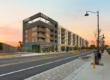

South Coast Metro (SCM), a dynamic mixed-use district primarily in Costa Mesa, Orange County, California, stands out as one of the region’s most desirable real estate destinations. Bounded roughly by Harbor Boulevard to the west, the 55 Freeway to the east, and extending between Baker and Sunflower avenues, SCM is anchored by the world-renowned South Coast Plaza, one of the largest luxury shopping centers in the United States with annual sales often exceeding $2 billion. This area blends high-end residential properties—such as modern condos, townhomes, and select single-family homes—with commercial offices, retail spaces, hotels, and emerging mixed-use developments. Proximity to John Wayne Airport, major employment hubs in Irvine and Newport Beach, extensive freeway access, walkable amenities, dining, entertainment, and cultural offerings drives exceptional demand.
As of late 2025 into early 2026, the broader Costa Mesa housing market reflects strong performance, with median home prices ranging from approximately $1.35 million to $1.6 million, showing year-over-year increases as high as 25% in some reports alongside signs of stabilization, modest inventory growth, and homes selling in 15–37 days on average amid competitive but cooling conditions. Properties in SCM command premiums due to lifestyle advantages, scarcity of land for new development, and ongoing projects like the Related Bristol Specific Plan, which promises walkable urban villages with parks and community spaces. In this high-value, rapidly evolving environment, accurate real estate appraisals are essential for home purchases, mortgage refinancing, sales, estate planning, property tax appeals, divorce settlements, or investment analysis. An appraisal provides an independent, professional opinion of market value—the most probable price a property would sell for under normal conditions between a willing, informed buyer and seller—ensuring fair transactions, lender protection, and informed decision-making.
Appraisals in SCM require specialized expertise because of unique local dynamics: premium location effects near South Coast Plaza, diverse property types (residential condos versus commercial offices or retail), potential for highest and best use redevelopment, rapid market appreciation or adjustments, homeowners association (HOA) fees common in condos/townhomes, and California-specific factors like Proposition 13 tax assessments (which cap annual increases but do not dictate market value appraisals). Licensed or certified appraisers regulated by California’s Bureau of Real Estate Appraisers (BREA) must follow the Uniform Standards of Professional Appraisal Practice (USPAP), established by the Appraisal Foundation and mandated federally and statewide. These standards ensure ethical, competent, objective, and well-documented valuations. BREA oversees licensing tiers (Trainee, Licensed Residential, Certified Residential, Certified General), requiring education (150–300+ hours), supervised experience (2,000–3,000+ hours), exams, and ongoing continuing education including USPAP updates.
The Step-by-Step South Coast Metro Appraisal Process
The appraisal process is systematic, typically taking 1–3 weeks from order to delivery in Orange County markets, though timelines can extend in busy periods or for complex commercial properties. It begins when a client—often a lender for mortgage financing, but also a homeowner, buyer, seller, or attorney—engages a qualified appraiser. Selection prioritizes BREA-licensed professionals with demonstrated local SCM or Costa Mesa experience, as comps (comparable properties) and neighborhood nuances demand familiarity. Referrals from real estate agents, lenders, or prior clients help identify experts who understand SCM’s walkability premiums, retail adjacency benefits, and mixed-use influences.
First, the appraiser defines the problem per USPAP Standard 1: identifying the client and intended users, the intended use (e.g., lending, market value for sale), the type and definition of value (most commonly “market value” as the price in an arm’s-length transaction), the effective date (usually the inspection or report date), relevant property characteristics (legal description, zoning, easements), and any extraordinary assumptions or hypothetical conditions (e.g., assuming completed repairs or no environmental issues). Scope of work is determined based on property complexity—residential condos may focus on interior features and HOA amenities, while commercial offices emphasize income potential.
Next comes the critical on-site property inspection, lasting 30 minutes to several hours. The appraiser measures interior and exterior dimensions accurately (using laser tools or tape for square footage verification, vital for per-square-foot pricing in high-value SCM condos), photographs all areas (with permission), assesses overall condition, quality of construction, layout, number of bedrooms/baths, upgrades (kitchen/bath remodels, flooring, smart home features), natural light, views (plaza proximity or city vistas add premium), mechanical systems (HVAC, plumbing, electrical), roof, foundation, landscaping, parking (garage or assigned spaces crucial in dense Metro), and any functional or external obsolescence. In SCM, appraisers note walkability to South Coast Plaza, nearby dining/retail, traffic patterns from freeways, noise levels, and amenities like community pools or fitness centers in modern developments. Exterior curb appeal—landscaping, paint condition, entry aesthetics—receives emphasis, as buyers in this competitive market prioritize first impressions. Safety issues, deferred maintenance (e.g., leaky roofs, outdated wiring), or unpermitted additions are flagged, as they can reduce value significantly. Homeowners should prepare by ensuring clean, clutter-free spaces, functioning utilities, easy access to attics/crawlspaces, and providing keys or codes if needed.
Following inspection, the appraiser collects and analyzes extensive data. This includes verifying public records (assessor data for lot size, year built, tax history, legal description), reviewing zoning and building permits (important in SCM due to redevelopment potential), gathering market data on supply/demand trends, interest rates, employment, and economic indicators affecting Orange County. Key is sourcing verified comparable sales (ideally 3–6 recent closed sales within 6–12 months, within 0.5–1 mile in SCM or adjacent Costa Mesa/Santa Ana areas), pending sales, active listings, and expired listings. Data sources encompass Multiple Listing Service (MLS), public recorder/assessor offices, appraiser databases, broker interviews, and rental data for income properties. Neighborhood analysis covers demographics, school quality (Costa Mesa Unified), crime trends, environmental factors (flood zones, seismic risks in California), and directional growth toward mixed-use projects.
Market analysis incorporates highest and best use evaluation—legally permissible (zoning-compliant), physically possible, financially feasible, and maximally productive use. In SCM, this might reveal that a low-density residential parcel’s highest/best use is redevelopment into higher-density mixed-use given surrounding trends like the Related Bristol project, potentially elevating land value.
Valuation Approaches Tailored to South Coast Metro
Appraisers apply up to three primary approaches from USPAP, reconciling them for a final opinion, though the sales comparison approach dominates residential appraisals.
The sales comparison approach (market data method), based on the principle of substitution, is primary for SCM residential properties. The appraiser selects comps similar in location, size, age, style, condition, and features, then adjusts their sale prices to estimate the subject’s value. Adjustments are made to the comps (never the subject) for differences: positive or negative for time/market conditions (SCM’s rapid 2025 appreciation requires upward adjustments for older comps), location (premiums of 10–20%+ for direct Metro proximity to South Coast Plaza, walkability, or freeway access versus more distant Costa Mesa areas), lot size/shape (larger or corner lots may add value), square footage (per-sq-ft rates often $800–$1,000+ in premium SCM condos), bedrooms/baths, age/condition, amenities (views, updated kitchens adding $20,000–$100,000+), financing terms, and concessions. Hypothetical example: A 1,800 sq ft, 3-bed/2.5-bath SCM condo sold for $1.4 million six months ago; the subject is similar but has superior plaza-facing views (+$50,000 adjustment) and newer appliances (+$15,000) but slightly smaller lot (-$10,000), yielding an adjusted comp value of $1.455 million. Multiple comps are reconciled judgmentally, weighting the most similar highest, not simply averaging.
The cost approach estimates value as land value (via vacant land sales or extraction) plus the depreciated replacement cost new of improvements. Replacement cost uses current construction costs per square foot (higher in OC due to labor/materials), indexed via cost manuals, minus accrued depreciation—physical (wear/tear, straight-line or observed condition), functional (outdated layout), and external (neighborhood factors like traffic). Add entrepreneurial profit. This approach is useful for newer SCM builds, unique custom properties, or when comps are scarce, providing a benchmark against market data. It highlights contributions of updates or obsolescence but is less reliable for older properties with significant depreciation.
The income approach capitalizes anticipated net operating income (NOI) into value, ideal for investment properties, rental condos, apartments, or commercial spaces in SCM. Estimate potential gross income (market rents, e.g., $3,000–$5,000+/month for premium Metro condos or office rents per sq ft), deduct vacancy/collection losses (low in high-demand SCM) and operating expenses (property taxes under Prop 13, insurance, maintenance, HOA, utilities, reserves), yielding NOI. Apply a capitalization rate (cap rate, derived from comp sales, often 4–6% for stable SCM commercial/income properties reflecting low risk/premium location) via direct capitalization: Value = NOI ÷ cap rate. For example, a commercial retail space with $200,000 NOI at 5% cap rate values at $4 million. Yield capitalization (discounted cash flow) projects multi-year income growth, reversion at sale, and discounts at a yield rate. Gross rent multipliers may supplement for simpler residential rentals. In SCM, strong tourism/retail draw and job proximity support stable or growing rents, but cap rates reflect investor demand for this amenity-rich submarket.
Reconciliation and Reporting
The appraiser reconciles indications from applicable approaches, giving most weight to the most relevant and reliable data (sales comparison for owner-occupied residential; income for investor-owned; cost for new/special-use). The final value opinion is a single figure (or range), rounded appropriately, supported by reasoning. Per USPAP Standard 2, a detailed report is prepared—often a Uniform Residential Appraisal Report (URAR/Form 1004) for residential or narrative/self-contained for commercial— including property description, market analysis, highest/best use, approach details, comp grids with adjustments/photos, reconciliation, certifications of impartiality/no interest, and the appraiser’s signature/license. Restricted-use reports are brief for specific clients only. Reports remain confidential except as legally required.
Key Factors Influencing Appraisals in South Coast Metro
Location premiums are paramount: adjacency to South Coast Plaza enhances retail/dining access, boosting values through convenience and prestige. Walkability, urban vibrancy, proximity to airport/freeways, and low crime relative to some areas contribute positively. Economic forces—strong OC employment (tech, finance, tourism), interest rate trends, and supply constraints from limited land—drive demand and appreciation, requiring time adjustments in comps. Physical factors include property condition, updates (permitted remodels add value; unpermitted do not), lot utility, and environmental/seismic considerations. Social/demographic appeal (diverse, affluent buyers seeking lifestyle) and government factors (zoning favoring mixed-use, building codes) also matter. Highest/best use analysis is crucial amid redevelopment pipelines, potentially shifting values upward for underutilized sites. Challenges include limited comps in unique SCM pockets (leading to broader-area adjustments), market volatility (rapid price shifts demand current data), HOA impacts on condos (monthly dues offset by amenities), and external obsolescence like congestion near the plaza.
Preparing for an Appraisal in South Coast Metro
To maximize value indication, homeowners/sellers should enhance curb appeal (mow, trim, paint, remove clutter), complete minor repairs (fix leaks, update fixtures, address safety issues), ensure all systems function, provide documentation (permits, receipts for renovations, utility bills, HOA docs, surveys), and disclose known issues transparently. Avoid major changes mid-process. In competitive SCM, well-maintained, updated properties with desirable features (open layouts, modern kitchens/baths, outdoor spaces) appraise stronger.
Common Challenges and Regulatory Considerations
In hot markets, low appraisals can derail deals (gap negotiations or buyer cash needed); solutions include additional comps or value appeals with new data. Commercial appraisals in SCM offices/retail may involve more complex income projections and tenant lease analysis. California regulations mandate BREA licensing, USPAP adherence, and independence (appraisers cannot be influenced by transaction parties). Violations can lead to fines or license revocation. Post-Prop 13, tax-assessed values lag market, so appraisals reflect true market dynamics.
Conclusion
The South Coast Metro real estate appraisal process delivers an objective, data-driven valuation critical in this premium, dynamic market. By following USPAP-guided steps—engagement, inspection, research, analysis via sales comparison, cost, and income approaches, reconciliation, and reporting—appraisers navigate SCM’s unique blend of luxury retail adjacency, mixed-use potential, high demand, and evolving developments to support sound financial decisions. Whether buying a plaza-adjacent condo, refinancing an office building, or selling a townhome, understanding and preparing for this process empowers stakeholders amid Costa Mesa’s strong but stabilizing market trends. Engaging a local, experienced BREA-certified appraiser ensures accuracy, compliance, and confidence in one of Orange County’s most sought-after districts. For property owners in SCM, staying informed on local trends and maintaining properties proactively enhances long-term value in this vibrant coastal economic hub.