

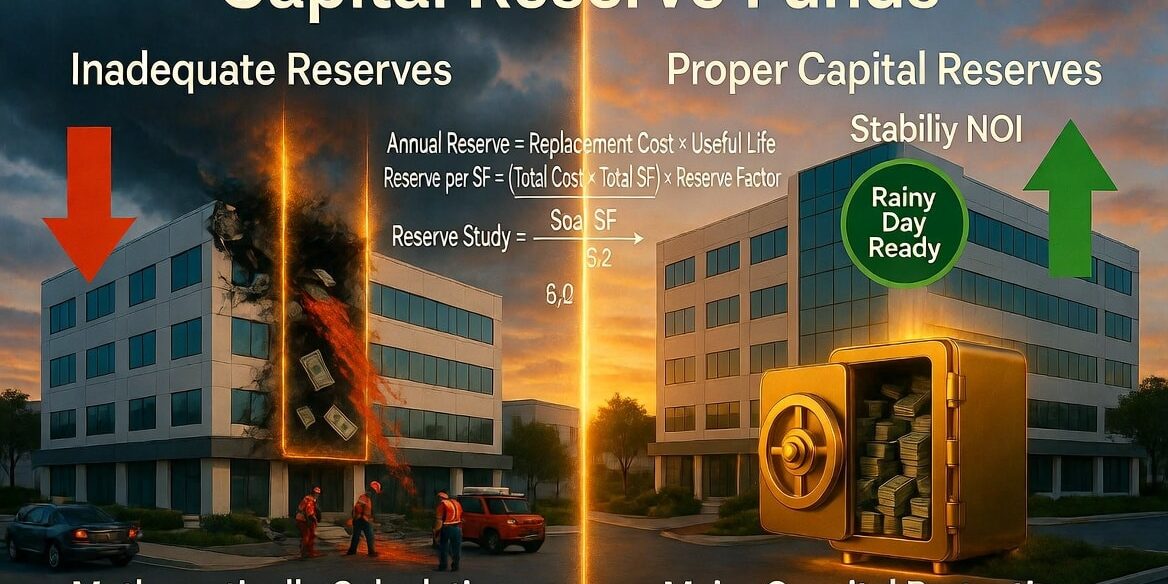
In the highly reactive, yield-obsessed arena of commercial real estate syndication, the amateur syndicator navigates the fiscal year with a fatal, completely delusional sense of financial invincibility. They acquire an aging, multi-million-dollar commercial asset and immediately distribute 100% of the Net Operating Income (NOI) to their Limited Partners to artificially inflate the year-one cash-on-cash return. They pat themselves on the back, masquerading as elite operators. Six months later, a massive atmospheric river hits Southern California, violently detonating a localized 20-year-old HVAC chiller and ripping open 3,000 square feet of roof membrane.
The amateur operator has zero cash in the bank. They are mathematically forced to issue an emergency “Capital Call,” begging their investors to wire simply to keep the building habitable. The LP investors revolt, the tenant files a massive business interruption lawsuit, and the capital stack completely collapses.
This is a catastrophic, multi-generational failure of physical and actuarial underwriting.
In the apex tiers of institutional capital, we do not view mechanical failure as a surprise; we view it as a mathematical certainty. A commercial building is an actively dying machine. The roof, the asphalt, the plumbing, and the HVAC all have a highly specific, mathematically quantifiable expiration date. If you are not aggressively withholding a calculated percentage of your cash flow to pre-fund these inevitable deaths, you do not own a stabilized asset; you own a ticking financial time bomb.
At The Malakai Sparks Group, backed by the institutional framework of L3 Property Management, we do not hope for good weather; we engineer the financial umbrella. Governing an eight-figure commercial rent roll requires the exact same ruthless, fiduciary discipline deployed when steering the La Cuesta Racquet Club board through highly regulated, million-dollar community maintenance assessments—you strip the emotion from the table, demand absolute fiscal responsibility, and legally enforce the governing documents to protect the collective equity. You do not survive the daily logistical warfare of this industry by writing blank checks; you endure the market with the unyielding physical and mental stamina of an Ironman, and the relentless, compounding structural momentum of a heavy 48KG kettlebell progression—every single repetition, every single dollar of withheld CapEx, must be mechanically locked out to endure the heavy weight of the market. Just as we relentlessly canvas the exact 2,500-home localized grid in the Numbered Streets of Huntington Beach to unearth unyielding equity before it hits the open market, we forensically audit the Capital Reserve matrix to permanently eradicate the Capital Call. Here is the definitive, institutional-grade guide to decoding the Capital Needs Assessment, surviving the mechanical slaughter, and mathematically guaranteeing your localized yield.
1. The Mathematics of the Capital Needs Assessment (CNA)
To successfully govern a commercial asset, an investor must completely dismantle the illusion that a “Rainy Day Fund” is an arbitrary, generic savings account. Institutional capital utilizes a forensic Capital Needs Assessment (CNA).
A CNA is an actuarial table for your physical dirt. An engineer mathematically maps the exact remaining useful life of every major mechanical component in the building.
-
The Actuarial Mandate: If your commercial roof has exactly 10 years of useful life remaining, the math is absolute. You do not wait 10 years and hope you have in the bank; you mathematically force the building to deposit a year ( a month) into a legally segregated, highly liquid CapEx reserve account.
-
The “Below the Line” Discipline: This money is withheld below the line. It is subtracted from the NOI before a single penny of cash flow is distributed to the investors. The amateur views this as a “loss of yield.” The elite institutional operator views this as the ultimate financial moat, entirely insulating the investors from the catastrophic friction of emergency bridge debt.
2. High-Density Friction and The Turnover Bleed
The reserve matrix is most violently tested within the heavy-turnover residential sectors, where infrastructural abuse is relentless and localized wear-and-tear is highly accelerated.
-
The Commuter Attrition: When operating massive residential complexes within the transit-oriented commuter grids of Santa Ana: High-Density Multi-Family & The Urban Redevelopment Core or the student-heavy logistical networks of Fullerton: The Northern Logistical & Academic Support Hub, the velocity of unit turnover requires massive, highly liquid reserves.
-
The Per-Unit Floor: Institutional lenders frequently mandate a minimum reserve of to per unit, per year, simply for routine capital replacements. Elite operators frequently double this to per unit. We know that high-density student and commuter tenants will absolutely eviscerate the localized flooring, appliances, and drywall. The hyper-funded reserve account allows the operator to execute a complete unit turn in 5 days using pre-funded capital, completely bypassing the friction of scrambling for cash and mathematically maximizing the unit’s uptime.
3. The Experiential Aesthetic vs. The CapEx Cliff
Capital Reserves become a highly volatile engineering puzzle when governing heavily curated, consumer-facing assets where visible perfection dictates the localized valuation.
-
The Culinary Premium: When executing heavy adaptive-reuse projects within the hyper-experiential retail grids of Costa Mesa: The Creative Office & High-Volume Experiential Retail Corridor or navigating the fiercely guarded historic preservation overlays of San Juan Capistrano: Historic Professional Office & Boutique Retail Arbitrage, the entire valuation is tied to the pristine aesthetic.
-
The Boutique Replacement Cost: A custom, 12-foot architectural glass door on a Michelin-star restaurant does not cost to replace; it costs . The historic masonry requires highly specialized, astronomically expensive tuck-pointing. If a landlord fails to pre-fund the “Aesthetic Reserve,” they will be mathematically forced to let the building’s facade degrade, instantly vaporizing the boutique retail premium they spent millions to entitle. Elite operators underwrite the premium replacement costs directly into the initial pro forma, forcing the building to pay for its own experiential upkeep.
4. The Industrial Core and The 3-Phase SLA
In the massive logistical and manufacturing sectors, the Capital Reserve shifts entirely from aesthetic preservation to heavy mechanical mitigation.
-
The Supply Chain Abuse: When acquiring massive distribution hubs within Anaheim: The Industrial Heart of Orange County or specialized terminal logistics centers in Huntington Beach: Coastal Industrial & The Aerospace/Defense Pivot, the sheer size of the concrete truck courts and 100,000-square-foot roofs dictate massive, “lumpy” CapEx requirements.
-
The NNN Trap: Amateur landlords assume that because the lease is Absolute NNN, they do not need reserves. This is a fatal legal error. As a lease nears its final 24 months, tenants frequently defer major maintenance. If a defense contractor vacates and leaves you with a destroyed roof and a burnt-out 3-phase electrical grid, you cannot lease the building to the next corporate tenant until it is fixed. The elite operator holds a massive “Transition Reserve,” mathematically guaranteeing they have the raw liquidity to instantly rehab the industrial shell and seamlessly capture the next cycle’s rent spike without waiting on a slow insurance payout or a lengthy tenant lawsuit.
5. Shielding the Clinical Moats and Corporate ESG
Institutional capital deploys elite reserve architecture to mathematically fulfill global corporate mandates and permanently secure inelastic medical credit.
-
The Medical Baseline: If you are securing advanced biomedical footprints within Fountain Valley: The Corporate Flex Corridor & Institutional Healthcare Fortress or entitling corporately backed clinical engines in Orange: The Institutional Healthcare & Medical Office Epicenter, mechanical failure is a federal liability. The hospital-grade MERV-13 air filtration systems and specialized biological waste infrastructure cannot go offline for a single hour. Elite operators mandate massive “Immediate Action Reserves.” If a clinical HVAC system fails, the landlord does not wait for a loan approval; the pre-funded capital instantly deploys the emergency vendor, preserving the tenant’s localized accreditation and legally defending the 15-year lease.
-
The Fortune 500 Compliance: This exact same strategic alignment is executed within the towering corporate bastions of Irvine: The Master-Planned Corporate Juggernaut and the heavily restricted suburban fortresses of Mission Viejo: South County Suburban Retail & High-Yield Healthcare Centers. Corporate headquarters require absolute visual and mechanical perfection. By carrying heavily fortified capital reserves, the landlord proves to the Fortune 500 conglomerate that they possess the unyielding financial sovereignty required to maintain the corporate moat.
6. The Sovereign Exit: Escrowing the Actuarial Ledger
The ultimate, multi-million-dollar consequence of a brutally executed Capital Reserve strategy is realized exclusively upon the terminal disposition of the asset.
-
The Frictionless Due Diligence: When transitioning multi-generational equity into the absolute sovereign wealth vaults of Newport Beach: The Wealth Management & Coastal Capital Center, the institutional buyer executes a forensic audit of your historical CapEx ledgers.
-
The Valuation Multiplier: An institutional buyer will deploy their own engineers to assess the roof and the HVAC. If they find deferred maintenance, they will violently slash your purchase price by millions. However, if the elite operator simply points to a fully funded, Capital Reserve account and legally transfers that liquid capital to the buyer at closing to cover the future roof replacement, the buyer’s risk mathematically drops to zero. You do not suffer the Cap Rate penalty. The fully capitalized reserve is the exact financial mechanism that justifies the multi-million-dollar premium exit valuation.
Conclusion: You Do Not Hope for Good Weather, You Build the Ark
In the highly capitalized, completely unforgiving arena of Southern California commercial real estate, relying on an empty bank account and hoping your 20-year-old roof survives another winter is an unforced error of massive proportions.
Amateur commercial brokers sell the year-one cash-on-cash return. They push the syndicator to distribute every last dime to appease the LP investors, completely ignore the compounding mechanical degradation that silently destroys the building’s infrastructure, and trap their clients inside a financially hollow asset that mathematically detonates the moment the localized friction strikes.
Elite commercial advisors are operational actuaries and financial engineers. We execute the Capital Needs Assessment. We mathematically force the below-the-line withholdings. We execute the liquidity sweep before a single distribution check is ever cut. At The Malakai Sparks Group and L3 Property Management, we ensure that when your wealth is deployed into a commercial asset, your physical dirt is not exposed to the elements; it is mathematically bulletproof, fully capitalized, and aggressively funded to permanently defend the absolute maximum yield of your multi-generational legacy.






