

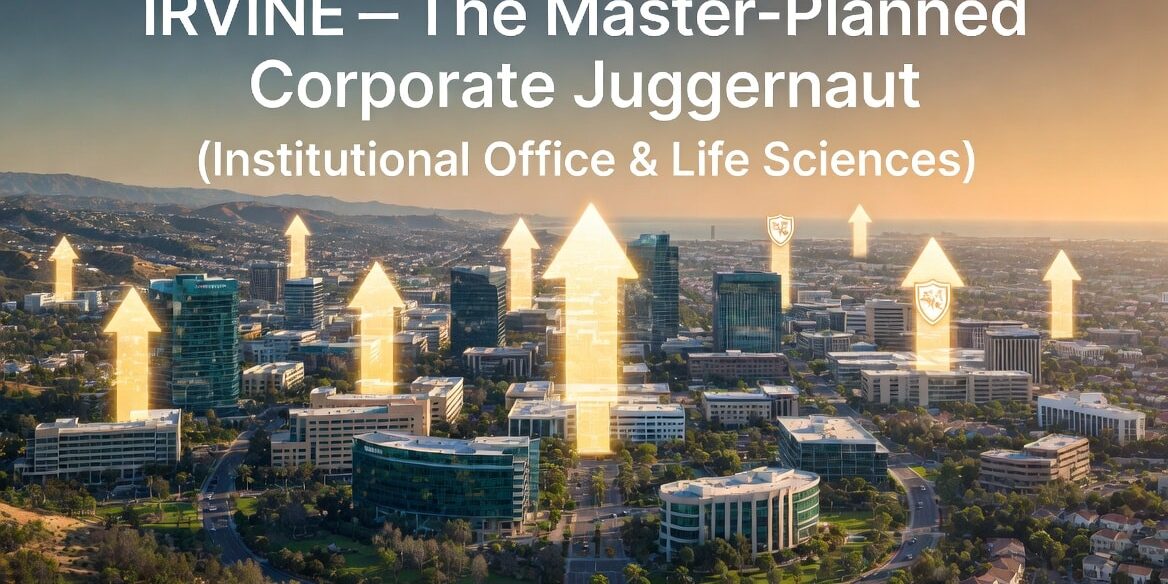
In the sprawling, decentralized topography of Southern California commercial real estate, the City of Irvine stands as a singular, heavily fortified economic anomaly. It is not a suburb that grew organically over time; it is a meticulously engineered, sovereign corporate state. For the institutional investor, the Family Office, and the multinational corporation, Irvine represents the ultimate macroeconomic safe haven. It is a grid designed to attract global capital, incubate hyper-advanced life sciences, and house the apex tiers of the Fortune 500.
Amateur commercial brokers and retail investors approach Irvine with a fundamental misunderstanding of the asset class. They attempt to apply standard, county-wide metrics to a micro-economy that is tightly controlled by master developers and governed by ruthless, uncompromising architectural mandates. They look at a Class B office building or a generic flex-industrial warehouse and assume that the physical dirt dictates the value.
This is the ultimate retail fallacy.
In Irvine, you are not simply buying the square footage; you are buying the proximity to a world-class talent pool, the logistical perfection of the Irvine Spectrum, and the impenetrable barrier to entry that mathematically protects your long-term equity. At The Malakai Sparks Group, we do not underwrite the cosmetic appeal of the building; we underwrite the institutional yield. We decode the mechanical infrastructure, we audit the corporate guaranties, and we execute the capital deployment.
Here is the definitive, forensic guide to dominating the Irvine commercial real estate market, decoding the “Tech-Med” life sciences explosion, and mathematically securing your position within Orange County’s master-planned juggernaut.
1. The Master-Planned Grid: The Architecture of Predictability
To successfully deploy capital into Irvine, an investor must first understand the psychological and legal framework of the Master Plan. Unlike the organic, chaotic urban sprawl found in northern Orange County or Los Angeles, Irvine’s commercial sectors were drawn on a blank canvas by the Irvine Company decades before the first foundation was poured.
This master-planned reality creates a massive, structural advantage for the commercial landlord: Weaponized Predictability.
The Zoning Monopoly
In an organically grown city, a commercial investor constantly faces the threat of municipal zoning changes. You might acquire a Class A office building, only to have the city rezone the adjacent parcel for high-density, low-income residential housing or a heavy manufacturing plant. This localized chaos introduces massive volatility to your tenant retention strategy.
In Irvine, the zoning is absolute. The corporate parks are strategically isolated from the residential villages. The arterial roads are mathematically designed to handle peak logistics without bleeding traffic into pedestrian zones. When you acquire an asset in the Irvine Business Complex (IBC) or the Irvine Spectrum, you have absolute assurance that the surrounding properties will forever maintain their institutional-grade appearance and utility.
The Barrier to Entry
The aesthetic mandates of Irvine are notoriously draconian. Signage is aggressively regulated. Landscaping must meet exact, drought-tolerant specifications. Exterior paint colors are strictly governed by architectural committees.
Amateur investors view these mandates as an operational headache. Elite operators view them as a financial moat. The sheer cost and bureaucratic friction required to build or reposition an asset in Irvine creates a massive barrier to entry. This barrier prevents sudden oversupply. Because developers cannot easily flood the market with cheap, inferior product, the existing premium inventory is mathematically protected from supply-side dilution. The Master Plan is the ultimate hedge against localized depreciation.
2. The Life Sciences Explosion: Engineering the “Tech-Med” Corridor
The most violent and lucrative shift in the Irvine commercial landscape over the last decade has been the explosive growth of the Life Sciences and Biotechnology sectors. As the tech industry faces macroeconomic volatility, the “Tech-Med” corridor in Irvine has asserted itself as the dominant force in commercial absorption.
Irvine is uniquely positioned to capture this global capital. It is anchored by the research juggernaut of UC Irvine, providing a continuous pipeline of elite, specialized talent. However, housing a life sciences tenant is not as simple as leasing standard office space. It requires extreme, highly capitalized infrastructure.
The Anatomy of a Biosafety Level (BSL) Lab
When a medical device manufacturer or a biopharmaceutical firm acquires space, they are not looking for open-concept desks and a ping-pong table. They require highly specialized wet labs, clean rooms, and R&D manufacturing floors.
If an investor attempts to lease a standard office building to a life sciences tenant, the deal will instantly collapse during the architectural audit. Life sciences tenants require:
-
Massive HVAC Tonnage: Standard office buildings are cooled based on human occupancy. Laboratories generate massive thermal loads from continuous-use medical equipment and require 100% outside air exhaust systems (single-pass air) to prevent cross-contamination.
-
Structural Floor Loading: A standard second-floor office is engineered for 50 pounds per square foot (PSF). Life sciences equipment, including heavy centrifuges and vibration-sensitive electron microscopes, frequently requires floor loads of 100 to 150 PSF.
-
Redundant Power Architecture: A power failure in a standard office means lost emails. A power failure in a wet lab means the destruction of decades of temperature-sensitive genetic research. These facilities require massive, uninterrupted power supplies (UPS) and heavy-duty, dual-feed electrical grids.
The Arbitrage of the Flex-Conversion
The elite play in the Irvine commercial market is the Flex-to-Lab Conversion. Savvy institutional investors are acquiring aging, single-story flex-industrial parks that possess the necessary clear heights and ground-level concrete slabs, and retrofitting them to accommodate life sciences tenants.
While the capital expenditure (CapEx) required for these tenant improvements is astronomical—frequently exceeding $150 to $250 per square foot—the yield is equally aggressive. Because the tenant is sinking millions of dollars of their own capital into the specialized build-out, they are fundamentally tethered to the dirt. They will sign 10-to-15-year triple-net (NNN) leases, completely stabilizing the asset and providing the landlord with bulletproof, recession-resistant cash flow.
3. The 4,000-Amp Infrastructure Audit: Underwriting the Power Grid
In the modern Irvine industrial and R&D market, the most valuable metric is not the square footage; it is the electrical capacity. We have transitioned from a localized, manufacturing economy into a high-density data, AI computing, and aerospace/defense economy.
When analyzing a premier flex building in the Irvine Spectrum, amateur brokers simply look at the loading docks and the parking ratio. They entirely ignore the invisible infrastructure that dictates the true terminal value of the asset.
The Illusion of “Heavy Power”
A listing might advertise “Heavy Power,” but in the context of 2026 industrial logistics, a standard 800-amp or 1,200-amp panel is functionally obsolete. Modern tenants—whether they are operating electric vehicle (EV) charging fleets, high-density server farms, or aerospace CNC machining centers—require massive, localized energy.
To command the ultimate premium in the Irvine market, an asset must possess 4,000-amp, 277/480-volt, 3-phase power.
If you acquire a 50,000-square-foot facility with inadequate power, upgrading the main switchgear is not merely a matter of hiring an electrician. It requires negotiating with Southern California Edison (SCE) to pull new high-voltage lines, potentially installing a new municipal transformer, and navigating years of bureaucratic red tape. This infrastructural deficit can cost an investor millions in lost lease revenue while the building sits vacant, waiting for the grid to catch up.
The Clear Height Premium
Verticality is the new square footage. In the logistics and advanced manufacturing sector, a building with a 16-foot or 18-foot clear height is rapidly depreciating into obsolescence. Modern 3PL (Third-Party Logistics) operators and advanced manufacturers utilize multi-tiered, automated racking systems and robotics that demand vertical space.
In Irvine, a building boasting a 24-foot to 32-foot clear height commands a massive, non-negotiable premium. Elite real estate operators forensically audit the structural steel, the fire suppression systems (specifically the presence of Early Suppression, Fast Response or ESFR sprinklers), and the column spacing before they ever underwrite the pro forma. If the physical box cannot accommodate modern logistics, the dirt is mathematically devalued.
4. The Mathematical Underwriting of the Irvine Yield
In the trenches of Orange County real estate, theoretical spreadsheet math is functionally useless. Overseeing the management of over 350 rental properties provides a brutal, unfiltered education in operational bleed. You learn that the “pro forma” is a marketing document, and the true yield is dictated by the unseen mechanics of the property.
When deploying multi-million-dollar capital into Irvine commercial real estate, the transaction must be ruthlessly underwritten using uncompromising institutional mathematics.
Decoding the Irvine Cap Rate
The Capitalization Rate (Cap Rate) is the fundamental metric of commercial valuation. It represents the un-leveraged rate of return on an investment property based on its generated income.
In the Irvine Spectrum, premium R&D and life sciences facilities frequently trade at highly compressed Cap Rates, historically hovering between 4.2% and 4.8%. Amateur investors view a 4.5% Cap Rate and immediately dismiss the asset, claiming they can find an 8% yield in the Inland Empire or out of state.
This reveals a profound ignorance of risk-adjusted returns. The 4.5% Cap Rate in Irvine is not a penalty; it is the mathematical cost of absolute security. You are accepting a lower initial yield in exchange for bulletproof, Fortune 500 tenant credit, zero localized crime, flawless municipal infrastructure, and historic, aggressive appreciation. The higher Cap Rate in a tertiary market is merely a risk premium compensating the investor for the high probability of tenant default and extended vacancy.
The Debt Service Coverage Ratio (DSCR)
For the institutional buyer utilizing leverage, the true viability of the asset is dictated by the Debt Service Coverage Ratio. This metric measures the property’s ability to cover its debt obligations using its generated income.
If an Irvine office complex generates $2,500,000 in NOI and the annual mortgage payments total $1,800,000, the DSCR is mathematically modeled as:
In a highly volatile economic environment, commercial lenders and private equity firms require a minimum DSCR of 1.25 to 1.30. An elite commercial advisor does not rely on the seller’s stated NOI. We execute a forensic audit of the trailing twelve-month (TTM) financials, stripping away artificial, one-time revenue spikes and uncovering hidden maintenance liabilities, to calculate the true, stabilized DSCR before the loan application is ever submitted.
The Cash-on-Cash Return Metric
While the Cap Rate models the asset as if it were purchased entirely in cash, the Family Office frequently prioritizes the Cash-on-Cash (CoC) return to measure the exact velocity of their deployed liquidity.
By structuring sophisticated commercial debt—such as interest-only bridge loans or highly leveraged mezzanine financing—an investor can mathematically inflate their CoC return, allowing their liquid capital to stretch across multiple Irvine assets rather than being trapped in a single, un-leveraged building.
5. The “Flight to Quality”: The Death of Class B Office
The Irvine commercial office market is currently undergoing a brutal, highly predictable bifurcation. It is a tale of two entirely different asset classes operating within the exact same zip code.
The traditional, multi-story Class B office building—characterized by drop ceilings, compartmentalized floor plans, aging HVAC systems, and massive asphalt parking lots—is facing a terminal decline. The modern corporate workforce completely rejects the sterile, cubicle-driven environment of the 1990s.
The Amenity-Rich Mandate
Conversely, the Class A+ market in Irvine is experiencing an aggressive “Flight to Quality.” Major corporations are willing to pay massive premiums for a smaller square footage footprint, provided that the physical environment acts as a weapon for talent acquisition and retention.
To command top-tier rents in the modern Irvine market, an office building must transform from a passive workspace into an experiential destination. This requires:
-
Hyper-Walkability: Integration with high-end retail, quick-service restaurants (QSR), and fitness centers. The Irvine Spectrum Center operates as the ultimate commercial anchor, allowing corporate employees to seamlessly transition from the boardroom to Michelin-recognized dining without stepping into a vehicle.
-
Indoor/Outdoor Architecture: Operable glass curtain walls, massive outdoor collaborative patios equipped with enterprise-grade Wi-Fi, and rooftop event spaces. The Southern California climate is the ultimate amenity, and buildings that enclose their tenants entirely in glass boxes are mathematically penalized.
-
Wellness Infrastructure: Hospital-grade MERV-13 air filtration systems, touchless elevator architecture, and end-of-trip facilities (secure bike storage, luxury showers, and locker rooms) for the endurance athlete commuter.
The Shadow Inventory Liability
The greatest threat to the Irvine office investor is the “Sublease Tsunami.” When massive tech conglomerates or defense contractors downsize their workforce, they dump hundreds of thousands of square feet of fully furnished, highly upgraded office space back onto the shadow market at a severe discount.
Amateur landlords attempting to lease direct space cannot compete with a desperate corporate tenant offering a 40% discount on a sublease. Elite commercial operators insulate their assets from this threat by hyper-segmenting their floor plans, targeting smaller, highly agile firms (3,000 to 10,000 SF) that are immune to massive corporate restructuring, and intentionally diversifying the rent roll across medical, legal, and creative sectors.
6. The Triple-Net (NNN) Fortress: Auditing the Corporate Guaranty
For the aging investor, the exhausted multifamily operator, or the high-net-worth Family Office, the ultimate objective of commercial real estate is passive, frictionless yield. In Irvine, this objective is achieved through the acquisition of the Absolute Triple-Net (NNN) lease.
In a true NNN structure, the tenant is mathematically responsible for every operational expense associated with the dirt: the property taxes, the commercial insurance premiums, and the common area maintenance (CAM), including the roof and the structure. The landlord’s only operational responsibility is cashing the check.
The Illusion of the “Absolute” Lease
However, the phrase “Triple Net” is the most abused and misunderstood term in commercial real estate. Amateur investors purchase a retail pad in Irvine, see the letters “NNN” on the marketing flyer, and assume they are entirely insulated from liability.
They close escrow, and three years later, the HVAC system catastrophically fails. They bill the tenant for the $45,000 replacement, only to discover a microscopic clause buried on page 42 of the lease agreement stating that the tenant is only responsible for routine maintenance, while the landlord is legally responsible for total capital replacements. Their passive yield has just been mathematically wiped out by a single mechanical failure.
Forensic Tenant Credit Analysis
Furthermore, a NNN lease is completely worthless if the entity signing the document lacks the capital to back it up.
When deploying capital into a single-tenant NNN asset in Irvine, elite operators do not simply look at the brand name on the building; we execute a forensic audit of the corporate guaranty.
-
The Franchisee Trap: Is the lease guaranteed by the multi-billion-dollar corporate parent entity, or is it guaranteed by a localized franchisee LLC with zero hard assets and a highly leveraged balance sheet?
-
The Balance Sheet Audit: We demand access to the corporate financials. We underwrite their debt-to-equity ratios, their historical liquidity, and their specific revenue generation at that exact Irvine location. If the tenant’s credit rating drops, the capitalization rate of the dirt instantly expands, and the mathematical value of your real estate immediately plummets. We protect the equity by ensuring the lease is anchored by unyielding, institutional-grade corporate credit.
7. Operational Reality: The Friction of the Common Area
Managing a massive real estate portfolio reveals the hidden traps of the commercial lease. In the high-density corporate parks of Irvine, the Common Area Maintenance (CAM) reconciliation is the ultimate battleground between landlord and tenant.
The CAM Reconciliation Audit
In a multi-tenant retail center or office park, the landlord estimates the annual operating expenses (landscaping, security, parking lot sweeping, exterior lighting) and bills the tenants a monthly pro-rata share. At the end of the fiscal year, the actual expenses must be mathematically reconciled against the estimated payments.
-
The Cap Liability: Aggressive corporate tenants will frequently negotiate a “CAM Cap” into their lease, stating that their controllable operating expenses cannot increase by more than 3% to 5% annually.
-
The Inflationary Bleed: If the macro-economy experiences an inflationary spike and the cost of janitorial labor, security contracts, and insurance premiums surges by 12%, the landlord is legally forbidden from passing those full costs through to the capped tenant. The landlord must absorb the delta, resulting in a direct, unrecoverable bleed to the Net Operating Income.
Elite commercial advisors audit the historical CAM schedules of an Irvine asset before acquisition, ensuring that the existing leases do not contain predatory caps or exclusions that will mathematically cripple the investor’s cash flow during an inflationary cycle.
8. Navigating the Irvine Bureaucracy: Entitlements and CEQA
Attempting to physically alter the dirt in Irvine is not a construction project; it is a highly sophisticated legal and political campaign. The municipal bureaucracy is designed to move slowly, deliberately, and with extreme prejudice against any project that threatens the aesthetic or logistical harmony of the Master Plan.
The CEQA Weaponization
The California Environmental Quality Act (CEQA) is the most formidable obstacle in commercial development. Originally designed to protect the environment, CEQA is frequently weaponized by competing developers, labor unions, and neighborhood coalitions to paralyze new commercial projects in endless litigation.
If an investor acquires a vacant parcel in the Irvine Business Complex with the intent to build a high-density, mixed-use corporate headquarters, they must survive a brutal Environmental Impact Report (EIR) process. They must mathematically prove that the new building will not generate excessive traffic friction at specific intersections, that it will not cast shadows on adjacent properties, and that it conforms perfectly to the rigid Irvine zoning matrix.
The Adaptive Reuse Arbitrage
Because vertical development is heavily restricted, the highest-yield play in the Irvine market is Adaptive Reuse.
Rather than attempting to break ground on new dirt, sophisticated developers acquire functionally obsolete, aging structures—such as dead retail big-box stores or abandoned single-story warehouses—and radically reposition the interior while leaving the exterior structural shell intact. By maintaining the original footprint, the developer frequently bypasses the most aggressive CEQA triggers, drastically compresses the entitlement timeline, and brings a hyper-modern, highly coveted asset to market years before a ground-up development could ever secure its final permits.
9. The 1031 Exchange Safe Haven: Parking Institutional Capital
For the ultra-high-net-worth individual, the generational Family Office, and the weary apartment syndicator, the Irvine commercial market serves as the ultimate destination for the 1031 Exchange.
When an investor liquidates a highly appreciated, management-intensive residential portfolio in Los Angeles or a tertiary market, they are suddenly staring down the barrel of a catastrophic capital gains tax liability. The IRS grants them exactly 45 days to identify a replacement asset and 180 days to close the transaction.
The Liquidity Challenge
The greatest threat to a 1031 Exchange is the lack of institutional-grade inventory. The investor possesses millions of dollars in highly explosive, ticking liquidity, but they refuse to park it in a volatile or management-heavy asset.
-
The Institutional Landing Pad: Irvine operates as the perfect capital vault. The investor executes a flawless transition, swapping their high-friction apartment buildings for a passive, corporately guaranteed medical office building or a NNN retail pad in the Irvine Spectrum. They entirely eliminate the operational headache of residential tenant management, upgrade the quality of their geographic dirt, and permanently defer millions of dollars in IRS taxation.
-
The Pre-Market Syndicate: Because elite Irvine assets rarely hit the public market, an investor entering a 1031 Exchange must have their replacement property identified before they close on their downleg. We leverage deep, institutional whisper networks to secure off-market, unlisted Irvine commercial dirt, ensuring our clients’ capital lands safely, securely, and completely out of the public eye.
10. The Environmental Mandate: ESG and Future-Proofing
The commercial real estate landscape in Irvine is rapidly evolving to meet the uncompromising mandates of global Environmental, Social, and Governance (ESG) frameworks. Institutional capital—such as sovereign wealth funds and massive pension portfolios—is legally restricted from acquiring dirt that does not meet strict sustainability benchmarks.
The Green Infrastructure Audit
To maximize the exit multiple of an Irvine commercial asset in the next decade, the building must be entirely future-proofed.
-
EV Fleet Architecture: Standard industrial warehouses must be retrofitted with massive localized power grids to support the charging infrastructure of entire fleets of electric delivery vehicles.
-
Solar Yield: The massive, flat rooftops of Irvine’s flex and industrial parks are no longer just weather barriers; they are independent revenue streams. Elite operators execute rooftop leases, installing vast solar arrays to monetize the California sun, driving additional NOI while satisfying corporate carbon-neutrality mandates.
-
Energy Disclosure Laws: California legislation (such as AB 802) mandates aggressive energy benchmarking and public disclosure. An energy-inefficient building in Irvine will not only suffer higher operational costs but will be mathematically penalized by institutional buyers during the appraisal process.
Conclusion: Deploying Capital in the Juggernaut
In the apex tiers of Southern California commercial real estate, the City of Irvine is not a market you simply participate in; it is an economic fortress you must strategically infiltrate.
Amateur commercial brokers operate on the surface. They download a generic offering memorandum, look at the advertised Cap Rate, and blindly advise their clients to sign the contract. They treat a multi-million-dollar institutional acquisition with the same superficial psychology as a residential home purchase, completely oblivious to the operational bleed, the mechanical liabilities, and the restrictive covenants buried in the dirt.
Over 14 years of real estate experience operating in these exact grids, the patterns of institutional wealth transfer become entirely predictable.
Elite real estate advisors are forensic auditors. We dismantle the pro forma. We mathematically stress-test the corporate guaranty. We underwrite the electrical grid, the HVAC tonnage, and the structural integrity of the asset. At The Malakai Sparks Group, we ensure that when your capital is deployed into the master-planned corporate juggernaut of Irvine, it is anchored to absolute, uncompromising, institutional reality.