

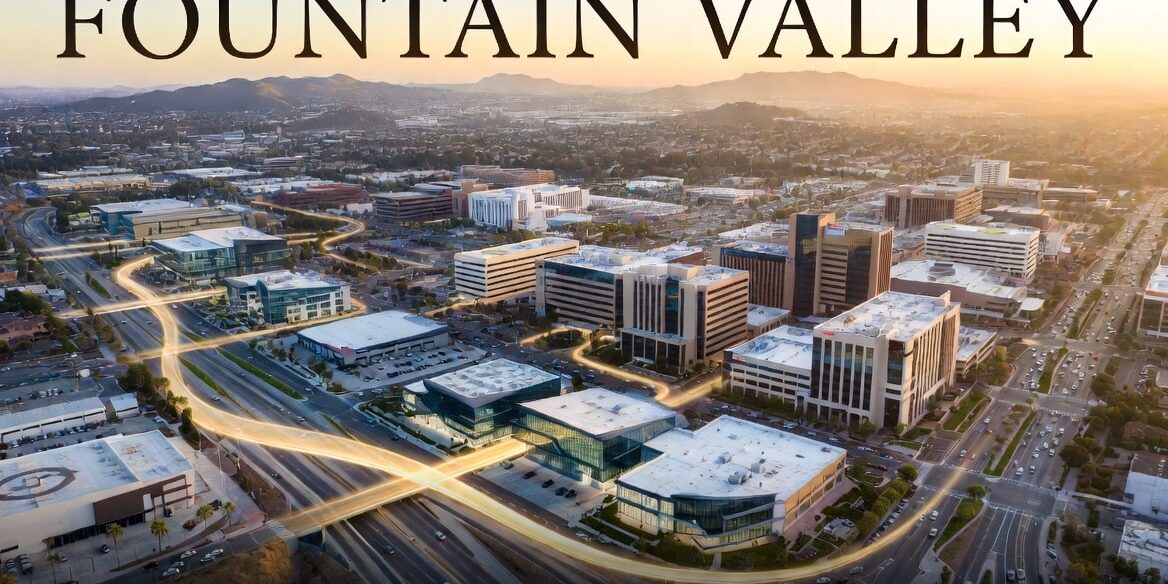
In the stratified, fiercely competitive topography of Orange County commercial real estate, the City of Fountain Valley operates under a masterclass of macroeconomic stealth. The amateur commercial broker, the out-of-state syndicator, and the retail investor look at the sprawling parks, the dense residential tracts, and the quiet suburban streets, and they falsely assume the city is devoid of institutional commercial velocity. They dismiss it as a mere commuter grid, entirely missing the multi-billion-dollar commercial engine roaring directly beneath the surface.
This is a catastrophic miscalculation of institutional capital.
Fountain Valley is not a passive suburb; it is a heavily fortified, hyper-lucrative corporate and healthcare vault. Bisected by the massive logistical artery of the 405 Freeway, it serves as the undisputed North American headquarters for global titans like Hyundai Motor America, Kingston Technology, and D-Link. Furthermore, it houses a staggering, dual-engine healthcare monopoly anchored by UCI Health – Fountain Valley and Orange Coast Memorial Medical Center.
When a Family Office, a private equity firm, or a specialized institutional developer deploys capital into Fountain Valley, they are not buying a sleepy suburban narrative. They are acquiring bulletproof, corporately guaranteed Triple-Net (NNN) leases. They are executing aggressive “Flex-Tech” repositioning strategies on aging industrial dirt. They are securing absolute, recession-resistant medical yield.
At The Malakai Sparks Group, we view Fountain Valley through the cold, uncompromising lens of healthcare logistics, global supply chain proximity, and master-planned corporate retention. We do not underwrite the aesthetic charm of the suburban landscape; we underwrite the specialized HVAC requirements of a surgical center, the structural PSI of a Kingston Technology server farm, and the absolute mathematical reality of the commercial cash flow.
Here is the definitive, forensic guide to dominating the Fountain Valley commercial real estate market, decoding the medical-tech convergence, navigating the corporate headquarters perimeter, and mathematically securing your position within North Orange County’s most heavily guarded commercial fortress.
1. The 405 Corporate Corridor: Headquarters & Global Capital
To understand the absolute peak of Fountain Valley’s commercial valuations, you must first underwrite the massive gravitational pull of the 405 Freeway Corporate Corridor. In landlocked Orange County, visible, freeway-fronting dirt is a fiercely contested, hyper-finite commodity.
The Global Headquarters Monopoly
Fountain Valley recognized decades ago that it could not compete with Anaheim for massive, million-square-foot logistics boxes. Instead, the city engineered a micro-economy specifically designed to incubate and retain global corporate headquarters.
By capturing the North American headquarters of Hyundai Motor America (a staggering, $200 million, 500,000-square-foot architectural glass monolith visible from the 405), the city mathematically anchored its institutional relevance. This is compounded by the massive footprint of Kingston Technology and various specialized defense and aerospace contractors like Surefire.
-
The Ecosystem Draw: When global titans anchor a city, they create a massive, localized vendor ecosystem. Tier-1 and Tier-2 suppliers, corporate legal firms, and specialized engineering contractors demand Class A office and flex-industrial space within a two-mile radius of the headquarters.
-
The Valuation Multiplier: Because the localized demand from these massive corporate entities is entirely irreplaceable, landlords in the 405 Corridor command massive, non-negotiable premiums on Full Service Gross (FSG) office leases and Triple-Net (NNN) flex leases. The dirt here is completely insulated from the “suburban office decline” because it functions as an essential, high-security corporate nervous system, not a passive workspace.
The Flight to “Amenity-Rich” Campuses
The traditional, multi-story Class B office building—characterized by drop ceilings, compartmentalized floor plans, and massive asphalt parking lots—is facing a terminal decline in Fountain Valley. The modern corporate workforce completely rejects the sterile environments of the 1990s.
To command top-tier, institutional rents in the Fountain Valley market, an office building must transform into an experiential corporate campus. Elite institutional developers acquire aging Class B structures and execute massive CapEx conversions:
-
Indoor/Outdoor Architecture: Installing operable glass curtain walls and massive outdoor collaborative patios equipped with enterprise-grade Wi-Fi.
-
Wellness Infrastructure: Hospital-grade MERV-13 air filtration systems, touchless elevator architecture, and secure bike storage and locker rooms for the commuter workforce. By forcing this modernization, developers capture the highest-paying tech and corporate tenants, completely stabilizing the rent roll and driving massive forced appreciation upon the asset’s capitalization rate.
2. The Dual-Engine Medical Megacenter: Healthcare Dominance
While the corporate headquarters generate massive high-wage employment, the most mathematically bulletproof, recession-resistant asset class in the entirety of Fountain Valley is the Medical Office Building (MOB).
In an era where standard commercial sectors are fighting e-commerce migration and remote work, healthcare real estate stands as the ultimate, impenetrable macroeconomic vault. The medical sector is entirely agnostic to consumer trends and stock market volatility.
The UCI Health and Orange Coast Memorial Moat
Fountain Valley is uniquely anchored by two massive clinical engines: UCI Health – Fountain Valley (formerly Fountain Valley Regional Hospital) and Orange Coast Memorial Medical Center. Combined, these campuses represent over 500 specialized acute-care beds, functioning as the undisputed healthcare epicenter for the surrounding coastal and inland grids.
-
The “Hub and Spoke” Expansion: Modern healthcare networks operate on a “Hub and Spoke” real estate model. The massive hospital campuses function as the “Hubs,” housing critical infrastructure like emergency rooms and intensive care units. To maximize operational efficiency, these hospitals aggressively offload lower-acuity procedures—such as outpatient surgery, diagnostic imaging, and dialysis—into the surrounding commercial grids.
-
The Perimeter Arbitrage: Institutional capital actively hunts for aging Class B office buildings or vacant retail pads on Warner Avenue or Brookhurst Street. We acquire these assets and execute massive CapEx conversions to transform them into highly specialized Medical Office Buildings (MOBs), capturing the overflow from the hospital campuses at a massive lease premium.
The Anatomy of the Medical Build-Out
Amateur commercial investors fail to grasp why medical office space trades at such mathematically irrational premiums. It is driven entirely by the staggering cost of the physical infrastructure and the resulting “stickiness” of the tenant.
When a specialized orthopedic surgery center or an oncology clinic leases space in Fountain Valley, the required infrastructure is absolute:
-
Structural Floor Loading: Multi-ton medical imaging equipment (MRI and CT scanners) requires heavily reinforced concrete floors exceeding 150 Pounds Per Square Foot (PSF) of structural load capacity.
-
Lead-Lined Architecture: Radiology suites require walls, doors, and glass heavily shielded with lead to prevent radiation bleed into adjacent corporate suites.
-
Specialized MEP Systems: Medical tenants require dedicated bio-hazard disposal systems, medical-grade gas lines plumbed directly into the walls, and heavily regulated, single-pass sterile air filtration to prevent cross-contamination.
These specialized build-outs routinely cost $300 to $500+ per square foot. Because the medical tenant sinks millions of dollars of their own capital into the physical infrastructure, they become functionally trapped. They will sign uncompromising 10-to-20-year Absolute Triple-Net (NNN) leases, aggressively renew them, and provide the institutional landlord with unparalleled, multi-decadal income stability.
3. Navigating the Regulatory Moat: OSHPD and Municipal Friction
Operating and retrofitting medical space in California introduces a massive, invisible matrix of regulatory liabilities that the amateur broker is completely unequipped to navigate. The primary gatekeeper is the Office of Statewide Health Planning and Development (OSHPD), now operating under the Department of Health Care Access and Information (HCAI).
The OSHPD 3 Mandate
In standard commercial development, you pull permits from the local city planning department. In medical real estate, specific facilities (such as licensed outpatient surgical clinics) are classified under OSHPD 3 jurisdiction.
-
The Bureaucratic Chokehold: OSHPD 3 regulations dictate exacting standards for seismic safety, emergency power generation, corridor widths (to accommodate gurneys), and infection control. Designing and permitting an OSHPD 3 facility is a brutal, multi-year bureaucratic war.
-
The Valuation Multiplier: Because building new medical supply that meets these draconian standards is logistically nightmarish and prohibitively expensive, the existing, grandfathered MOB inventory in Fountain Valley holds a massive monopoly. Elite real estate operators actively hunt for aging, mismanaged medical buildings near the hospitals. By executing localized modernizations without triggering massive new OSHPD mandates, they legally bypass the development friction and lock in world-class healthcare networks at top-of-market NNN rents.
ADA Compliance and “Drive-By” Litigation
Furthermore, medical real estate must maintain absolute, uncompromising adherence to the Americans with Disabilities Act (ADA). In Fountain Valley, where older commercial building stock is frequently repurposed for medical use, ADA compliance is a massive liability.
Elite commercial advisors execute forensic ADA audits prior to acquisition. We measure the exact slope of the concrete ingress ramps, the turning radius in the restrooms, and the elevator cab dimensions. If the building is deficient, the landlord is exposed to catastrophic “drive-by” lawsuits from predatory litigators. We force the seller to fund the required concrete and architectural modifications in escrow, entirely shielding our client’s capital from post-closing legal extraction.
4. The Light Industrial & “Flex-Tech” Frontier
While cities like Anaheim dominate the heavy, 500,000-square-foot big-box distribution centers, Fountain Valley controls a highly lucrative, hyper-specialized industrial sub-sector: Urban Light Industrial and Flex-Tech Logistics.
The industrial grids in Fountain Valley—specifically along the heavily trafficked corridors of Lawson River Avenue, Mount Cliffwood Circle, and the Newhope corridor—are characterized by highly functional, smaller-footprint manufacturing shells ranging from 10,000 to 50,000 square feet.
Class B to Class A Repositioning
The modern supply chain and the high-tech corporate sector demand immediate, localized logistics and R&D infrastructure. A standard 1970s manufacturing building with 14-foot ceilings and grade-level doors is functionally obsolete for a modern biomedical logistics firm or aerospace contractor.
-
The Industrial Arbitrage: Institutional capital is acquiring these aging shells and executing massive CapEx conversions. We acquire the asset at a depressed manufacturing Cap Rate, upgrade the electrical grid to handle 3-phase, high-capacity power, and modernize the front-office facade to appeal to high-end engineering talent.
-
The “Flex” Yield Premium: The highest yield is achieved through the “Flex” model—buildings that feature a 50/50 split between highly upgraded corporate office space in the front, and dock-high, 24-foot clear warehouse distribution in the rear. Once modernized, the asset is leased to venture-backed biomedical firms or advanced defense contractors on 10-to-15-year Absolute NNN leases. The dirt transitions from a stagnant $1.50/SF manufacturing rate to a hyper-lucrative specialized rate, forcing a massive compression in the Cap Rate and a multi-million-dollar exit multiple.
Environmental Liabilities: The Phase I Reality
Because Fountain Valley has a dense history of light manufacturing, automotive repair, and aerospace support, the industrial dirt is highly prone to environmental contamination.
Elite commercial operators never acquire Fountain Valley industrial dirt without executing a forensic Phase I Environmental Site Assessment (ESA). If historical records indicate the presence of underground storage tanks (USTs) or the historic use of heavy chemical degreasers (like PCE or TCE), the acquisition is immediately paused for a Phase II soil and vapor intrusion audit. In California, environmental liability is strict and runs with the title. We utilize specialized environmental counsel to force the seller into massive escrow holdbacks to fund state-mandated remediation, ensuring our clients never inherit the multi-million-dollar toxic legacy of the previous generation.
5. Experiential Retail & The NNN Corporate Fortress
The traditional, generic anchored retail strip mall is dead in tertiary markets. However, in the highly affluent, geographically constrained borders of Fountain Valley, prime retail real estate is thriving. This survival is predicated on a singular macroeconomic factor: Experiential Arbitrage.
The Medtail Convergence
One of the most lucrative trends currently rewriting the commercial retail landscape of Fountain Valley is the convergence of healthcare and traditional retail, known as “Medtail.” Historically, medical tenants were relegated to sterile, multi-story office parks hidden from the main arterial roads. Today, patients demand the same frictionless, highly visible, drive-up convenience from their healthcare providers that they expect from a high-end grocery store.
-
The Retail Pad Arbitrage: Elite commercial operators are aggressively acquiring aging retail pads along Brookhurst Street or Magnolia Street and executing the Medtail repositioning. We decline to lease a vacant 5,000-square-foot retail pad to a generic discount retailer. Instead, we execute massive CapEx upgrades to lease the space to an urgent care network, an elite cosmetic dentistry group, or a specialized veterinary hospital.
-
The Yield Expansion: Medical tenants are willing to pay massive, top-of-market NNN retail rents specifically for the arterial visibility and surface-level parking. The dirt transitions from a high-risk, volatile retail use to a heavily insulated, corporately guaranteed medical use.
The NNN Lease Audit
For the passive investor, the Absolute Triple-Net (NNN) lease in a Fountain Valley retail center is the ultimate financial instrument. The tenant pays the base rent, plus 100% of the property taxes, commercial insurance, and Common Area Maintenance (CAM).
However, a NNN lease is completely worthless if the entity signing the document lacks the capital to back it up.
-
The Balance Sheet Audit: When an international luxury QSR or a national retail brand signs a 15-year lease on Warner Avenue, we execute a forensic audit of the corporate parent’s balance sheet. We ensure the lease is guaranteed by billions of dollars in global liquidity, entirely insulating the landlord from localized economic downturns.
-
The CAM Reconciliation: Elite landlords deploy specialized commercial property managers who understand the precise legal definitions of “controllable vs. uncontrollable” operating expenses, ensuring that the asset’s structural maintenance is successfully passed through to the tenant without accidentally violating the strict limitations of the lease agreements.
6. High-Density Multi-Family: Managing the Operational Bleed
The multi-family landscape in Fountain Valley is an extreme anomaly. In cities like Santa Ana or Costa Mesa, massive apartment complexes are abundant, and syndicators trade them with high velocity. In Fountain Valley, the original city planning heavily prioritized sprawling single-family residential tracts over high-density multi-family structures.
The Institutional Monopoly
Because multi-family assets are incredibly rare in Fountain Valley, the investors who own them hold a staggering monopoly. The demand for rental housing is relentless, driven by the massive workforce operating at the hospitals, the corporate headquarters, and the highly desirable Fountain Valley School District.
-
The Vacancy Vacuum: Fountain Valley boasts some of the lowest historical vacancy rates in all of Southern California. When a unit becomes available, it is absorbed immediately at top-of-market rents.
-
The Valuation Multiplier: Due to the extreme scarcity of the asset class within the city limits, whenever an apartment complex does hit the market, it commands an astronomical premium. Institutional capital will aggressively overpay for the dirt because they know the municipal zoning will mathematically prevent any competing developer from building new apartment supply across the street.
Defeating the AB 1482 Rent Caps
Overseeing the management of massive residential portfolios—exceeding 350 rental units—provides a brutal, unfiltered education in the reality of the multi-family asset class.
California’s AB 1482 instituted statewide rent caps and strict “Just Cause” eviction protections. When acquiring existing, aging multi-family stock in Fountain Valley, elite operators navigate this legislative minefield through precise “Substantial Remodel” exemptions. We mathematically calculate the exact buyout cost (“Cash for Keys”) against the projected post-renovation NOI, ensuring the repositioning strategy is legally compliant and financially viable before the capital goes hard.
Utility Recapture (RUBS)
In older Fountain Valley multi-family assets built in the 1960s and 1970s, the buildings are frequently master-metered for water and gas. The landlord pays the entire municipal utility bill, actively bleeding the Net Operating Income.
We implement Ratio Utility Billing Systems (RUBS) to mathematically transfer the massive, fluctuating municipal water and gas costs off the landlord’s balance sheet and back to the tenant base. This single operational pivot drastically inflates the NOI and drives massive forced appreciation upon the asset’s capitalization rate.
7. Entitlements and CEQA Warfare in a Suburban Core
Attempting to physically alter the exterior of a commercial building or execute ground-up development in Fountain Valley is not a construction project; it is a highly sophisticated, deeply political campaign.
The CEQA Weaponization
The California Environmental Quality Act (CEQA) is routinely weaponized by competing developers, affluent neighborhood coalitions, and local traffic safety boards to drag a commercial project into years of paralyzing litigation.
To survive the Environmental Impact Report (EIR) process in Fountain Valley, the developer must deploy specialized land-use attorneys and traffic engineers.
-
The Neighborhood Friction: If an institutional developer attempts to acquire an aging retail strip and bulldoze it for a high-density, mixed-use complex, they will face massive resistance from the surrounding single-family residents concerned about traffic density and visual sightlines.
-
The Mitigation Strategy: Institutional developers mathematically integrate the cost of community mitigation directly into the initial land valuation. We lower our acquisition strike price to offset the millions of dollars in municipal exactions—such as installing specialized acoustic retaining walls, executing massive landscaping buffers, and redesigning exterior lighting to prevent nighttime lumen bleed—required to actually secure the final building permits.
8. Financial Architecture: Institutional Mathematics and DSCR
Deploying capital into the heavily fortified grids of Fountain Valley requires brutal, uncompromising institutional mathematics. You must speak the language of the commercial capital markets.
Analyzing the Bifurcated Cap Rate
Fountain Valley does not possess a single capitalization rate. The city is fiercely bifurcated based on asset class and proximity to the medical centers or the 405 freeway.
-
The Medical NNN Floor: A stabilized, corporately guaranteed Medical Office Building (MOB) sitting adjacent to Orange Coast Memorial will trade at a brutally compressed Cap Rate (frequently 4.0% to 4.5%). The Family Office accepts this low yield because the asset acts as a multi-generational treasury bond, entirely insulated by the OSHPD barrier to entry.
-
The Flex-Tech Value-Add Premium: Conversely, an aging, functionally obsolete light-manufacturing building in the Lawson River corridor might trade at a 5.5% to 6.5% Cap Rate. The elite operator acquires this higher-yield asset specifically for the “Value-Add” arbitrage—executing the flex-office conversion, upgrading the electrical infrastructure, and leasing the space to an advanced aerospace or biotech tenant to drive the terminal valuation into the institutional tier.
The Debt Service Coverage Ratio (DSCR) Defense
When financing a value-add repositioning, traditional retail banks are entirely useless. They underwrite loans based on the Debt Service Coverage Ratio (DSCR) of the current, trailing twelve-month cash flow.
If you acquire a vacant industrial shell with the intent to reposition it for a specialized medical clinic or a tech headquarters, the current NOI is mathematically negative. A retail bank will instantly reject the loan.
Elite operators bypass the retail banking friction entirely by utilizing institutional Bridge Debt or Debt Fund capital. These lenders underwrite the Loan-to-Cost (LTC) and the projected, stabilized exit valuation. They provide the highly agile capital required to execute the physical construction, allowing the developer to bridge the gap until the asset is fully leased and ready for permanent, non-recourse take-out financing.
9. The Generational 1031 Exchange Landing Pad
Fountain Valley commercial real estate serves as the ultimate, highly secure landing pad for the 1031 Exchange investor.
When a multi-family operator in Los Angeles is exhausted by rent control, progressive municipal taxation, and the relentless operational friction of managing 100 residential tenants, they demand an exit. Alternatively, an investor holding a high-density, surf-side asset in Huntington Beach or a value-add duplex in Costa Mesa may seek to transition their equity away from the operational intensity of those active corridors. However, liquidating their massive equity triggers a catastrophic capital gains tax event.
Swapping Friction for Passive Wealth
The strategic maneuver is the institutional 1031 Exchange into the Fountain Valley NNN retail, stabilized MOB market, or the premium Flex-Tech industrial sector.
We liquidate the high-friction, management-heavy portfolio and seamlessly route that equity directly into a passive, corporately guaranteed medical clinic near UCI Health, or a fully stabilized, high-yield corporate headquarters facility on the 405 corridor.
-
The Geographic Upgrade: The investor transitions their capital out of volatile, high-density environments and anchors it safely within a master-planned, heavily regulated corporate dynamic, similar to the master-planned corporate estate structures found in Irvine or a sprawling suburban legacy hold in Fountain Valley.
-
The 45-Day Identification Trap: The IRS mandates that the investor identify their replacement property within exactly 45 days of closing their sale. Because institutional-grade inventory in Fountain Valley is hyper-scarce, entering a 1031 exchange without pre-identifying an asset is financial suicide. We leverage our deep, off-market institutional whisper networks to secure the replacement asset before the investor’s current property goes hard.
-
The Legacy Transfer: By parking the capital in a passive Fountain Valley commercial asset, the investor entirely eliminates their operational headache. They radically upgrade the quality of their geographic dirt, utilizing the same generational wealth strategies executed in Laguna Beach, a sweeping bluff-top retreat in San Clemente, a historic, walkable cottage enclave in Seal Beach, or a harbor-centric vacation asset in Dana Point. Under current tax law, the heirs inherit the property with a “Step-Up in Basis,” legally and permanently erasing the entire history of capital gains taxes built up over the last four decades.
Conclusion: Dominating the Corporate Fortress
In the high-stakes arena of Southern California commercial real estate, the City of Fountain Valley is not a quiet bedroom community; it is a highly complex, heavily fortified corporate and healthcare machine that punishes theoretical mistakes with multi-million-dollar losses.
Amateur commercial brokers look at an aging industrial building and sell the existing rent roll. They completely fail to audit the massive Phase II environmental liabilities of legacy manufacturing, they ignore the draconian OSHPD mandates required for medical repositioning, and they stumble blindly into neighborhood CEQA traps that paralyze their clients’ capital for a decade. They operate on residential assumptions in an intensely institutional commercial grid, entirely missing the multi-generational stability that parallels wealth preservation strongholds like the refined enclaves of Newport Beach or the multi-acre equestrian compounds in San Juan Capistrano.
Over 14 years of operating in the trenches, navigating the complex operational bleed of vast property portfolios and the uncompromising math of commercial financing, the true mechanics of asset stabilization become absolute. Managing the daily logistical realities of an extensive property portfolio dictates that theoretical pro formas must be ruthlessly stress-tested against the physical constraints of the dirt.
Elite real estate advisors are logistical engineers and wealth architects. We execute the Medtail zoning arbitrages. We navigate the environmental indemnifications. We mathematically underwrite the massive CapEx required for aerospace and space-tech industrial conversions along the 405 corridor. At The Malakai Sparks Group, we ensure that when your wealth is deployed into the corporate and medical core of Fountain Valley, it is backed by uncompromising forensic mathematics, permanently capturing the upside of Orange County’s most fiercely protected commercial grid.