

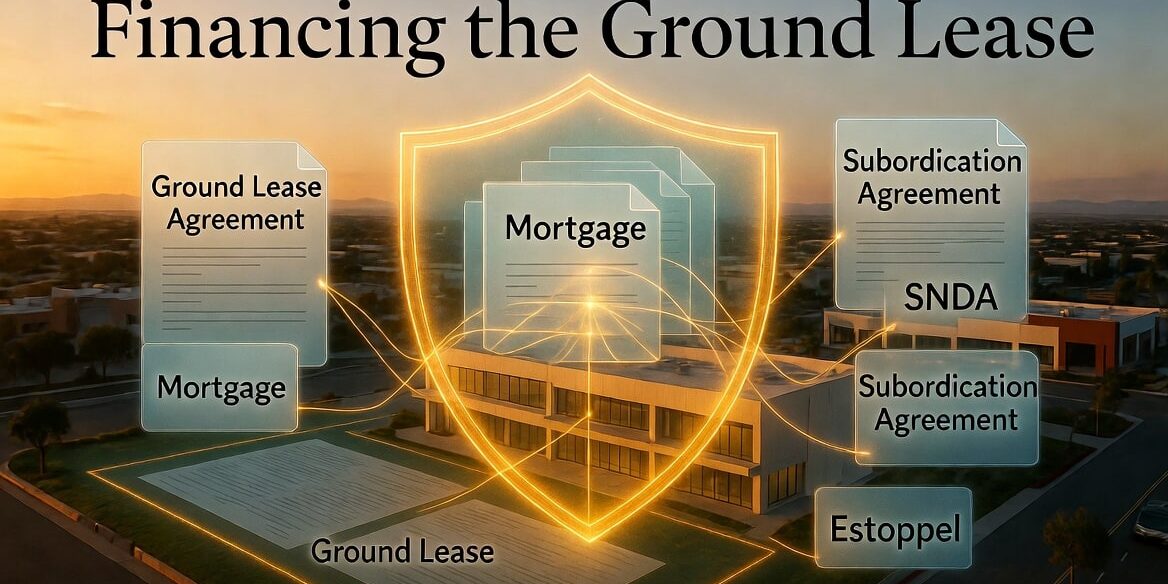
In the highly reactive, yield-obsessed arena of commercial real estate syndication, the amateur operator approaches the closing table with a fatal misunderstanding of absolute sovereignty. They identify a massive, multi-million-dollar retail center generating astronomical cash flow. They secure their Limited Partner (LP) equity, lock in an 8% capitalization rate, and blindly assume they are acquiring an impenetrable asset. They completely fail to realize that they are not buying the physical dirt; they are merely buying a Leasehold Interest—a 99-year Ground Lease originated in 1965 that only has 42 years remaining.
When the amateur approaches their local community bank for a 30-year mortgage, the underwriter takes one look at the leasehold timeline and violently rejects the loan. The amateur is completely paralyzed. They suddenly realize that building a multi-million-dollar structure on someone else’s land fundamentally alters the mathematics of the collateral. The asset is not a perpetual wealth vault; it is a depreciating chronological clock. If you fail to secure institutional leverage tailored specifically to the leasehold matrix, your equity will mathematically bleed to zero the moment the ground lease expires.
This is a catastrophic, multi-generational failure of legal and capital stack engineering.
In the apex tiers of institutional capital, we do not view a Ground Lease as a liability; we view it as a highly weaponized arbitrage opportunity. You are acquiring the cash-flowing improvements for a fraction of the cost of the fee-simple dirt. However, financing a leasehold interest without an uncompromising legal structure is the financial equivalent of executing a naked short options strategy without deploying the protective wings of an Iron Condor—you are leaving your entire capital stack completely unhedged against a catastrophic margin call.
At The Malakai Sparks Group, backed by the institutional frameworks of L3 Real Estate and L3 Property Management, we do not hope for banking flexibility; we mathematically force the capital stack to align with the chronological clock. Governing an eight-figure ground lease requires the exact same ruthless, fiduciary discipline deployed when steering the La Cuesta Racquet Club board through complex, multi-million-dollar municipal and structural liabilities—you strip the emotion from the table, demand absolute structural protection, and strictly enforce the governing documents to protect the collective equity. You do not survive the daily logistical warfare of this industry by ignoring the ticking clock; you engineer your portfolio with the unyielding physical and mental stamina of an Ironman, and the relentless, compounding structural momentum of a heavy 48KG kettlebell progression—every single repetition, every single debt covenant, must be mechanically locked out to endure the weight of the macroeconomic cycle. Just as we relentlessly canvas every microscopic demographic shift across our exact 2,500-home farming route in the Numbered Streets of Huntington Beach to unearth unyielding equity before it hits the open market, we forensically audit the ground lease matrix to permanently secure your sovereign yield. Here is the definitive, institutional-grade guide to decoding Leasehold Financing, surviving the amortization squeeze, and mathematically guaranteeing your commercial leverage.
1. The Mathematics of the Leasehold Diminution
To successfully finance a ground lease, an investor must completely dismantle the illusion that their collateral is perpetual. A bank lending on a standard fee-simple property knows the dirt will always be there. A bank lending on a leasehold interest knows that at the end of the lease term, the building legally reverts back to the landowner.
-
The Rule of “Term Plus Ten”: Institutional lenders mitigate this chronological risk through brutal amortization constraints. To secure a commercial mortgage on a ground lease, the remaining term of the lease must mathematically exceed the amortization period of the loan by an absolute minimum of 10 to 20 years. If you want a 25-year loan, the ground lease must have at least 45 years remaining. If the lease only has 20 years left, the building is entirely unfinanceable through standard channels, violently crushing the asset’s liquidity and trapping the operator in an illiquid shell.
-
The Ground Rent Escalation Trap: The bank will also forensically audit the ground lease’s rent escalations. If the lease dictates that the ground rent resets to “Fair Market Value” every 10 years, the lender will algorithmically assume the absolute worst-case scenario. If a future ground rent spike mathematically consumes the building’s Net Operating Income (NOI), the Debt Service Coverage Ratio (DSCR) collapses, and the bank will unconditionally refuse to fund the debt.
2. High-Density Friction and the “Subordination” Matrix
The leasehold debt matrix is most violently tested within the heavy-turnover, massive construction sectors of urban residential development, where the legal structure of the dirt dictates the survival of the project.
-
The Podium Requirement: When operating massive residential complexes within the transit-oriented commuter grids of Santa Ana: High-Density Multi-Family & The Urban Redevelopment Core or the student-heavy logistical networks of Fullerton: The Northern Logistical & Academic Support Hub, developers frequently utilize ground leases to avoid the massive upfront capital required to purchase the dirt.
-
Subordinated vs. Unsubordinated: The institutional lender will demand to know one absolute fact: Is the ground lease Subordinated or Unsubordinated? If it is Subordinated, the landowner has legally agreed to put the bank’s mortgage in first position. If the developer defaults, the bank can foreclose and seize both the building and the underlying dirt. Unsubordinated ground leases (which account for 95% of institutional deals) mean the bank only gets the building. If the developer goes bankrupt, the bank must step into the developer’s shoes and continue paying the landowner the ground rent, or they lose the multi-million-dollar building entirely. Securing debt on an unsubordinated lease requires mathematical perfection, forcing the developer to inject massive amounts of their own liquid equity to satisfy the bank’s terror.
3. The Experiential Aesthetic vs. The Reversionary Clause
Securing leverage becomes a highly volatile engineering puzzle when governing heavily curated, consumer-facing assets where massive capital is poured into bespoke architecture.
-
The Culinary Illusion: When executing heavy acquisitions within the hyper-experiential retail grids of Costa Mesa: The Creative Office & High-Volume Experiential Retail Corridor or navigating the fiercely guarded historic preservation overlays of San Juan Capistrano: Historic Professional Office & Boutique Retail Arbitrage, operators spend millions building out Michelin-star kitchens and specialized courtyards on top of leased dirt.
-
The Reversionary Squeeze: The bank’s underwriters know that every dollar spent on Tenant Improvements (TI) ultimately benefits the landowner, not the operator, due to the “Reversionary Clause”—the legal statute dictating that all improvements become the property of the landowner at lease expiration. Elite operators legally force the landowner to execute a New Lease Provision. This covenant legally mandates that if the operator defaults on the ground lease, the landowner is strictly required to sign a brand-new ground lease directly with the bank, preserving the bank’s collateral and mathematically ensuring the lender will authorize the bespoke construction debt.
4. Industrial Portfolios and the “Estoppel” Veto
In the massive logistical and manufacturing sectors, navigating a ground lease acquisition requires uncompromising legal coordination between the landowner, the operator, and the institutional lender.
-
The Port Authority Gridlock: When acquiring massive distribution hubs within Anaheim: The Industrial Heart of Orange County or specialized terminal logistics centers in Huntington Beach: Coastal Industrial & The Aerospace/Defense Pivot, the underlying dirt is frequently owned by massive municipalities, railroad companies, or port authorities who explicitly refuse to sell the fee-simple rights.
-
The Ground Lessor Estoppel: To execute a acquisition of the industrial warehouses sitting on that municipal dirt, the CMBS or LifeCo lender will require a Ground Lessor Estoppel. The elite operator must legally force the municipality to sign a document swearing, under penalty of perjury, that the ground lease is in full force and effect, that no defaults currently exist, and that the municipality explicitly consents to the new mortgage. If the amateur operator fails to secure this precise document during the due diligence window, the institutional lender will instantly kill the multi-million-dollar capital stack, and the escrow violently detonates.
5. Shielding the Clinical Moats and Corporate Lease Alignment
Institutional capital deploys elite legal architecture to mathematically synchronize the ground lease timeline with the massive corporate tenancies that sit on top of them.
-
The Chronological Trap: If you are securing advanced biomedical footprints within Fountain Valley: The Corporate Flex Corridor & Institutional Healthcare Fortress or entitling corporately backed clinical engines in Orange: The Institutional Healthcare & Medical Office Epicenter, your hospital tenant may demand a 20-year lease. However, if your underlying ground lease expires in 15 years, you legally cannot grant the tenant a 20-year term. You are mathematically attempting to lease chronological space you do not own.
-
The Option Execution: This exact same strategic hurdle exists within the towering corporate bastions of Irvine: The Master-Planned Corporate Juggernaut and the suburban fortresses of Mission Viejo: South County Suburban Retail & High-Yield Healthcare Centers. Before securing the debt or signing the Fortune 500 NNN lease, the elite operator proactively approaches the landowner and legally exercises their 10-year ground lease extension options decades in advance. By mathematically pushing the expiration date of the dirt out to 40 or 50 years, the operator completely harmonizes the corporate sub-leases with the senior debt amortization, entirely shielding the asset from chronological default.
6. The Sovereign Exit: Selling the Depreciating Clock
The ultimate, multi-million-dollar reality of a ground lease is realized exclusively upon the terminal disposition of the asset.
-
The Wasting Asset Paradigm: When transitioning multi-generational equity into the absolute sovereign wealth vaults of Newport Beach: The Wealth Management & Coastal Capital Center, operators must understand that a leasehold interest is mathematically a “wasting asset.” As the clock ticks down, the building becomes increasingly difficult to finance, which violently compresses the buyer pool.
-
The Preemptive Restructure: Elite operators never hold a ground lease until it drops below 35 years. Decades before the capital markets freeze, they execute a massive Ground Lease Restructure. They approach the landowner, offer a localized spike in the ground rent or a massive upfront cash payment, and legally force the landowner to reset the clock back to a full 99 years. The instant the ink dries on the 99-year extension, the asset transitions from an unfinanceable, expiring liability back into a pristine, institutional-grade vault. The elite operator sells the freshly reset leasehold to a sovereign wealth fund, mathematically capturing a massive exit premium by engineering the timeline before the market ever perceived the risk.
Conclusion: You Do Not Own the Dirt, You Engineer the Clock
In the highly capitalized, completely unforgiving arena of Southern California commercial real estate, blindly acquiring a leasehold interest without an aggressive, mathematically proven financing strategy is an unforced error of massive proportions.
Amateur commercial brokers sell the inflated cash-on-cash return. They push the syndicator to ignore the underlying land matrix, completely gloss over the catastrophic amortization squeeze awaiting them at the bank, and trap their clients inside a chronologically decaying asset that mathematically bankrupts their equity as the lease inevitably expires.
Elite commercial advisors are capital stack engineers and chronological actuaries. We audit the New Lease Provisions. We execute the Ground Lessor Estoppels. We mathematically force the 99-year extensions before the asset is ever listed on the open market. At The Malakai Sparks Group, L3 Real Estate, and L3 Property Management, we ensure that when your wealth is deployed into a commercial leasehold, your capital is not a victim of the clock; it is a mathematically bulletproof, institutionally executed, and legally shielded architecture engineered to permanently extract the absolute maximum yield from your legacy.