In the highly reactive, top-line-obsessed arena of commercial real estate syndication, the amateur operator approaches a liquidity event with a fatal, multi-generational level of chronological ignorance. They successfully acquire an eight-figure commercial asset, execute a flawless value-add stabilization over three years, and perfectly time the macroeconomic peak to sell the building for a massive profit. They confidently accept a buyer’s offer and casually request a payoff demand from their Commercial Mortgage-Backed Securities (CMBS) lender to clear the remaining 10-year mortgage.
Three days later, the payoff demand arrives, and the amateur is completely paralyzed. In addition to the principal balance, the Wall Street lender has mathematically levied a prepayment penalty. The amateur is entirely trapped. If they sell the building, the penalty violently vaporizes their entire equity upside, leaving their Limited Partners with nothing. If they cancel the sale, they remain handcuffed to the debt while the market cycle aggressively turns against them.
This is a catastrophic, multi-million-dollar failure of capital stack engineering.
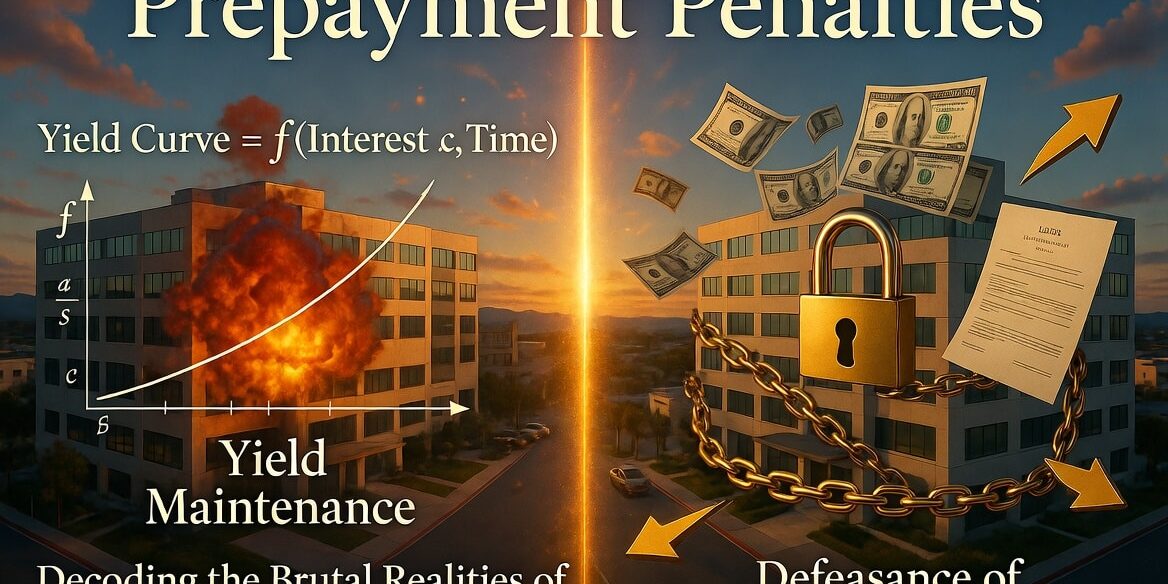
In the apex tiers of institutional capital, we do not view an institutional mortgage as a flexible line of credit; we view it as a weaponized, mathematical bond. When you secure non-recourse CMBS, LifeCo, or Agency debt, the lender is promising global bondholders a guaranteed, uninterrupted yield for exactly 10 years. If you attempt to break that promise early, you are legally and mathematically forced to make the bondholders completely whole. You do not just pay a fee; you execute Yield Maintenance or Defeasance—the two most violently expensive exit mechanisms in the United States financial system.
At The Malakai Sparks Group, backed by the institutional framework of L3 Real Estate and L3 Property Management, we do not hope for banking flexibility; we mathematically engineer the exit before the ink on the promissory note ever dries. Governing an eight-figure commercial debt stack requires the exact same ruthless, fiduciary discipline deployed when steering the La Cuesta Racquet Club board through complex, multi-million-dollar structural and liability assessments—you strip the emotion from the table, demand absolute structural protection, and strictly enforce the governing documents to protect the collective equity. You do not survive the daily logistical warfare of this industry by blinding yourself to the exit costs; you engineer your portfolio with the unyielding physical and mental stamina of an Ironman, and the relentless, compounding structural momentum of a heavy 48KG kettlebell progression—every single repetition, every single debt covenant, must be mechanically locked out to endure the weight of the macroeconomic cycle. Just as we relentlessly canvas every microscopic demographic shift across our exact 2,500-home farming route in the Numbered Streets of Huntington Beach to unearth unyielding equity before it hits the open market, we forensically audit the prepayment matrix to permanently secure your sovereign yield. Here is the definitive, institutional-grade guide to decoding the prepayment slaughter, surviving the Treasury swap, and mathematically guaranteeing your commercial exit.
1. The Mathematics of the Yield Slaughter
To successfully survive a commercial exit, an investor must completely dismantle the illusion that a prepayment penalty is a simple percentage fee.
In the residential world, a prepayment penalty might be 1% of the loan balance. In the institutional commercial arena, Yield Maintenance is a brutally complex present-value calculation tied directly to the Federal Reserve’s macroeconomic interest rate environment.
-
The Macroeconomic Trap: The mathematical severity of Yield Maintenance is entirely dependent on current U.S. Treasury yields. If you locked in a 4% commercial loan, and current Treasury yields drop to 2%, the lender cannot reinvest your payoff money to get their 4% back. Therefore, the formula violently mathematically punishes you, forcing you to pay the entire delta of the lost interest over the remaining life of the loan. In a dropping interest rate environment, a Yield Maintenance penalty can easily exceed 20% to 25% of your total loan balance.
2. High-Density Friction and The Value-Add Squeeze
The Yield Maintenance trap is most violently triggered within the heavy-turnover residential sectors, where operators execute rapid “Value-Add” strategies but utilize the wrong debt vehicle.
-
The Timeline Mismatch: When operating massive residential complexes within the transit-oriented commuter grids of Santa Ana: High-Density Multi-Family & The Urban Redevelopment Core or the student-heavy logistical networks of Fullerton: The Northern Logistical & Academic Support Hub, an amateur syndicator will secure a 10-year Fannie Mae loan, but plan to renovate and sell the building in 3 years.
-
The Refinance Paralysis: By year three, the building is stabilized, and the NOI is massive. The operator wants to execute a cash-out refinance to return capital to their investors. However, because they are seven years early on a 10-year Agency loan, the Yield Maintenance penalty is . The penalty mathematically consumes the exact equity they were trying to extract. Elite operators never pair a 3-year execution strategy with 10-year Yield Maintenance debt; they utilize flexible, step-down prepay structures to maintain absolute chronological liquidity.
3. The Experiential Aesthetic vs. The Treasury Substitution
While Yield Maintenance is a brutal formula, Defeasance is an entirely different legal beast frequently deployed in CMBS debt, dictating the survival of heavily curated, consumer-facing assets.
-
The Boutique Liquidation: When executing heavy acquisitions within the hyper-experiential retail grids of Costa Mesa: The Creative Office & High-Volume Experiential Retail Corridor or navigating the fiercely guarded historic preservation overlays of San Juan Capistrano: Historic Professional Office & Boutique Retail Arbitrage, you frequently deploy CMBS non-recourse debt.
-
The Collateral Swap: Defeasance is not a fee paid to the lender. It is a legal substitution of collateral. To sell the retail center, you must legally release the physical dirt from the REMIC trust. To do this, you are mathematically required to purchase a highly specific, customized portfolio of U.S. Treasury bonds that exactly replicate your monthly mortgage payments. You transfer these Treasuries to a “Successor Borrower,” who continues paying the Wall Street trust on your behalf. The sheer legal, accounting, and securities broker fees required just to execute the Defeasance trade frequently exceed , completely irrespective of the cost of the Treasuries themselves.
4. Heavy Industrial Portfolios and the Open Window
In the massive logistical and manufacturing sectors, navigating Defeasance requires uncompromising chronological precision and an understanding of the “Open Window.”
-
The Supply Chain Execution: When managing massive distribution hubs within Anaheim: The Industrial Heart of Orange County or specialized terminal logistics centers in Huntington Beach: Coastal Industrial & The Aerospace/Defense Pivot, the assets trade at massive valuations. A Defeasance penalty here could easily eclipse $$5,000,000.
-
The “Par” Arbitrage: Institutional CMBS and LifeCo loans contain a highly guarded “Open Window”—typically the final 3 to 6 months of the 10-year loan term. During this exact window, the Yield Maintenance and Defeasance requirements completely evaporate, and the borrower can pay off the loan at “Par” (zero penalty). Elite operators legally engineer their multi-million-dollar industrial dispositions to close strictly within this 90-day window, manipulating the escrow timeline to mathematically perfectly thread the needle and capture 100% of the equity.
5. Shielding the Clinical Moats and Corporate Lease Alignment
Institutional capital deploys prepayment architecture to mathematically mirror the exact inelasticity of their global corporate tenants.
-
The Medical Maturity Alignment: If you are securing advanced biomedical footprints within Fountain Valley: The Corporate Flex Corridor & Institutional Healthcare Fortress or entitling corporately backed clinical engines in Orange: The Institutional Healthcare & Medical Office Epicenter, your hospital tenant signs a 15-year lease.
-
The Coterminous Execution: Amateur landlords will place a 10-year loan on a 15-year lease. This is chronological suicide. In year 10, the loan matures, and you must refinance. If interest rates have spiked, your debt service explodes, but your tenant’s rent is locked for another 5 years. You mathematically bleed to death. Elite landlords execute coterminous debt—structuring the LifeCo loan to mature the exact same month the corporate lease expires. This exact same chronological alignment is executed within the towering corporate bastions of Irvine: The Master-Planned Corporate Juggernaut and the heavily restricted suburban fortresses of Mission Viejo: South County Suburban Retail & High-Yield Healthcare Centers, permanently protecting the landlord from interest rate risk and the Yield Maintenance trap simultaneously.
6. The Sovereign Exit: Weaponizing the Assumption
The ultimate, multi-million-dollar redemption of the brutal Yield Maintenance and Defeasance structures is realized exclusively upon the terminal disposition of the asset in a high-interest-rate environment.
-
The Valuation Multiplier: When transitioning multi-generational equity into the absolute sovereign wealth vaults of Newport Beach: The Wealth Management & Coastal Capital Center, the prepayment penalty actually becomes your greatest asset.
-
The Frictionless Assumption Override: Because Defeasance is so catastrophically expensive, CMBS and institutional loans are universally Assumable. If you locked in a 3.5% loan, and current debt costs 7.5%, you do not pay the building off. You execute a legal Assumption, allowing the institutional buyer to seamlessly step into your artificially low, non-recourse debt. By completely bypassing the current volatile debt markets, the buyer’s yield mathematically skyrockets. The elite operator charges the buyer a massive “Assumption Premium” on the purchase price. You literally weaponize the Defeasance trap, converting what would have been a penalty into a increase in your exit valuation.
Conclusion: You Do Not Pay the Penalty, You Engineer Around It
In the highly capitalized, completely unforgiving arena of Southern California commercial real estate, blindly signing a 10-year institutional loan without possessing a mathematically guaranteed, 10-year hold strategy is an unforced error of massive proportions.
Amateur commercial brokers sell the immediate interest rate. They push the syndicator to accept the Wall Street capital, completely ignore the catastrophic Treasury substitution matrix buried deep within the promissory note, and trap their clients inside a legally paralyzed building that mathematically detonates the moment they attempt an early exit.
Elite commercial advisors are capital stack engineers and chronological actuaries. We audit the Defeasance mechanisms. We execute the coterminous lease alignments. We mathematically force the Open Window negotiations before the REMIC trust is ever finalized. At The Malakai Sparks Group, L3 Real Estate, and L3 Property Management, we ensure that when your wealth is deployed into a commercial asset, your debt is not a chronological trap; it is a mathematically bulletproof, institutionally executed, and legally isolated firewall engineered to permanently secure the absolute maximum yield of your multi-generational legacy.