

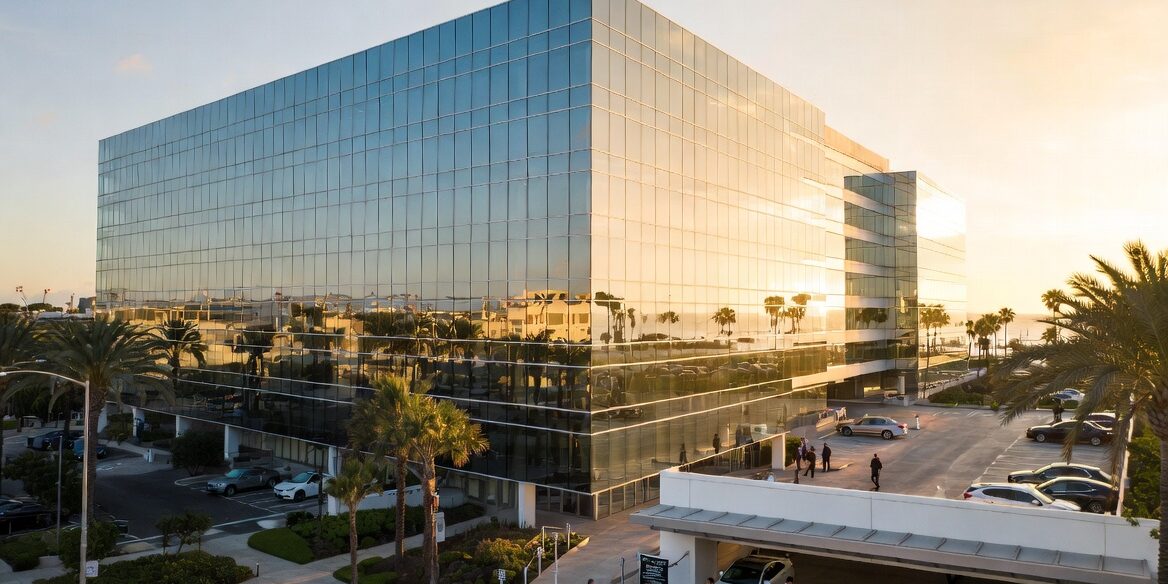
Office buildings in Newport Beach, Orange County, California, continue to anchor one of the most desirable commercial real estate submarkets in Southern California as of 2026. With its stunning coastal backdrop, direct access to John Wayne Airport, and strategic positioning along key arteries such as the 405, 73, and MacArthur Boulevard corridors, Newport Beach attracts premium tenants, including Fortune 500 headquarters, financial institutions, professional services firms, boutique tech companies, and healthcare-related offices. Areas like Newport Center, Fashion Island-adjacent zones, the Airport Area, and Koll Center host Class A and trophy properties that command top rents due to lifestyle amenities, views, and connectivity.
Unlike high-density urban cores, Newport Beach office developments often feature a mix of mid-rise structures, campus-style layouts, and integrated parking solutions—ranging from multi-level garages and underground facilities to surface lots—driven by high land values and stringent aesthetic standards. In this environment, parking management transcends mere logistics; it becomes a strategic differentiator that influences tenant retention, employee productivity, leasing velocity, and overall asset performance. With hybrid and flexible work models now firmly entrenched post-pandemic, average daily occupancy in many buildings hovers between 40-65%, creating both opportunities and complexities for parking optimization.
California’s ongoing push toward reduced vehicle miles traveled (VMT), electrification, and sustainable development—coupled with Orange County’s traffic pressures—has elevated parking from a compliance checkbox to a core operational pillar. Newport Beach’s Municipal Code (Title 20, Chapter 20.40 as updated through 2025 ordinances) provides the regulatory backbone, but forward-thinking operators go far beyond minimums to deliver efficient, secure, user-friendly, and environmentally responsible systems. This comprehensive guide outlines best practices tailored to Newport Beach office buildings, drawing on current 2026 realities to help property owners, managers, and tenants maximize value while minimizing costs and environmental impact.
The Regulatory Landscape: Zoning Standards and Flexibility in 2026
Newport Beach maintains a tiered, net-floor-area-based parking requirement for office uses that balances supply with demand. For business, corporate, general, and governmental offices (with no more than 20% medical uses):
- The first 50,000 square feet requires 1 space per 250 square feet.
- The next 75,000 square feet requires 1 space per 300 square feet.
- Any floor area above 125,001 square feet requires 1 space per 350 square feet.
Medical and dental offices follow a stricter 1 space per 200 square feet standard, while outpatient surgery facilities use 1 per 250. These ratios, unchanged in core structure since recent code reviews, reflect the city’s recognition that office demand is lower than retail or restaurant uses.
Importantly, the 2025 amendments (including updates to the Local Coastal Program Implementation Plan) introduced greater flexibility. The city now permits the Community Development Director to approve parking reductions of up to 20% when supported by detailed utilization studies, shared-parking agreements, or provision of alternative mobility features. A dedicated Parking Management (PM) Overlay District allows customized strategies in targeted commercial zones. Reductions are also available for ADA compliance improvements, bicycle end-of-trip facilities (up to 10% with showers/lockers), and dedicated rideshare/delivery curb space (up to 10%). In-lieu fee programs can further offset requirements in appropriate cases.
These provisions encourage data-driven approaches rather than blanket over-supply, helping owners navigate high land costs while aligning with state mandates for lower VMT and greenhouse gas reductions. Operators who proactively engage with planners during entitlements or lease negotiations often secure variances that translate into millions in saved construction and maintenance expenses.
Why Parking Management Directly Impacts Office Building Success
In Newport Beach’s competitive market—where vacancy rates have stabilized around 14-16% in premium submarkets and absorption favors ESG-aligned properties—parking quality influences every leasing decision. Employees expect seamless arrival experiences amid regional congestion on the 405 and 55 freeways. Tenants evaluate properties based on predictability, security, and sustainability features that support hybrid schedules and EV adoption rates (now exceeding 35% in Orange County professional sectors).
Poor management manifests as morning gridlock, employee frustration, unauthorized parking spilling over onto residential streets, or underutilized assets tying up capital. Conversely, excellence in this area boosts Net Operating Income through higher occupancy, reduced turnover, premium leasing rates, and potential ancillary revenue from managed visitor parking. With insurance and liability considerations rising, integrated security and emergency access planning also protects against claims and supports business continuity during wildfire or flood events common to coastal Orange County.
Comprehensive Best Practices for 2026
1. Conduct Ongoing Data-Driven Audits and Demand Forecasting
The foundation of effective management begins with rigorous analysis rather than static assumptions:
- Deploy multi-week utilization studies using license-plate recognition cameras, IoT sensors, or third-party consultants to capture true peak (typically 9-11 a.m. Tuesdays-Thursdays) and valley patterns.
- Factor in hybrid work realities: Model scenarios for 40%, 60%, and 80% attendance days, incorporating tenant-specific flex schedules.
- Leverage shared-parking modeling in mixed-use zones near retail or hotels to reduce total required spaces by 15-25%.
- Integrate weather, event, and seasonal data (e.g., summer beach traffic spillover) into forecasts.
Annual reviews allow dynamic adjustments—reallocating spaces for EV charging, executive reserved areas, or temporary contractor needs—while providing defensible documentation for code reduction requests.
2. Embrace Smart Technology and Digital Integration
Technology turns parking into a responsive, revenue-generating asset:
- Implement cloud-based reservation platforms linked to building access systems and tenant calendars, eliminating circling and enabling dynamic pricing for premium spots during peak events.
- Install real-time occupancy sensors with mobile apps and digital signage that guide drivers directly to available stalls, reducing search time by up to 70%.
- Use AI-powered analytics to predict demand, automate enforcement via virtual permits, and generate reports for ESG scoring.
- Integrate with property management software for seamless visitor pre-registration and contactless entry.
In 2026, systems incorporating predictive maintenance alerts and energy usage tracking for EV chargers deliver both operational savings and marketing advantages.
3. Prioritize Layered Security and Emergency Preparedness
Security in Newport Beach offices must address both everyday threats and regional risks:
- Adopt credentialed access with license-plate recognition, mobile badges, and visitor kiosks that log every entry and require tenant approval.
- Segment zones clearly—employee-only, visitor short-term, EV-dedicated, and accessible stalls—using bollards, gates, and color-coded signage.
- Deploy 360-degree high-resolution cameras with AI anomaly detection, integrated lighting, and 24/7 monitoring centers.
- Design clear evacuation routes and maintain unobstructed access for first responders, fuel delivery, and generator maintenance, especially critical given coastal wildfire and sea-level rise considerations.
Regular drills and coordination with Newport Beach Police and Fire departments ensure compliance and peace of mind.
4. Advance Sustainability and Resilience Features
Sustainability is no longer optional; it is a tenant expectation and regulatory driver:
- Target at least 20-30% of spaces with Level 2 or DC fast EV chargers, qualifying for state and utility incentives while future-proofing against 2035 ICE vehicle phase-outs.
- Incorporate permeable pavers, bioswales, and green roofs on garage structures to manage stormwater and reduce urban heat island effects.
- Install solar canopies over surface lots to generate on-site renewable energy and provide shade, often offsetting 15-25% of parking area lighting loads.
- Promote active transportation with secure bike rooms, e-bike chargers, showers, and lockers—directly supporting code-allowed parking reductions.
These elements help achieve LEED, WELL, or Parksmart certifications and appeal to institutional investors prioritizing ESG metrics.
5. Develop User-Centric Operational Policies and Enforcement
Policies must balance efficiency with tenant satisfaction:
- Unbundle parking from leases, offering tiered options (reserved, flex, visitor passes) at market rates to discourage unnecessary driving and generate revenue.
- Implement dynamic demand management: staggered arrival windows, carpool incentives, or overflow partnerships with nearby facilities.
- Provide clear wayfinding, generous turning radii for delivery vehicles, and accessible pathways compliant with ADA and California Title 24.
- Maintain rigorous upkeep—restriping every 18-24 months, pressure washing, landscaping integration, and LED lighting upgrades—to preserve aesthetics in this image-conscious coastal city.
Multi-tenant buildings benefit from standardized yet customizable tenant handbooks outlining rules and expectations.
6. Integrate Parking with Broader Mobility and Workplace Strategies
View parking as one piece of holistic employee experience:
- Partner with OCTA, rideshare providers, and local shuttle services to offer subsidized transit passes or on-site pickup zones.
- Track commuting patterns through annual surveys and adjust allocations accordingly.
- Collaborate with the city on Transportation Demand Management (TDM) plans to unlock further parking flexibility.
- In larger campuses, explore valet or automated parking technologies for high-density garages.
Measuring Success: KPIs and Return on Investment
Effective programs deliver quantifiable returns. Target metrics include:
- Average occupancy below 85% during peaks (indicating right-sized supply)
- Search time under 2 minutes
- Reduction in complaints by 50%+
- Energy and maintenance cost savings of 15-30%
- Contribution to higher tenant renewal rates and leasing premiums
ROI calculations often show payback periods under 24 months for smart systems and EV infrastructure through combined operational savings, incentives, and revenue.
Implementation Roadmap for Property Managers
- Baseline audit within the first quarter.
- Technology pilot on the first level of the garage.
- Policy rollout with tenant feedback sessions.
- Annual review tied to lease cycles and code updates.
- Scale successful elements campus-wide.
Engage consultants familiar with Orange County nuances for seamless execution.
Looking Ahead: Future Trends Shaping 2027 and Beyond
As autonomous vehicles, widespread micromobility, and potential congestion pricing emerge, parking demand may decline by another 10-20%. Newport Beach operators who invest now in flexible infrastructure—modular chargers, convertible stalls, and data platforms—will lead the market. Continued code evolution toward performance-based standards rather than fixed ratios will reward proactive managers.
Conclusion
Best practices in parking management for office buildings in Newport Beach, Orange County, blend regulatory compliance with innovative technology, robust security, deep sustainability commitments, and tenant-focused operations. By conducting data-driven audits, deploying smart systems, enforcing layered security, embracing green features, crafting thoughtful policies, and integrating with broader mobility solutions, property teams create environments that enhance daily experiences while controlling costs and supporting community goals.
In a market where every detail matters—from the view out the window to the ease of parking upon arrival—these strategies position buildings as resilient, competitive assets. Property owners and managers who treat parking as a strategic advantage rather than an afterthought will thrive amid evolving work patterns, electrification, and sustainability imperatives. The result is not only higher asset values and tenant loyalty but also a positive contribution to Newport Beach’s quality of life and environmental stewardship for years to come.






