

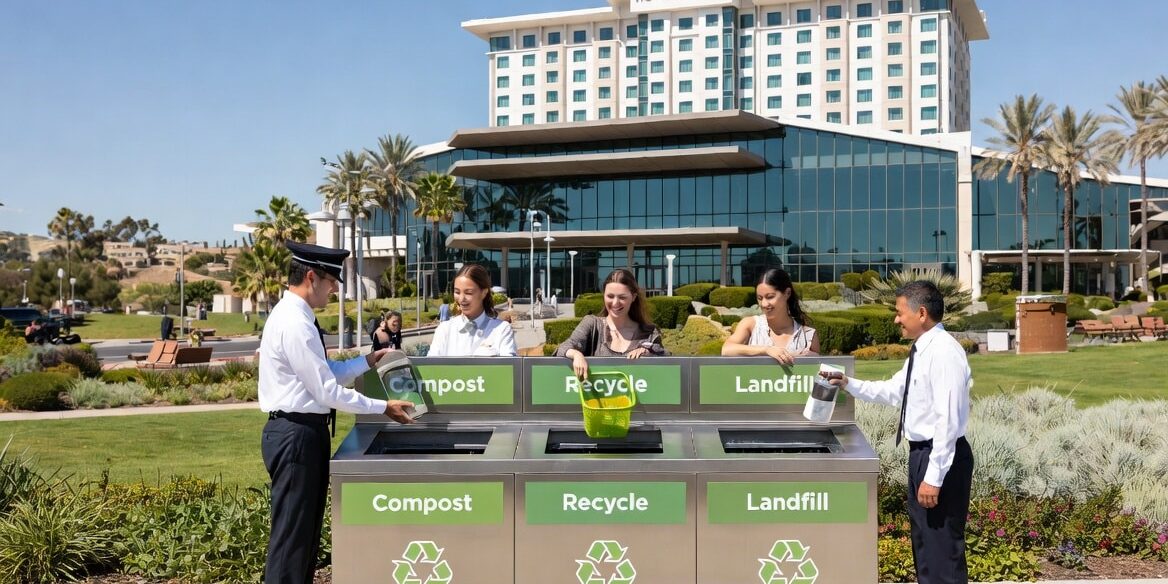
Hotels and hospitality venues in Lake Forest, Orange County, California, play a vital role in the region’s economy, serving a mix of business travelers, leisure visitors, and event attendees drawn to the area’s strategic location near the Irvine Spectrum Center, major corporate parks, John Wayne Airport, and convenient access via the I-5, 405, and 241 freeways. Lake Forest’s hospitality sector includes mid-scale and upscale hotels, boutique properties, conference centers, and full-service restaurants that cater to both transient guests and local events. These facilities generate substantial waste volumes—often 2 pounds or more per occupied room daily—stemming from guest room operations, food and beverage services, linens, packaging, and special events.
Unlike residential or office settings, hotels face unique challenges: fluctuating occupancy, high food waste from kitchens and banquets, single-use amenities, and the need to maintain impeccable guest experiences. Effective waste management is no longer optional; it drives cost savings, regulatory compliance, guest loyalty among sustainability-conscious travelers, and environmental responsibility. In Lake Forest, operators must navigate stringent California mandates while aligning with local programs enforced through the city’s exclusive commercial hauler, CR&R Environmental Services.
California’s aggressive waste reduction goals, particularly Senate Bill 1383 (SB 1383), have transformed the landscape since its full implementation in 2022. The state aims to reduce organic waste disposal by 50% from 2014 levels by 2020 and 75% by 2025, while recovering at least 20% of surplus edible food. Lake Forest enforces these through its Municipal Code and partnerships with CR&R, requiring all commercial businesses—including hotels—to participate in mandatory three-stream separation: trash (gray or black containers), recycling (blue), and organics (green). Additional laws like Assembly Bill 341 (AB 341) mandate recycling for businesses generating four or more cubic yards of trash weekly, and AB 827 requires food service establishments to provide customer-facing bins for on-site consumption.
Local Regulatory Framework in Lake Forest
Lake Forest’s commercial waste program, delivered exclusively by CR&R, mandates color-coded, labeled containers compliant with SB 1383 standards. All businesses receive standardized bins: gray/black for landfill trash, blue for commingled recyclables (paper, cardboard, plastics, metals), and green for organics (food scraps, plate scrapings, yard trimmings, food-soiled paper). Containers must feature graphic labels showing acceptable and prohibited items to minimize contamination.
Hotels must:
- Subscribe to and participate in organics collection or self-haul with detailed recordkeeping.
- Provide adequate, accessible containers for employees, contractors, tenants, and guests (excluding restrooms).
- Deliver annual education on proper sorting to staff and new tenants within 14 days of occupancy.
- Conduct periodic container inspections and correct contamination issues.
Larger properties qualify as Tier Two commercial edible food generators under SB 1383 if they have on-site food facilities and 200 or more rooms. Starting January 1, 2024, these hotels must prioritize recovering surplus edible food for donation before composting or disposal, maintaining records of donations. AB 1826 further requires organics recycling for businesses generating two or more cubic yards of total waste weekly.
Construction and demolition projects in Lake Forest demand at least 65% diversion from landfills, with CR&R holding the exclusive franchise for debris hauling since July 2025. Non-compliance risks enforcement actions, including notices of violation, fines, or service interruptions. These rules reflect broader Orange County and statewide priorities to curb methane emissions from landfills while promoting circular economy principles.
Why Effective Waste Management Matters for Lake Forest Hotels
Poor waste practices inflate disposal costs, expose properties to regulatory penalties, and damage reputation in a competitive market where guests increasingly prioritize eco-friendly certifications like Green Key or LEED. Hotels in Lake Forest benefit from proximity to corporate clients who favor sustainable partners for events. Diversion programs can cut waste hauling expenses by 20-40% through volume reduction and lower landfill fees. Environmentally, diverting organics prevents methane—a potent greenhouse gas—while composting returns nutrients to soil. Socially, food donation programs address hunger in Orange County. With rising guest expectations and California’s climate goals, proactive management enhances operational resilience and supports long-term profitability.
Key Best Practices for Waste Management in Lake Forest Hotels
1. Perform Comprehensive Waste Audits and Establish Metrics
Begin with baseline audits analyzing waste streams by department (kitchens, housekeeping, banquets, guest rooms). Track generation rates, composition, and diversion percentages over several weeks to identify hotspots like pre-consumer food prep or amenity packaging. Use tools recommended by CR&R or third-party consultants to measure against SB 1383 targets. Set achievable KPIs, such as 75% overall diversion or specific organics recovery rates. Re-audit quarterly to adapt to seasonal occupancy fluctuations. This data-driven foundation ensures compliance documentation and uncovers cost-saving opportunities.
2. Implement Robust Source Separation with Proper Infrastructure
Adopt Lake Forest’s mandated three-stream system citywide. Place clearly labeled green organics bins in all food preparation, service, and break areas; blue recycling in back-of-house and public spaces; and gray trash only as a last resort. For guest-facing food service under AB 827, position adjacent three-bin stations with easy-to-read signage. In guest rooms, provide discreet recycling and organics options or centralized collection points. Invest in wheeled carts for efficient internal transport to dumpsters. CR&R offers assistance with bin sizing and placement to optimize collection frequency and reduce fees.
3. Prioritize Organics Diversion and Composting Programs
Organics comprise the largest landfill contributor in California. Hotels must route all food scraps, vegetable trimmings, bones, eggshells, coffee grounds, and plate scrapings into green containers for CR&R collection or approved processing (composting or anaerobic digestion). Layer food waste with yard trimmings or newspaper in carts to control odors. Larger properties can explore on-site composting for landscaping use or partner with local farms. Track diversion to meet the 75% reduction goal, potentially converting waste into renewable energy or soil amendments.
4. Launch Edible Food Recovery and Donation Initiatives
Tier Two hotels must donate maximum feasible surplus edible food. Partner with organizations like Second Harvest Food Bank or local pantries to redirect prepared but unserved meals, produce, and pantry items. Implement “rescue-ready” protocols in kitchens: separate usable items before they spoil, use FIFO (first-in, first-out) inventory, and train staff on safe donation handling. Maintain detailed logs for compliance. This practice not only fulfills SB 1383 but also supports community needs while reducing disposal volumes.
5. Enhance Recycling Programs Across All Operations
Expand beyond mandates with comprehensive recycling: cardboard breakdown in receiving areas, commingled materials from guest rooms, and specialized streams for glass, aluminum, and plastics. Housekeeping teams can collect recyclables during turndown service. Banquets generate high recyclable volumes from event setups—capture these systematically. CR&R’s commingled program simplifies participation; aim for contamination rates below 5% through education. Explore mattress, linen, and carpet recycling partnerships for end-of-life items.
6. Drive Source Reduction and Sustainable Purchasing
Prevention beats diversion. Switch to bulk amenities (refillable dispensers for shampoo, lotion) to slash plastic waste. Adopt portion control in restaurants, digital menus over printed ones, and reusable linens or cloth napkins. Negotiate with vendors for minimal packaging, returnable crates, or take-back programs. Eliminate single-use plastics where feasible, aligning with broader Orange County trends. These measures lower incoming waste, cut purchasing costs, and appeal to eco-conscious guests.
7. Invest in Staff Training and Guest Engagement
Compliance hinges on people. Provide mandatory annual training via CR&R resources or internal toolkits on sorting, contamination avoidance, and food rescue. Use posters, videos, and “what goes where” guides in multiple languages. For guests, deploy in-room cards, lobby signage, and app notifications encouraging participation—many hotels report 30-50% guest diversion boosts from clear communication. Reward departments with diversion milestones to foster a culture of sustainability.
8. Leverage Technology for Tracking and Optimization
Adopt waste management software to log weights, generate compliance reports for the city and CalRecycle, and predict peaks during events. Smart bins with sensors can alert staff to fullness or contamination. Integrate with property management systems for real-time data. CR&R conducts annual audits; prepare by maintaining digital records of self-haul (if applicable), donations, and education efforts. These tools streamline reporting and identify inefficiencies.
9. Manage Special Waste Streams and Back-of-House Operations
Handle grease from kitchens through licensed interceptors and recycling. Divert e-waste (old electronics), batteries, and fluorescent bulbs via certified programs. Partner for linen reuse or donation rather than disposal. For renovations or C&D projects, achieve 65%+ diversion using CR&R’s exclusive services and approved facilities. Maintain separate roll-off bins for clean streams like wood or metal.
10. Build Partnerships and Seek Certifications
Collaborate with CR&R for customized programs, training, and audits. Join industry groups for best-practice sharing or pursue certifications (e.g., Green Globe) that validate efforts. Participate in Orange County-wide initiatives for bulk compost giveaways or food recovery networks. These alliances provide resources, reduce costs through shared services, and enhance market positioning.
Challenges and Opportunities Specific to Lake Forest
Hospitality in Lake Forest experiences variable demand—peaks during corporate events or Spectrum visits create waste surges, while space constraints in urban-adjacent properties complicate bin placement. High food service volumes test organics systems, and guest turnover demands consistent education. Yet opportunities abound: proximity to processing facilities keeps transport emissions low, and CR&R’s support eases implementation. Forward-thinking hotels turn compliance into competitive advantages, attracting corporate contracts and millennial/Gen Z travelers who value sustainability.
Conclusion
Best practices in waste management for hotels and hospitality in Lake Forest blend strict adherence to SB 1383, AB 341, and local CR&R programs with innovative reduction, diversion, and engagement strategies. By conducting audits, enforcing three-stream separation, prioritizing food donation and organics recycling, training teams, and leveraging technology and partnerships, properties achieve high diversion rates, lower costs, and superior guest satisfaction. These efforts support California’s 75% organics reduction target while positioning Lake Forest hotels as responsible community leaders.
In an era of climate accountability and discerning travelers, proactive waste management is a strategic imperative. Lake Forest operators who embrace these practices not only ensure compliance and operational efficiency but also contribute to a cleaner, more sustainable Orange County. Collaboration among management, staff, guests, and the city—via CR&R—will drive continued progress, turning waste challenges into opportunities for excellence in hospitality.