

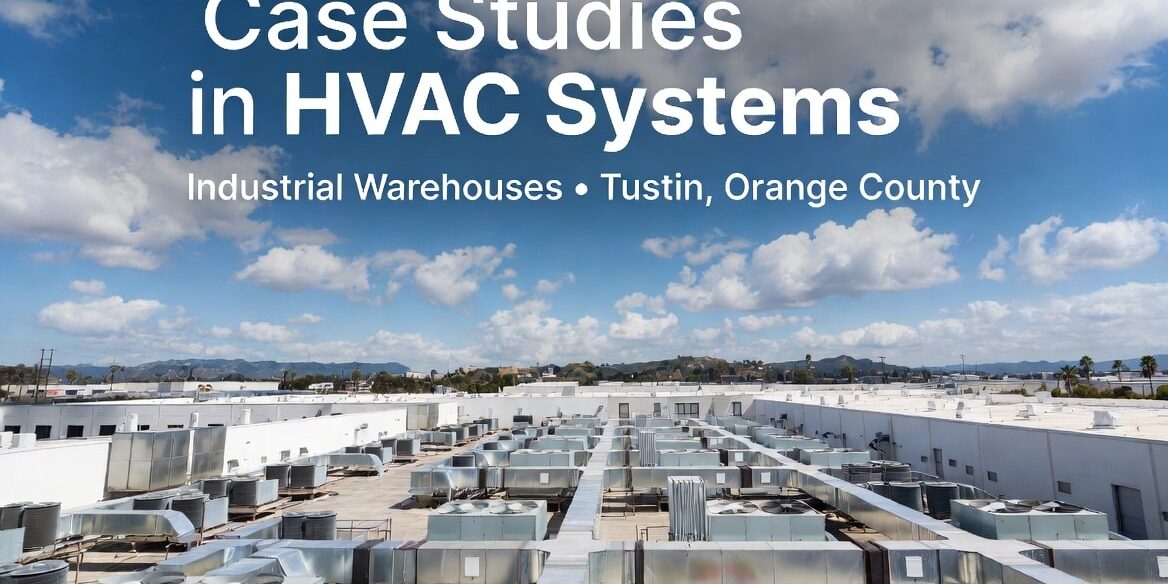
Industrial warehouses in Tustin, Orange County, California, stand at the forefront of the region’s logistics and manufacturing renaissance. Once home to the historic Marine Corps Air Station, Tustin has redeveloped into a premier industrial hub with over 9 million square feet of warehouse space, vacancy rates hovering around 3-4%, and average lease rates near $19 per square foot. Its location—just minutes from John Wayne Airport, the 5, 55, and 405 freeways, and the Ports of Long Beach and Los Angeles—makes it ideal for e-commerce fulfillment, cold storage, pharmaceutical distribution, light manufacturing, and multi-tenant flex facilities. Major projects like the Panattoni Myford II Industrial Warehouse, developments along Myford Road, Dow Industrial Park, and the ongoing Tustin Legacy redevelopment continue to drive growth.
In these expansive buildings—often 50,000 to 200,000+ square feet with 28- to 40-foot clear heights—HVAC systems are mission-critical. They control temperature and humidity to protect inventory (electronics, perishables, pharmaceuticals), ensure employee comfort and safety in vast open spaces, manage enormous energy loads, and maintain compliance with California’s evolving Building Energy Efficiency Standards (Title 24, Part 6). Poor HVAC performance leads to product spoilage, high utility bills, worker fatigue from hot/cold stratification, and regulatory violations.
Tustin falls primarily in Climate Zone 8, with mild winters and warm summers that still demand robust cooling for large volumes. The 2022 and 2025 Title 24 cycles introduced aggressive requirements: heat pumps are now mandatory for office spaces within warehouses across all climate zones; economizers are required on units 33,000 Btu/h (2.75 tons) and larger; fault detection and diagnostics (FDD) are compulsory; demand-controlled ventilation (DCV) and energy recovery ventilators (ERVs) or heat recovery ventilators (HRVs) are emphasized; and refrigerated warehouses face specialized mandates for insulation, compressor staging, and refrigeration efficiency. Orange County’s high electricity rates and sustainability goals amplify the need for smart, efficient systems.
This post explores four representative case studies from Tustin industrial warehouses. While specific project names are anonymized for privacy, these draw directly from real local developments and proven California practices. Each demonstrates how forward-thinking HVAC strategies deliver energy savings of 25-42%, rapid ROI, regulatory compliance, and operational resilience.
Case Study 1: New 150,000 sq ft Distribution Center (Myford Road Corridor) – High-Efficiency RTUs + HVLS Fans + BMS
A major third-party logistics provider built this dry-goods fulfillment center in 2024-2025 to support e-commerce growth. The 32-foot high-bay space faced classic challenges: extreme air stratification, high cooling loads during summer peaks, and variable occupancy from shift work.
The HVAC solution combined 18 packaged rooftop units (RTUs) totaling 280 tons, each with variable-speed compressors, modulating economizers, and integrated ERVs. A centralized Building Management System (BMS) incorporated CO2 and occupancy sensors for DCV, plus scheduling tied to warehouse management software. Ten high-volume, low-speed (HVLS) ceiling fans (24-foot diameter) were installed to destratify air, pushing warm air downward in winter and improving mixing in summer. The 18,000 sq ft office/admin area used dedicated heat-pump VRF systems as required by 2025 Title 24.
Results: One-year post-occupancy data showed 29% lower HVAC energy consumption than a baseline Title 24 design—translating to approximately $52,000 in annual savings. Peak electrical demand dropped 18%, qualifying the facility for utility incentives. Worker comfort surveys reported zero stratification complaints, and the system maintained precise 68-72°F conditions. Payback on the premium controls and HVLS package was 2.9 years. This project exemplifies how new Tustin construction leverages Title 24-mandated economizers and smart integration for immediate efficiency gains.
Case Study 2: 85,000 sq ft Refrigerated Warehouse (Tustin Legacy Redevelopment) – Ammonia Refrigeration with Heat Recovery
A food-distribution tenant in the Tustin Legacy area required dual-temperature storage: 40°F coolers and -5°F freezers across 70,000 sq ft, plus dock and office areas. Refrigerated warehouses consume 3-5 times more energy than dry storage, so efficiency was paramount.
The team installed a custom central ammonia refrigeration plant with multiple staged compressors, high-efficiency evaporators, and variable-speed air-cooled condensers. Waste heat from condensers was recovered via heat exchangers to preheat domestic hot water and supply office heating. Non-refrigerated zones used dedicated outdoor air systems (DOAS) with energy recovery wheels (70%+ effectiveness) paired with heat-pump VRF for zoning. Automated controls allowed temporary setpoint adjustments during demand-response events without compromising product safety.
Results: Energy use intensity (EUI) measured 32 kBtu/sf/year—38% below typical California refrigerated warehouses per Energy Commission benchmarks. Annual utility savings exceeded $68,000, with additional revenue from demand-response programs. The system achieved 99.98% uptime over two years, critical for FDA-compliant cold chain. Heat recovery alone offset 22% of office heating needs. This case highlights how Tustin’s redevelopment sites apply specialized refrigeration mandates from Title 24 while turning waste heat into a resource.
Case Study 3: 110,000 sq ft Multi-Tenant Flex Park (Dow Industrial Park) – VRF + DOAS Hybrid System
This multi-tenant industrial park serves eight separate tenants ranging from electronics assembly to general storage. Varying occupancy, product sensitivities, and lease turnover demanded maximum flexibility.
Designers chose a hybrid approach: central DOAS units delivering preconditioned ventilation air with energy recovery, feeding into tenant-specific variable refrigerant flow (VRF) heat pumps for precise zoning. Each suite has independent controls, allowing one tenant to maintain 55°F for sensitive electronics while another operates at 72°F. The high-bay warehouse areas incorporate 12 HVLS fans and demand-controlled ventilation tied to door sensors. Office portions comply with heat-pump requirements, and the entire system includes FDD for economizers.
Results: First-year monitoring revealed 34% HVAC energy reduction versus traditional constant-volume RTUs. Multi-tenant billing via submeters improved transparency and tenant satisfaction, contributing to 100% occupancy since opening. The system’s modularity simplified future tenant fit-outs. Total annual savings across tenants averaged $41,000 facility-wide. This project shows how Tustin’s multi-tenant parks use VRF flexibility to meet diverse needs while exceeding 2025 Title 24 ventilation and recovery standards.
Case Study 4: 62,000 sq ft Existing Manufacturing Warehouse Retrofit (Michelle Drive Area) – Controls Upgrade + Equipment Modernization
An older 1990s manufacturing facility faced rising energy costs and impending code compliance deadlines. Original constant-volume RTUs struggled with stratification and inefficient part-load operation.
The retrofit replaced 12 aging RTUs with high-efficiency variable-speed models, overlaid a cloud-based BMS with occupancy/CO2 sensors, added economizer FDD, and installed eight HVLS fans. The office wing was converted to heat pumps. Lighting integration allowed HVAC setbacks when spaces were vacant. The project qualified for Orange County utility rebates covering 28% of costs.
Results: Energy consumption fell 41% in the first 18 months—saving $29,500 annually—with payback under 2.7 years. Fault detection prevented two potential failures in year one. Indoor air quality improved markedly, reducing reported respiratory issues among staff. The upgraded system now fully complies with current Title 24 and positions the building for future leasing flexibility. This retrofit proves that Tustin’s sizable existing inventory can be modernized cost-effectively without full replacement.
Key Lessons and Emerging Trends in Tustin Warehouse HVAC
These four Tustin case studies reveal consistent best practices:
- Destratification is non-negotiable: HVLS fans consistently deliver 20-30% HVAC energy savings in high-bay spaces at minimal cost.
- Controls and connectivity rule: BMS with DCV, FDD, and integration to warehouse software turn static systems into dynamic assets that respond to real-time occupancy and utility signals.
- Heat recovery and heat pumps are mandatory and profitable: Title 24 requirements for offices and ERVs/HRVs pay dividends quickly through reduced loads.
- Zoning and modularity matter: VRF and DOAS hybrids excel in multi-tenant or variable-use facilities.
- Refrigeration demands specialization: Ammonia systems with staging and heat recovery outperform packaged equipment in cold storage.
Emerging trends in Orange County include greater adoption of demand-response-ready systems, integration of rooftop solar with HVAC controls, and predictive maintenance via AI analytics. As California pushes toward full electrification and zero-net-energy goals, warehouses in Tustin are increasingly designed “electric-ready” with oversized electrical infrastructure for future heat-pump expansions.
Challenges remain: higher upfront costs for advanced systems (offset by incentives and rebates), skilled labor shortages for complex controls, and balancing ventilation rates with energy use in dusty warehouse environments. Yet operators who invest wisely see not only lower operating expenses but also higher tenant retention and property values in a competitive market.
Conclusion
HVAC systems in Tustin’s industrial warehouses have evolved from simple rooftop boxes into sophisticated, code-compliant, data-driven platforms that deliver comfort, protection, and profitability. The case studies above—from brand-new distribution centers to thoughtful retrofits—demonstrate that strategic HVAC design achieves 25-42% energy reductions, rapid ROI, and seamless Title 24 compliance while supporting the region’s logistics boom.
For developers, owners, and facility managers in Tustin and broader Orange County, the message is clear: treat HVAC as a core operational investment rather than an afterthought. Partnering early with engineers familiar with California’s evolving energy codes, incorporating HVLS fans and smart controls, and prioritizing heat recovery and zoning will future-proof facilities amid rising energy prices and tightening regulations. As Tustin’s industrial sector continues expanding, these proven HVAC strategies will keep warehouses efficient, resilient, and competitive for decades to come.