

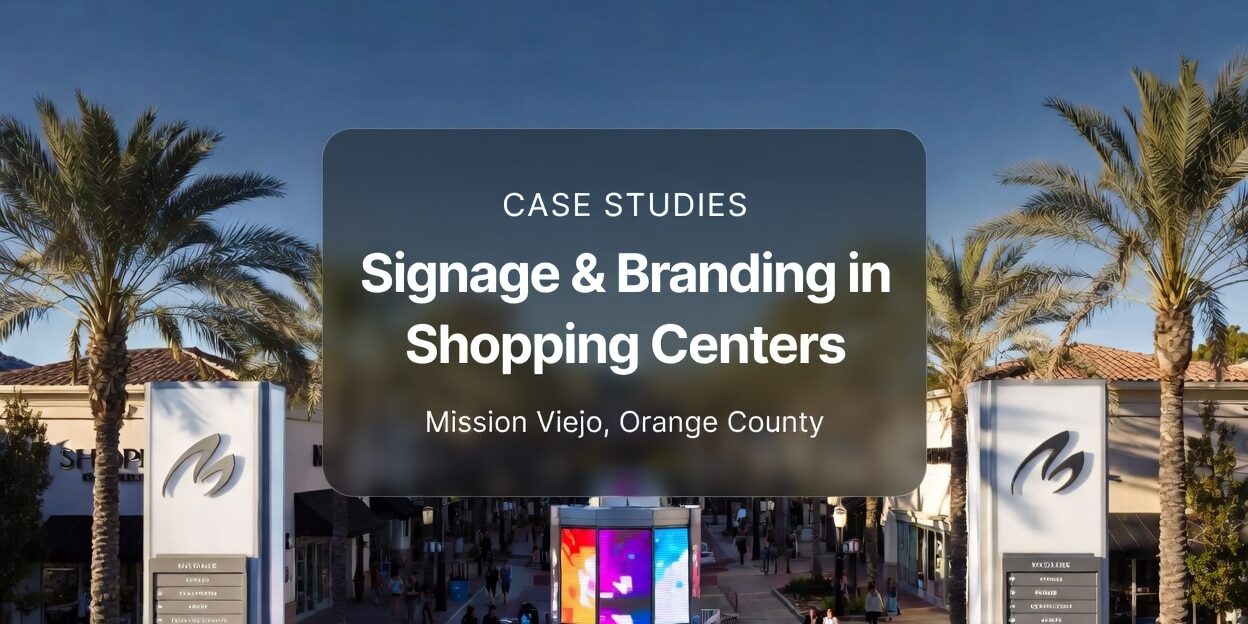
In the meticulously planned community of Mission Viejo, Orange County, shopping centers serve as more than retail hubs—they are social anchors in a city renowned for its Spanish Colonial Revival architecture, family-friendly atmosphere, and affluent demographics. With its strategic location in South Orange County, bordered by major freeways and serving residents from Ladera Ranch, Rancho Santa Margarita, and beyond, Mission Viejo’s retail landscape demands sophisticated signage and branding strategies. Effective signage here must navigate strict municipal codes while creating memorable first impressions that drive foot traffic in an era of online shopping competition.
Unlike flashier urban malls, Mission Viejo shopping centers excel when their visual identity harmonizes with the city’s Mediterranean aesthetic: warm stucco tones, terracotta accents, and understated elegance. Signage and branding become critical tools for differentiation, wayfinding, tenant visibility, and emotional connection. This in-depth exploration examines real-world case studies from The Shops at Mission Viejo and Kaleidoscope, revealing how smart signage and branding initiatives have transformed these properties, boosted performance, and respected local character.
The Regulatory Framework: Balancing Compliance and Creativity in Mission Viejo
Any successful signage and branding project in Mission Viejo begins with a deep understanding of Chapter 9.29 of the Municipal Code. The city enforces some of Orange County’s stricter standards to preserve its master-planned appeal. Wall signs are limited to one square foot per linear foot of building frontage. Freestanding monument signs must be architecturally compatible with the center’s style, using materials and scale that blend with Spanish Colonial or Mediterranean themes. Pole signs are heavily restricted or prohibited in many zones.
Flashing, moving, pulsating, or animated signs are banned, along with most off-site advertising. Window signs cannot exceed 25 percent of the glass area. All projects typically require Design Review Committee approval, emphasizing simplicity, effectiveness, and neighborhood compatibility. These rules push developers and property managers toward high-quality, integrated solutions rather than cheap, attention-grabbing tactics. The result is cleaner, more sophisticated retail environments that enhance rather than clash with Mission Viejo’s residential surroundings.
Case Study 1: The 1999 Transformation – Rebranding Mission Viejo Mall as The Shops at Mission Viejo
Perhaps the most transformative example in Mission Viejo retail history occurred in 1999 when Simon Property Group invested over $150 million (with additional contributions from the city and tenants totaling more than $200 million) to reinvent the dated Mission Viejo Mall. Originally opened in 1979 with dark interiors and a conventional mall layout, the property struggled with low occupancy and an outdated image.
The rebranding to “The Shops at Mission Viejo” was more than cosmetic. The name shift signaled a move toward “casual elegance,” targeting the area’s high median household incomes. Architecturally, 62 new skylights flooded the space with natural light, orange and brown tiles were replaced with beige marble and limestone, and the center expanded by nearly 45 percent to over 1.2 million square feet.
Signage played a pivotal role. New primary identification monuments at major entrances featured refined typography and materials echoing the updated Mediterranean-inspired architecture. Internal wayfinding and directory systems were completely overhauled with larger, clearer maps and consistent branding standards imposed on new tenants. Anchor stores like the new Nordstrom and Saks Fifth Avenue received custom facade treatments and illuminated channel lettering that complied with height and illumination rules while commanding attention.
The results were dramatic. Occupancy soared toward 100 percent, new upscale tenants such as A/X Armani Exchange and Polo Jeans Co. joined, and the center became a regional destination. Annual sales tax projections for the city jumped significantly. This case demonstrates how a comprehensive signage and branding overhaul, aligned with architectural upgrades, can reposition an entire property in a competitive market.
Case Study 2: Kaleidoscope – Using Iconic Architecture for Memorable Branding
While The Shops at Mission Viejo represents the classic regional mall, Kaleidoscope offers lessons in lifestyle and entertainment-focused branding. This distinctive center features a bold tensioned fabric canopy as its signature architectural element—an instantly recognizable landmark visible from surrounding streets.
Branding at Kaleidoscope revolves around this canopy, which serves as both functional shade and powerful visual identifier. Signage is deliberately secondary yet supportive: monument signs at entry points use clean, modern fonts with subtle lighting to highlight the name “Kaleidoscope” without overwhelming the fabric structure. Tenant signage follows strict criteria to maintain visual harmony, often incorporating the center’s colorful, vibrant palette that evokes energy and community gathering.
The center’s original association with the Edwards Kaleidoscope theater reinforced its positioning as an entertainment destination. Even as retail mixes evolved, wayfinding signage directs visitors seamlessly between dining, retail, and recreational offerings. In 2013, the Planning and Transportation Commission approved a comprehensive signage program that included six exterior nondigital banners to promote tenants and upcoming events—similar to successful programs at other Orange County centers—while rejecting earlier proposals for digital signs that would have violated the no-flashing rule. This approval, paired with interior and exterior renovations and landscaping upgrades, helped revitalize tenant visibility and foot traffic.
Kaleidoscope proves that bold architectural branding, supported by disciplined signage programs, creates lasting recall in suburban markets where drivers make quick decisions about where to shop or dine.
Case Study 3: Food Court Renovation and Mall-Wide Directory Upgrades at The Shops at Mission Viejo
In the mid-2010s, a targeted renovation of The Shops at Mission Viejo’s 20,000-square-foot food court by Architecture Design Collaborative provided valuable insights into operational signage. The project included new flooring, furniture, lighting, and column designs alongside a complete refresh of signage and wayfinding elements.
New directories and ad-panels were installed throughout the mall, featuring updated graphics, better lighting, and improved hierarchy of information. Kiosk locations received integrated branding, with one quickly occupied by Starbucks. The renovation demonstrated how secondary signage systems—directories, directional signs, and tenant locators—directly impact dwell time and tenant visibility. By creating consistent visual language across the property, the project reduced shopper frustration and encouraged exploration of less prominent areas.
This case underscores the importance of maintaining and periodically refreshing internal branding systems, even in established centers, to keep the guest experience fresh and aligned with the overall upscale identity established in the 1999 rebrand.
Case Study 4: The 2025-2026 Open-Air Village Expansion – Bridging Indoor and Outdoor Experiences
The most forward-looking case involves Simon Property Group’s multimillion-dollar expansion at The Shops at Mission Viejo, adding approximately 50,000 square feet of open-air retail and dining in a new “village” setting. Approved in recent years and slated for completion by late 2026, the project converts surface parking into four freestanding buildings along a half-acre promenade with outdoor seating and landscaping.
This expansion demands sophisticated new signage strategies. Planners must develop wayfinding systems that seamlessly connect the traditional enclosed mall with the new outdoor village. New monument signs for the freestanding buildings will need to complement both the existing mall identity and the fresh open-air aesthetic. Tenant branding guidelines will likely emphasize outdoor visibility—larger blade signs, awnings with integrated lettering, and subtle illumination suitable for evening use—all while adhering to the city’s strict limits on height, materials, and non-flashing illumination.
The design reportedly blends classic Mission Style elements with clean modern lines. Signage must reinforce this hybrid identity while strictly adhering to city standards on scale, materials, and lighting. Sustainability features, such as solar-powered elements or energy-efficient LEDs, may be incorporated. This project illustrates how signage and branding must evolve with physical changes, creating unified experiences across hybrid retail formats and positioning The Shops at Mission Viejo as a forward-thinking destination for South Orange County.
Key Best Practices Emerging from Mission Viejo Case Studies
Several principles emerge from these examples. First, develop a comprehensive Signage Master Plan early that addresses primary identification, tenant criteria, wayfinding, and temporary promotions—all while securing Design Review approval. Second, prioritize architectural integration. Successful projects in Mission Viejo use materials (stone, stucco, wrought iron accents) and color palettes that feel native to the community.
Third, leverage technology thoughtfully. While animated signs are prohibited, modern static digital directories and mobile app integration can enhance the physical signage program. Fourth, measure success through metrics beyond aesthetics: increased dwell time, higher tenant sales reports, improved customer surveys, and stronger brand recall in local market research.
Finally, plan for longevity. High-quality materials and flexible design standards allow properties to adapt as retail evolves without frequent, costly overhauls.
Challenges and Future Outlook
Mission Viejo shopping center operators face unique hurdles: heavy car dependency requiring strong roadside visibility from Marguerite Parkway and surrounding arterials, competition from larger destinations like Irvine Spectrum Center, and evolving consumer preferences toward experiential retail. Centers like The Patio at Mission Viejo and smaller neighborhood plazas must also align their more modest signage programs with the same aesthetic standards to maintain cohesion across the city’s retail fabric.
Looking ahead, as The Shops at Mission Viejo’s village opens, other centers may follow with similar hybrid approaches. Successful operators will continue blending compliance with creativity, using signage and branding not just to inform but to invite and delight.
In conclusion, the case studies from Mission Viejo demonstrate that thoughtful signage and branding are powerful economic drivers. By respecting the city’s design ethos while embracing innovation, shopping centers can thrive as vibrant community destinations for years to come.