

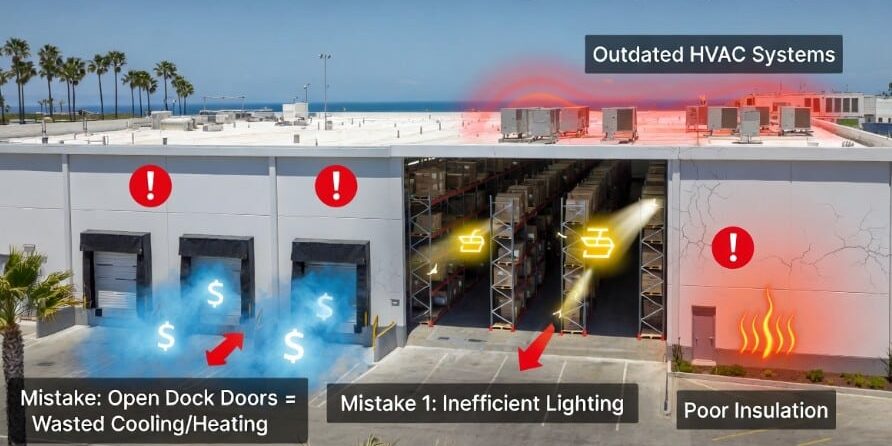
Warehouse and distribution centers in Huntington Beach, Orange County, California, form a critical backbone of the region’s logistics and supply chain network. With its prime coastal location, direct access to the Ports of Los Angeles and Long Beach, and major transportation arteries including the 405, 22, and 55 freeways, Huntington Beach has experienced robust growth in industrial space. The city’s industrial inventory exceeds 16 million square feet, encompassing modern e-commerce fulfillment centers, third-party logistics facilities, cold storage operations, and general warehousing along corridors such as Beach Boulevard, Bolsa Avenue, and the Golden West industrial areas. These facilities handle everything from consumer goods and apparel to perishable items, supporting Southern California’s massive retail and manufacturing economy.
However, energy efficiency remains a persistent challenge in these large-scale operations. Warehouses and distribution centers are inherently energy-intensive due to their vast footprints, high ceilings, 24/7 or extended-hour operations, and heavy reliance on lighting, HVAC, material handling equipment, and refrigeration (where applicable). In Huntington Beach, average commercial electricity rates from Southern California Edison (SCE) hover around $0.34 per kWh—among the higher rates in the state—making even modest inefficiencies translate into tens or hundreds of thousands of dollars in annual excess costs. Beyond finances, poor energy performance conflicts with California’s aggressive climate goals under Senate Bill 100 (100% clean energy by 2045) and exposes operators to compliance risks, higher greenhouse gas emissions, and reputational issues with tenants and investors who increasingly demand ESG-aligned facilities.
The primary regulatory framework governing energy use is California’s Title 24, Part 6 (Building Energy Efficiency Standards), enforced locally by the Huntington Beach Building Division. These standards apply to all new construction, additions, alterations, and major tenant improvements in nonresidential buildings, including warehouses. The 2022 standards (still in effect for many ongoing projects) and the updated 2025 standards (mandatory for permits filed on or after January 1, 2026) impose stricter requirements on lighting power densities, HVAC efficiency, building envelope performance, controls, and integration of renewables. Additional layers include CALGreen (Title 24, Part 11) for green building measures and local incentives from SCE for efficiency upgrades. Despite these rules, many facilities—particularly those built before 2010 or expanded without full compliance—fall short, leading to common and costly mistakes.
Understanding these pitfalls is essential for operators, property managers, and developers in Huntington Beach. Below are the most prevalent errors observed across the city’s warehouse stock, each accompanied by real-world impacts and why they persist in this coastal logistics hub.
1. Relying on Outdated or Inefficient Lighting Systems
One of the most widespread mistakes is continuing to use legacy lighting technologies such as T12 or even older T8 fluorescent fixtures, high-pressure sodium lamps, or metal halide systems installed decades ago. In Huntington Beach warehouses, where ceilings often exceed 30 feet and floor plates span 100,000+ square feet, lighting can account for 20-40% of total energy consumption. Without LED retrofits or advanced controls, facilities burn electricity continuously even in unoccupied aisles or during daylight hours near skylights.
The error compounds because many operators assume “it still works,” overlooking Title 24’s prescriptive lighting power density limits (often 0.6-1.0 W/sq ft depending on space type in 2025 standards) and mandatory occupancy sensors, daylight dimming, and automatic shut-off requirements. Coastal humidity and salt air accelerate lamp degradation, increasing maintenance and failure rates. Consequences include inflated utility bills (potentially $50,000–$150,000 annually for a mid-sized facility), excessive heat generation that burdens HVAC systems, and non-compliance during city inspections or tenant audits. Studies of similar California warehouses show LED upgrades with sensors can deliver 50-70% savings, yet many Huntington Beach operators delay due to upfront capital concerns despite SCE rebates covering 30-50% of costs.
2. Neglecting Building Envelope and Insulation Upgrades
Many warehouses in Huntington Beach feature older metal buildings or tilt-up concrete with inadequate roof and wall insulation, single-pane or poorly sealed windows/skylights, and dark-colored roofing that absorbs heat. The mistake stems from prioritizing initial construction speed over long-term performance, especially in pre-Title 24 eras. High-bay structures create massive surface areas exposed to the mild but humid coastal climate, where even small temperature swings drive unnecessary cooling loads.
Title 24 mandates minimum insulation levels (e.g., R-30+ for roofs in Climate Zone 6, where Huntington Beach falls) and cool-roof or high-albedo materials to reduce heat gain. Ignoring these leads to heat gain in summer (increasing cooling by 15-25%) and heat loss in winter. Dock and loading areas exacerbate the issue with frequent door openings. The result: higher energy use, comfort complaints for workers, accelerated equipment wear, and failure to meet performance-based compliance paths. In Orange County’s competitive leasing market, non-compliant buildings face longer vacancies and lower rents from sustainability-focused tenants.
3. Failing to Implement Zoning, Occupancy Sensors, and Smart Controls
Treating the entire warehouse as a single conditioned and lit zone is a classic error. Vast open layouts mean lighting and HVAC run at full capacity across unused storage aisles, overflow areas, or night shifts with partial occupancy. High ceilings cause thermal stratification—hot air rises while floors stay cold—yet many facilities lack destratification fans or variable controls.
Title 24 2025 standards require advanced controls, including ASHRAE Guideline 36 sequences for HVAC and mandatory occupancy-based lighting shutoff. Without sub-zoning, demand-response capabilities, or IoT sensors, operators waste 30-50% of energy. In Huntington Beach’s 24-hour distribution centers serving e-commerce, this mistake is common during fluctuating volumes. Impacts include unnecessary peak demand charges from SCE, higher carbon footprints, and missed opportunities for automated demand response programs that pay facilities to curtail load.
4. Poor Dock Door and Loading Area Management
Dock doors represent one of the largest sources of uncontrolled air infiltration in warehouses. Many Huntington Beach facilities still use basic strip curtains, damaged seals, or no air curtains at all. With dozens of truck doors opening hundreds of times daily near the coast, humid marine air rushes in, forcing HVAC systems to work overtime and compromising temperature stability in temperature-sensitive storage.
Title 24 and CALGreen emphasize vestibules, high-speed doors, dock shelters, and air barriers. Neglecting maintenance leads to 10-20% of total HVAC energy loss in some studies. Truck idling further compounds emissions and energy waste. Coastal corrosion from salt air accelerates door failures, yet deferred maintenance remains rampant. The outcome: spoiled goods in cold storage zones, worker discomfort, higher refrigeration loads, and potential violations during energy audits.
5. Inefficient HVAC and Ventilation Design Without Proper Sizing or Maintenance
Oversized or poorly maintained rooftop units, constant-volume systems without variable air volume (VAV) or economizers, and lack of demand-controlled ventilation plague many older Huntington Beach warehouses. Operators often install systems based on rule-of-thumb sizing rather than detailed load calculations, ignoring Title 24’s efficiency thresholds for packaged equipment, duct sealing, and economizer requirements.
In the mild South Coast climate, free cooling opportunities are abundant yet underutilized. Without regular filter changes, coil cleaning, or refrigerant checks, systems lose 20-30% efficiency. High ceilings demand destratification strategies that are frequently absent. Results include excessive runtime, comfort issues, and failure to qualify for SCE’s energy efficiency incentives or performance-based compliance.
6. Using Outdated or Inefficient Material Handling Equipment
Electric forklifts, conveyors, and automated guided vehicles (AGVs) from the 2000s or earlier remain in service long after more efficient models with regenerative braking, lithium-ion batteries, and smart charging became available. In high-throughput Huntington Beach distribution centers, these assets operate 16+ hours daily, drawing significant power.
Title 24 indirectly influences equipment via overall building performance, but many operators overlook SCE’s forklift electrification rebates. Old lead-acid batteries require inefficient charging stations with high standby losses. The mistake drives up demand charges and prevents full utilization of on-site solar. Savings of 30-50% are achievable with modern fleets, yet capital constraints and “if it ain’t broke” thinking prevail.
7. Lack of Energy Monitoring, Submetering, and Data Analytics
Without real-time submetering of lighting, HVAC, refrigeration, and plug loads, operators fly blind. Many Huntington Beach warehouses have only whole-building utility meters, missing granular insights into waste. Title 24 encourages (and 2025 updates strengthen) energy management information systems for larger buildings.
Absence of dashboards or fault detection means scheduling errors, simultaneous heating/cooling, or leaking equipment go unnoticed. In a port-adjacent market with volatile energy prices, this leads to 10-25% avoidable waste. Data-driven competitors using analytics achieve rapid ROI on fixes.
8. Ignoring On-Site Renewables, Energy Storage, and Incentives
Despite abundant sunshine and SCE programs (including Charge Ready and solar incentives), many facilities skip rooftop solar, battery storage, or EV charging infrastructure. Title 24 2025 expands solar and battery requirements for certain nonresidential buildings. Coastal permitting hurdles and upfront costs deter adoption, yet missed opportunities mean higher grid dependence amid OC’s electrical capacity constraints.
9. Poor Maintenance Practices and Lack of Staff Training
Deferred maintenance on seals, filters, and controls, combined with minimal employee training on energy protocols, creates a cycle of waste. Night-shift crews leaving lights on or doors ajar is common. Without ongoing commissioning, small issues become major energy drains.
10. Overlooking Refrigerated or Cold Storage Specifics (Where Applicable)
Facilities with cold storage often undersize insulation, use inefficient evaporators/condensers, or lack heat recovery. In Huntington Beach’s perishable logistics hubs, refrigeration can consume 60-70% of energy. Title 24 refrigeration measures tighten evaporator and condenser standards in 2025. Failures here risk product loss and massive bills.
Regional Challenges Amplifying These Mistakes
Huntington Beach’s coastal environment accelerates equipment corrosion, while port proximity drives 24/7 truck traffic and higher baseline loads. Grid constraints in Orange County (noted in 2026 reports on electrification demands) make peak shaving critical. Rapid e-commerce growth leads to rushed expansions without full energy planning.
Conclusion
Common energy efficiency mistakes in Huntington Beach warehouses and distribution centers—outdated lighting, poor envelope performance, inadequate controls, leaky docks, inefficient HVAC, legacy equipment, absent monitoring, missed renewables, lax maintenance, and cold storage oversights—cost operators dearly in dollars, compliance, and competitiveness. Each error compounds in the city’s high-rate, regulated environment, undermining California’s decarbonization goals.
Fortunately, solutions exist through Title 24 compliance, SCE incentives, retrofits, and data-driven operations. By auditing facilities, prioritizing quick wins like LEDs and controls, and planning for 2025 standards, operators can achieve 30-60% energy reductions, lower operating costs, attract premium tenants, and future-proof assets. In a market where logistics demand continues to surge, avoiding these pitfalls is not optional—it is essential for sustainable success in Huntington Beach and across Orange County.