Understanding the exact square footage of a commercial space might seem like a straightforward task—just grab a tape measure, right? In the world of commercial real estate, it is rarely that simple.
When you are negotiating a lease for a premium office space near Bella Terra or a retail storefront in Downtown Huntington Beach, every single square inch carries a heavy financial weight. Misunderstanding how that space is measured can cost you or your tenants tens of thousands of dollars over the lifespan of a lease.
The confusion almost always boils down to two distinct metrics: Usable Square Footage (USF) and Rentable Square Footage (RSF).
Whether you are evaluating a new asset to add to your portfolio or preparing to list a vacancy, mastering these calculations is non-negotiable. Here is the definitive guide to understanding, calculating, and negotiating RSF and USF in the Orange County commercial market.
What is Usable Square Footage (USF)?
Usable Square Footage (USF) is exactly what it sounds like: the actual, physical space that a tenant occupies and uses exclusively for their business operations. It is the area where the tenant can lay down rugs, place desks, build display racks, or install manufacturing equipment.
If you were to walk into a suite and lock the door behind you, everything within those walls is the Usable Square Footage.
What USF Includes:
-
Private offices and cubicle areas.
-
Dedicated reception areas within the suite.
-
Storage closets or private IT rooms inside the tenant’s space.
-
Private restrooms located exclusively within the tenant’s suite.
What USF Excludes:
-
Shared hallways and corridors.
-
Public restrooms.
-
Building lobbies and main reception areas.
-
Janitorial closets, electrical rooms, and stairwells.
The Huntington Beach Context: Imagine a boutique surf shop leasing a space in a larger retail complex near Pacific City. The USF is the exact footprint where they display their boards, run their cash register, and store their back-stock. They do not get to exclusively “use” the shared outdoor walkways or the complex’s public restrooms, so those are not part of their USF.
What is Rentable Square Footage (RSF)?
Rentable Square Footage (RSF) is the number that truly dictates the financials of a lease. RSF is the tenant’s Usable Square Footage plus their proportional share of the building’s shared spaces, known as “Common Areas.”
Because all tenants benefit from the building’s lobby, the shared hallways, the elevators, and the public restrooms, landlords distribute the cost of these spaces across all the tenants in the building.
The Common Area Factor (Load Factor)
To convert USF into RSF, you must calculate the Common Area Factor, frequently referred to in the industry as the Load Factor or Add-On Factor.
This factor represents the percentage of the building that is dedicated to shared spaces.
Buildings with expansive, luxurious lobbies, wide corridors, and large fitness centers will have a high Load Factor. Older, utilitarian industrial buildings near the Gothard Street corridor will have a very low Load Factor because almost all the space is directly usable by the tenant.
The Mathematics of RSF and USF
To calculate these figures accurately, you need three baseline numbers for the entire property:
-
Total Building Rentable Area: The total square footage of the entire building (excluding vertical penetrations like elevator shafts and stairwells).
-
Total Building Usable Area: The sum of all the exclusive tenant spaces in the building.
-
Tenant’s Specific USF: The exact footprint the specific tenant will occupy.
Step 1: Calculate the Load Factor
The Load Factor is determined by subtracting the total usable area from the total rentable area, and then dividing that number by the total usable area. The formula is expressed as:
Alternatively, you can simplify it to:
Example Scenario:
You own a multi-tenant office building on Beach Boulevard.
-
Total Building Rentable Area = 25,000 sq. ft.
-
Total Building Usable Area = 21,500 sq. ft.
Your building’s Load Factor is 16.27%.
Step 2: Calculate the Tenant’s RSF
Once you have the building’s Load Factor, you apply it to the specific tenant’s Usable Square Footage to determine the square footage they will actually pay rent on.
Example Scenario Continued:
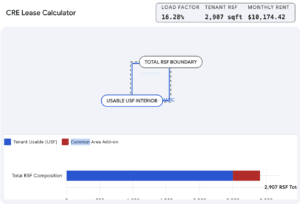
A new tech startup wants to lease a suite in your building. You measure the inside of their suite, and their USF is 2,500 sq. ft.
When drafting the lease, the tenant will be quoted and billed based on 2,907 RSF, even though they can only place desks in 2,500 sq. ft.
(Note: To help visualize how these numbers interact, I have included an interactive calculator below where you can test different building scenarios.)
Why the Load Factor is a Major Deal Parameter
In a competitive market like Orange County, the Load Factor can make or break a deal. Tenants are becoming increasingly savvy, and they will compare the efficiency of your building against your competitors.
High Load Factor (18% – 25%+)
Class A office buildings generally have higher load factors. Tenants are paying for prestige—grand marble lobbies, expansive shared conference centers, and upscale restroom facilities.
-
The Pitch: When marketing a space with a 20% load factor, your leasing team must heavily sell the amenities. The tenant needs to feel that the 20% upcharge is providing them with a recruiting advantage and a premium corporate image.
Low Load Factor (5% – 12%)
Industrial flex spaces and older, bare-bones office parks boast low load factors.
-
The Pitch: This is a pure efficiency play. You are selling the tenant on the fact that they are only paying for the space they actually use. A 5,000 RSF suite in a building with an 8% load factor will feel significantly larger inside than a 5,000 RSF suite in a building with a 20% load factor.
The BOMA Standard: Keeping it Honest
If a tenant disputes your square footage calculations, the argument is usually settled by deferring to the BOMA Standards.
The Building Owners and Managers Association (BOMA) International establishes the universally accepted rules for measuring commercial space. BOMA regularly updates its standards (the most recent major update for office buildings was in 2017) to account for modern architectural trends, such as shared outdoor balconies or expansive tenant amenity centers.
When you purchase a commercial property or prepare to market a major vacancy, it is highly recommended to hire an architect or a professional space planner to conduct a “BOMA-certified measurement.” This provides you with a defensible, certified document that eliminates ambiguity during lease negotiations. If a tenant’s broker asks, “How did you arrive at this RSF?”, handing them a BOMA-certified floor plan instantly shuts down the debate.
The Financial Impact: A Huntington Beach Scenario
Let’s look at why understanding these metrics is critical for your bottom line.
Imagine two competing professional office buildings on Edinger Avenue. Both are asking $3.50 per RSF / month.
A medical tenant is looking for exactly 3,000 sq. ft. of usable space (USF) to build out their examination rooms.
Building A (The Efficient Building):
-
Has a Load Factor of 12%.
-
Tenant’s RSF = 3,000 $\times$ 1.12 = 3,360 RSF.
-
Monthly Rent = 3,360 $\times$ $3.50 = $11,760.
Building B (The Amenity-Heavy Building):
-
Has a Load Factor of 22%.
-
Tenant’s RSF = 3,000 $\times$ 1.22 = 3,660 RSF.
-
Monthly Rent = 3,660 $\times$ $3.50 = $12,810.
Over a standard 5-year lease term, Building B will cost the tenant $63,000 more than Building A, despite the base rent ($3.50) and the physical footprint (3,000 USF) being identical.
If you are the owner of Building B, you must ensure your common areas are pristine, modern, and highly functional, otherwise, the tenant will quickly realize they are paying a $63,000 premium for a dusty lobby and outdated elevators.
Integrating Square Footage into Your Lease Strategy
Understanding the math is only the first step. The way you apply these numbers to your leasing strategy dictates the long-term value of your asset.
As we discussed in our foundational piece, The Ultimate Guide to Huntington Beach Commercial Property Management, the strength of your lease contracts is the lifeblood of your property’s valuation.
When drafting your lease agreements:
-
Be Explicit: Never use the generic term “square footage.” The lease must explicitly state the Usable Square Footage, the Rentable Square Footage, and the Load Factor percentage used to bridge the two.
-
Define the Common Areas: Clearly outline what constitutes the common areas in your specific building. If you plan to add a new shared fitness center next year, does your lease allow you to recalculate and increase the Load Factor for existing tenants? (Typically, leases lock in the RSF for the duration of the term, but “re-measurement clauses” can be negotiated).
-
Pro-Rata Share: The RSF is what determines a tenant’s “Pro-Rata Share” of the building’s operating expenses in a Triple Net (NNN) lease. If your RSF math is wrong, you will under-bill your tenants for property taxes and insurance, eating directly into your Net Operating Income.
Conclusion
Whether you are looking to acquire a new industrial asset or reposition a retail center, precise measurement is the bedrock of commercial real estate underwriting. By understanding the critical distinction between what a tenant uses and what a tenant rents, you empower yourself to negotiate stronger leases, accurately market your vacancies, and confidently maximize the yield of your Huntington Beach portfolio.