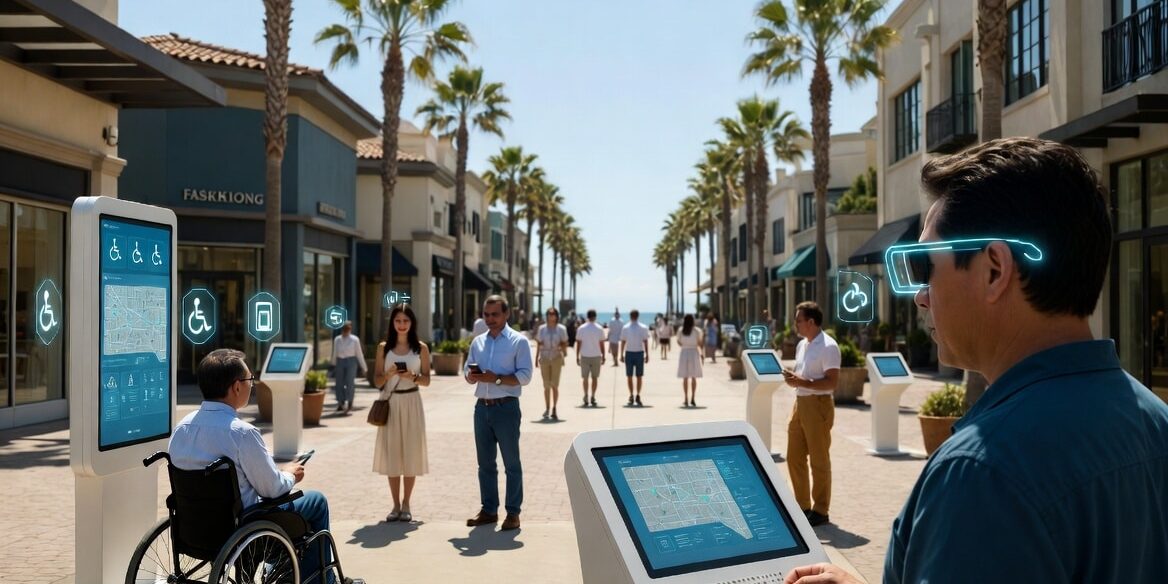
In the heart of Orange County, California, Newport Beach stands as a premier destination for luxury shopping, waterfront dining, and upscale lifestyle experiences. Iconic shopping centers such as Fashion Island, The Bluffs, and Corona del Mar Plaza attract millions of visitors annually, blending coastal charm with world-class retail. However, behind the polished facades and vibrant retail environments lies a critical responsibility: ensuring that these spaces are accessible to everyone, including individuals with disabilities. As federal and state regulations evolve, shopping center owners and operators in Newport Beach are increasingly turning to advanced technology to achieve and maintain accessibility compliance. This comprehensive guide explores how technology is transforming accessibility in Newport Beach shopping centers, the legal framework driving these changes, practical implementation strategies, real-world benefits, challenges, and future trends.
The Importance of Accessibility in Shopping Centers
Accessibility is not merely a legal checkbox; it is a fundamental human right that promotes inclusion, equality, and dignity for all individuals. According to the World Health Organization, over one billion people worldwide live with some form of disability, a figure projected to increase with aging populations. In the United States, the Centers for Disease Control and Prevention (CDC) estimates that approximately 61 million adults—about 1 in 4—live with a disability. In Orange County, with its diverse and aging demographic, ensuring barrier-free environments in public spaces like shopping centers is essential for community well-being and economic vitality.
For shopping centers, accessibility directly impacts customer experience, foot traffic, and revenue. A welcoming environment encourages longer visits, repeat business, and positive word-of-mouth. Conversely, non-compliance can lead to costly lawsuits, reputational damage, and lost opportunities. In Newport Beach, where tourism and local spending drive the economy, accessible shopping centers contribute to the city’s reputation as an inclusive coastal haven.
Key barriers traditionally faced by individuals with disabilities in shopping centers include:
- Physical obstacles such as uneven pathways, high counters, narrow aisles, and inaccessible restrooms.
- Sensory challenges for those with visual, auditory, or cognitive impairments.
- Navigational difficulties in large, multi-level complexes.
- Limited access to information in alternative formats.
Technology offers powerful solutions to dismantle these barriers, turning compliance from a burden into a strategic advantage.
Legal Framework Governing Accessibility in California and Newport Beach
Accessibility compliance in the United States is primarily governed by the Americans with Disabilities Act (ADA) of 1990, a landmark civil rights law that prohibits discrimination against individuals with disabilities in public accommodations, including shopping centers. Title III of the ADA applies to privately owned retail spaces, requiring them to remove architectural barriers where “readily achievable” and provide auxiliary aids and services.
In California, the state maintains some of the strictest accessibility standards in the nation through the California Building Code (CBC), Title 24, and the Unruh Civil Rights Act. The CBC incorporates ADA requirements but often exceeds them with more stringent construction and alteration standards. For instance, California’s disability access laws mandate detailed specifications for ramps, doorways, parking spaces, signage, and restroom facilities.
Newport Beach, as part of Orange County, adheres to these state and federal mandates while also following local building permits and inspections enforced by the City of Newport Beach’s Community Development Department. Recent updates to accessibility guidelines, including the 2022 CBC revisions and ongoing DOJ (Department of Justice) interpretations of ADA web and digital accessibility, emphasize that compliance extends beyond physical structures to digital interfaces, wayfinding systems, and customer service tools.
Notable legal developments include:
- ADA Web Accessibility Lawsuits: Courts have increasingly ruled that websites and mobile apps associated with public accommodations must be accessible, often citing the lack of alt text, keyboard navigation, and screen reader compatibility.
- California’s ADA Defense Funding: While some states have passed laws to curb “drive-by” lawsuits, California remains a hotspot for accessibility litigation, with shopping centers frequently targeted.
- 2024-2025 Regulatory Updates: Enhanced focus on electric vehicle (EV) charging station accessibility, autonomous delivery integration, and AI-driven customer support.
Failure to comply can result in injunctive relief, monetary damages (including statutory minimums under the Unruh Act of $4,000 per violation), attorney fees, and corrective action plans. Proactive technology integration helps mitigate these risks while enhancing operational efficiency.
How Technology is Revolutionizing Accessibility Compliance
Modern technology provides scalable, cost-effective, and user-centric solutions for accessibility. Shopping centers in Newport Beach are at the forefront of adopting these innovations, driven by both regulatory pressure and competitive differentiation.
1. Digital Wayfinding and Navigation Systems
Large shopping centers like Fashion Island span hundreds of thousands of square feet with multiple levels, parking structures, and outdoor areas. Traditional static maps fall short for users with mobility, visual, or cognitive challenges.
GPS-enabled indoor navigation apps utilize Bluetooth beacons, Wi-Fi triangulation, and augmented reality (AR) to provide turn-by-turn directions. For example:
- Apps like Google Maps Indoor or custom solutions integrated with Apple Maps allow users to locate accessible entrances, elevators, and restrooms in real time.
- Beacons and IoT sensors placed strategically throughout the mall detect user proximity and deliver personalized audio or haptic feedback via smartphones.
- AR overlays on mobile devices can highlight accessible routes, avoiding stairs or construction zones.
In Newport Beach, several high-end retail complexes have piloted beacon-based systems that integrate with parking guidance, alerting drivers to van-accessible parking spaces and providing seamless navigation from vehicle to store.
Benefits:
- Reduces anxiety for first-time or infrequent visitors.
- Supports users with visual impairments through voice-guided navigation.
- Generates valuable anonymized data for optimizing traffic flow and maintenance.
2. Assistive Technologies for Sensory Impairments
Technology addresses visual, auditory, and cognitive barriers effectively:
- Screen Reader Compatibility and Digital Signage: Websites, tenant directories, and interactive kiosks must comply with WCAG 2.1 or 2.2 standards (Web Content Accessibility Guidelines). High-contrast displays, text-to-speech features, and braille-compatible interfaces are becoming standard.
- Hearing Assistance Systems: Induction loop systems, FM or infrared assistive listening devices, and real-time captioning via apps like Ava or Google Live Transcribe ensure clear communication at customer service desks, events, and announcements.
- Visual Alert Systems: Flashing lights synchronized with fire alarms or public address systems for deaf or hard-of-hearing individuals.
- Cognitive Support Tools: Simplified interfaces, pictogram-based apps, and AI chatbots that offer step-by-step guidance in plain language.
Newport Beach shopping centers are incorporating these into common areas and individual stores, often partnering with organizations like the Lighthouse for the Blind or the Hearing Loss Association of America for testing and feedback.
3. Smart Parking and Mobility Solutions
Accessible parking remains one of the most litigated areas under the ADA.
- Smart parking systems use sensors and cameras to monitor availability of accessible stalls, displaying real-time information on digital boards or mobile apps. Reservations for van-accessible spaces can be integrated with valet services.
- EV charging stations designed with accessible heights, clear floor space, and route connectivity.
- Autonomous shuttles or mobility scooters equipped with GPS and obstacle detection for on-site transportation.
- Drone or robot-assisted delivery to vehicles for shoppers with mobility limitations, reducing the need to navigate long distances.
In Orange County, initiatives aligned with California’s aggressive EV adoption goals have led to accessible charging infrastructure that exceeds minimum requirements, including longer cords and lowered controls.
4. AI and Machine Learning for Proactive Compliance Monitoring
Artificial intelligence is shifting accessibility from reactive fixes to predictive maintenance:
- Computer vision systems mounted on ceilings or integrated into security cameras automatically detect blocked accessible routes, improperly placed signage, or occupied accessible restrooms.
- IoT sensor networks monitor door pressures, ramp slopes, elevator functionality, and lighting levels, alerting facility managers to deviations before they become violations.
- Predictive analytics analyze foot traffic patterns, maintenance logs, and incident reports to prioritize upgrades.
- Chatbots and virtual assistants powered by natural language processing (NLP) provide 24/7 support, answering accessibility-related queries and guiding users.
Some Newport Beach properties have implemented AI dashboards that generate compliance reports for annual audits, significantly reducing legal exposure.
5. Inclusive E-Commerce and Hybrid Shopping Experiences
The rise of omnichannel retail means accessibility must extend to online platforms:
- Accessible websites and apps with proper ARIA labels, sufficient color contrast, and keyboard-only navigation.
- Virtual shopping tours using 360-degree videos or VR that simulate in-person experiences for those unable to visit physically.
- Curbside pickup and contactless options optimized for accessibility, including voice-activated ordering and delivery to accessible parking spots.
- AI-powered recommendation engines that factor in user preferences for accessible routes or product locations.
During the post-pandemic era, Newport Beach retailers have accelerated these integrations, ensuring seamless transitions between digital and physical spaces.
Case Studies: Technology in Action in Newport Beach and Orange County
While specific proprietary implementations vary, several trends are evident in Orange County’s premier retail destinations:
Fashion Island, one of Newport Beach’s flagship open-air centers, has invested in comprehensive digital mapping and beacon technology. Visitors can now use a dedicated app to navigate from the parking garage directly to accessible entrances and restrooms, with options for audio descriptions and large-print directions. Facility managers report fewer complaints and improved guest satisfaction scores.
Smaller centers like The Bluffs and those in Corona del Mar have adopted modular IoT solutions for cost-effective compliance. Sensors track elevator wait times and restroom availability, while integrated apps provide real-time status updates.
County-wide, collaborations between mall operators, technology providers (such as Cisco, IBM, or specialized accessibility firms like UsableNet), and disability advocacy groups have led to pilot programs testing haptic feedback wearables and AI-driven crowd management that avoids overwhelming sensory environments.
These examples demonstrate that technology adoption is not limited to mega-malls but scales effectively across different property sizes and budgets.
Implementation Strategies for Shopping Center Operators
Successfully integrating technology for accessibility compliance requires a structured approach:
- Conduct Comprehensive Audits: Begin with ADA/Title 24 compliance assessments covering physical, digital, and operational elements. Engage certified access specialists (CASp) familiar with Newport Beach regulations.
- Develop a Technology Roadmap: Prioritize solutions based on high-impact areas (e.g., navigation, parking) and budget. Consider phased rollouts starting with pilot zones.
- Partner with Experts: Collaborate with accessibility technology vendors, local universities (such as UC Irvine’s tech programs), and disability organizations for user testing and validation.
- Staff Training and Change Management: Train employees on using new systems and responding to accessibility needs. Foster a culture of inclusion through regular workshops.
- Measure and Iterate: Use analytics to track usage, satisfaction, and compliance metrics. Conduct annual reviews and update systems as regulations evolve.
- Budget Considerations: Initial investments in beacons, sensors, and software can range from tens of thousands to millions depending on scale. However, ROI is realized through reduced litigation, higher occupancy, increased dwell time, and enhanced brand loyalty.
Funding opportunities, including grants from California’s disability access programs or federal tax incentives for barrier removal, can offset costs.
Benefits Beyond Compliance
Technology-driven accessibility delivers multifaceted advantages:
- Economic Gains: Studies by the U.S. Department of Labor indicate that accessible businesses capture a larger share of the disability market, estimated at $1 trillion in disposable income annually in the U.S. In tourist-heavy Newport Beach, this translates to substantial revenue potential.
- Customer Loyalty: Inclusive experiences foster emotional connections and positive reviews on platforms like Yelp and Google.
- Operational Efficiency: Automated monitoring reduces manual inspections and downtime.
- Innovation Leadership: Early adopters position themselves as forward-thinking leaders in Orange County’s competitive retail landscape.
- Social Impact: Contributing to a more equitable community enhances corporate social responsibility (CSR) profiles and attracts talent.
Quantitative data from similar implementations nationwide shows 15-30% increases in visit duration and repeat visits among users with disabilities when technology supports seamless access.
Challenges and Considerations
Despite the promise, integration faces hurdles:
- Cost and ROI Uncertainty: Smaller tenants or older properties may struggle with upfront expenses.
- Technical Integration: Legacy systems in established Newport Beach centers can complicate deployment of modern IoT and AI solutions.
- Privacy Concerns: Collecting location data via beacons raises GDPR/CCPA compliance issues; transparent policies and anonymization are essential.
- User Adoption: Not all individuals with disabilities are tech-savvy; hybrid approaches (technology + human support) are necessary.
- Rapidly Evolving Standards: Keeping pace with WCAG updates, new DOJ rules, and California-specific amendments requires ongoing vigilance.
- Equity Across Tenants: Ensuring uniform standards across diverse retailers demands strong lease agreements and management oversight.
Operators must balance innovation with practicality, starting with user-centered design principles.
Future Trends in Accessibility Technology for Shopping Centers
Looking ahead to 2027 and beyond, several exciting developments are poised to further transform Newport Beach shopping centers:
- 5G and Edge Computing: Enabling faster, more reliable real-time navigation and sensor data processing.
- Advanced AI and Computer Vision: More sophisticated obstacle detection, emotion-aware crowd management, and personalized accessibility profiles.
- Wearable and Implantable Tech Integration: Smart glasses with object recognition, haptic vests for navigation, or direct neural interfaces in the longer term.
- Metaverse and Extended Reality (XR): Fully immersive virtual malls accessible from anywhere, complete with haptic feedback for tactile experiences.
- Sustainable and Inclusive Design: Solar-powered sensors, eco-friendly materials in assistive devices, and universal design principles embedded from the planning stage.
- Regulatory Technology (RegTech): Automated compliance platforms that self-audit against evolving laws using natural language processing of legal documents.
With California’s leadership in both technology innovation (Silicon Beach influence) and progressive disability rights, Newport Beach is well-positioned to become a model for accessible retail environments nationwide.
Conclusion: Building Truly Inclusive Shopping Experiences
Integrating technology into accessibility compliance is no longer optional for shopping centers in Newport Beach, Orange County. It represents a convergence of legal necessity, ethical responsibility, and smart business strategy. By embracing digital wayfinding, assistive tools, AI monitoring, smart parking, and inclusive digital platforms, property owners can create environments where every visitor—regardless of ability—feels welcome, empowered, and valued.
The journey requires investment, collaboration, and commitment, but the rewards extend far beyond avoiding lawsuits. Inclusive shopping centers strengthen communities, boost economies, and reflect the progressive spirit of coastal California. As technology continues to advance, Newport Beach’s retail destinations have the opportunity to lead by example, proving that accessibility and excellence in retail can—and must—go hand in hand.
For shopping center operators in Newport Beach seeking to begin or enhance their accessibility technology initiatives, the time is now. Consult with local experts, engage with the disability community, and invest in solutions that not only meet today’s standards but anticipate tomorrow’s expectations. In doing so, these iconic venues will continue to thrive as vibrant, welcoming hubs for all residents and visitors in Orange County.