In the complex calculus of Orange County real estate acquisition, high-net-worth buyers obsess over the tangible metrics. They underwrite the square footage, they audit the foundation, and they ruthlessly negotiate the price per foot.
However, they frequently ignore the single most powerful factor dictating their daily quality of life: the psychological environment of the urban grid.
Amateur real estate agents unlock the front door, show the buyer the newly renovated kitchen, and ask, “Can you see your family living here?” They treat the property line as the absolute edge of the buyer’s universe.
This is a fundamental failure of advisory.
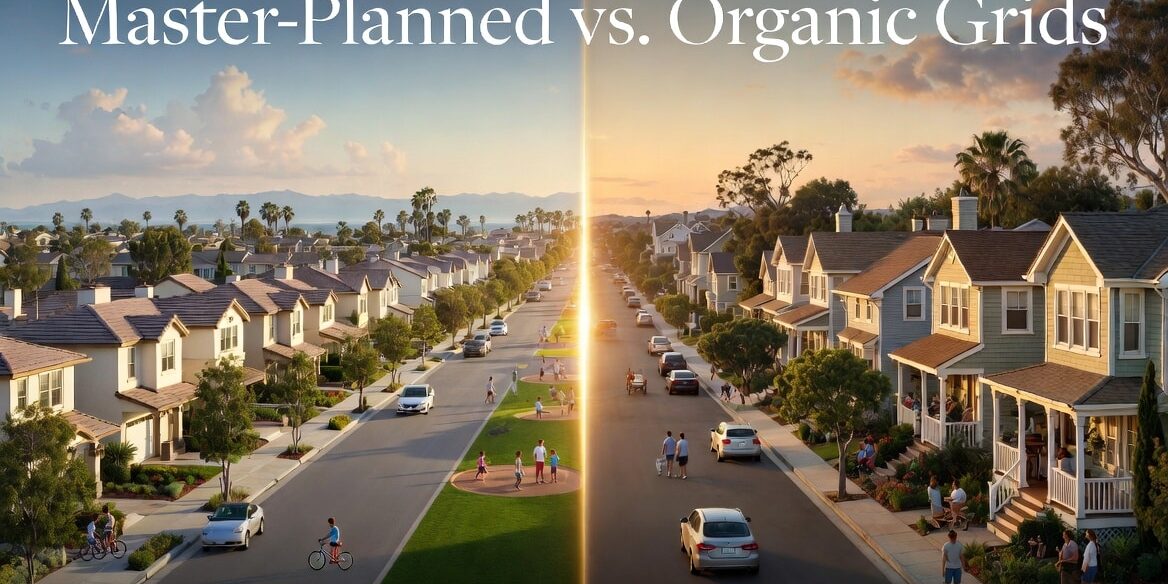
You do not just live inside your house; you live inside the neighborhood matrix. The moment you pull out of your driveway, the urban planning of your specific zip code begins to assert absolute control over your daily mental state. In Orange County, the residential landscape is violently divided into two diametrically opposed psychological environments: the heavily fortified Master-Planned Grid and the eclectic, unpredictable Organic Grid.
Buying the right house in the wrong grid will result in immediate, suffocating buyer’s remorse. At The Malakai Sparks Group, we view urban planning as a measurable lifestyle amenity. Here is the definitive, institutional-grade guide to decoding neighborhood psychology, auditing your family’s tolerance for chaos, and selecting the grid that perfectly aligns with your operational reality.
1. The Master-Planned Fortress: Weaponized Predictability
For the CEO, the surgeon, or the high-volume entrepreneur whose professional life is defined by high-stakes chaos, the home must serve as a frictionless sanctuary. For this demographic, the Master-Planned Grid is the ultimate psychological retreat.
When you acquire a master-planned corporate estate in Irvine or an ultra-luxury, guard-gated compound in Newport Beach, you are buying into an environment engineered for absolute predictability.
-
The Visual Purity: Every tree is planted at the exact same interval. The streetlights match the mailboxes. The sidewalks are perfectly manicured, and the roads curve in mathematically optimized sweeps designed to slow traffic and maximize park frontage.
-
The Psychological Benefit: This hyper-regulated uniformity significantly reduces cognitive load. You never have to worry about a neighbor parking a dilapidated RV on the street, painting their house neon blue, or launching a noisy auto-repair hobby in their driveway. The Master Association explicitly bans visual friction.
-
The Bureaucratic Tax: The cost of this serenity is your autonomy. You are living inside a corporate structure. If you wish to plant a rosebush or change the color of your front door, you must submit a formal architectural application to a committee of your neighbors. For the hyper-independent buyer, this level of micromanagement quickly transforms a sanctuary into a bureaucratic prison.
2. The Organic Grid: Architectural Anarchy and Cultural Soul
On the opposite end of the psychological spectrum lies the Organic Grid. These are the neighborhoods that grew naturally over decades, entirely devoid of a massive corporate developer dictating the aesthetic.
When you purchase a historic, walkable cottage in Seal Beach or a sweeping architectural masterpiece in Laguna Beach, you are buying into the Organic Grid.
-
The Cultural Vibrancy: These neighborhoods possess undeniable “soul.” You will find a hyper-modern, glass-and-steel compound sitting directly next door to a 1920s Spanish bungalow, which sits next door to a heavily wooded, mid-century surf shack. The streets do not perfectly align, the lot sizes fluctuate wildly, and the architecture is fiercely individualistic.
-
The Psychological Benefit: The Organic Grid attracts creatives, entrepreneurs, and high-net-worth purists who demand absolute architectural freedom. You own the dirt, and subject only to basic city zoning, you can execute your vision without begging an HOA for permission.
-
The Logistical Chaos: The psychological threat of the Organic Grid is unpredictability. If you buy a high-density, surf-side asset in Huntington Beach or a value-add duplex in Costa Mesa, you must tolerate the friction. Your neighbor might have an overgrown lawn. Parking will be highly contested. The streets will be messy, active, and loud. If visual disorder triggers your anxiety, the cultural soul of the neighborhood will never compensate for the daily stress of the street.
3. The Privacy vs. Proximity Paradox
The layout of the grid directly dictates the social mechanics of your family. You must align the neighborhood’s urban planning with how you prefer to interact with humanity.
-
The Inward-Facing Estate: The Master-Planned grids of South County are inherently “inward-facing.” The homes are designed to draw you into the private backyard. You pull into your three-car garage, the heavy door closes, and you retreat to your private pool. It is an architecture of isolation.
-
The Outward-Facing Community: Conversely, if you target a harbor-centric vacation asset in Dana Point or a bluff-top retreat in San Clemente, the grid is “outward-facing.” Front porches are utilized. Neighbors walk their dogs to the local coffee shop. The physical density forces proximity, fostering a hyper-social, interactive environment. You must mathematically audit whether you want to know your neighbors’ names or never see them at all.
4. The Transition Zones: The Suburban Hybrid
For the buyer who cannot tolerate the chaotic friction of the coast, but refuses to submit to the militarized bureaucracy of Irvine or Newport Coast, elite operators identify the “Transition Zones.”
These are the established, legacy grids that offer massive square footage with minimal governance.
If a client seeks the ultimate hybrid, we pivot their capital toward a sprawling suburban legacy hold in Fountain Valley or a multi-acre equestrian compound in San Juan Capistrano. These areas feature wide, predictable, tree-lined streets and massive lots that mimic the serenity of a Master Plan, but because they were built decades ago, they are completely devoid of aggressive HOAs. You secure the psychological comfort of the suburban grid without sacrificing your architectural sovereignty.
5. The Pre-Acquisition Grid Audit
How do we ensure our clients acquire the correct psychological environment? We do not rely on the MLS description. We execute a Grid Audit.
Before we allow a client to enter a multi-million-dollar escrow, we physically and legally map the friction of the street.
-
We audit the CCRs (Covenants, Conditions, and Restrictions) of the neighborhood. If a client owns commercial vehicles or has teenage drivers, we ensure the street parking regulations will not trigger a daily logistical war.
-
We drive the grid at 7:00 AM, 3:00 PM, and 9:00 PM. A street that looks like a serene paradise during a Tuesday morning open house can transform into a paralyzed, high-decibel nightmare during the afternoon school run or weekend tourist surge. We expose the reality of the grid before the capital is deployed.
Conclusion: Audit the Street, Not Just the House
In the high-stakes arena of Orange County real estate, the psychological weight of your neighborhood will eventually supersede the aesthetic beauty of your home.
Amateur real estate agents sell the countertops. They ask their clients if they like the flooring, and completely fail to ask if they have the psychological tolerance for the neighborhood’s municipal infrastructure. They lead their clients directly into lifestyle incompatibility.
Elite real estate advisors underwrite the environment.
Over 14 years of operating in the trenches, we have mastered the micro-cultures of Orange County’s most complex urban grids. At The Malakai Sparks Group, we are your lifestyle architects. We decode the Master-Plans, we navigate the Organic Grids, and we ensure that your multi-million-dollar acquisition provides the exact psychological environment your family requires to thrive.