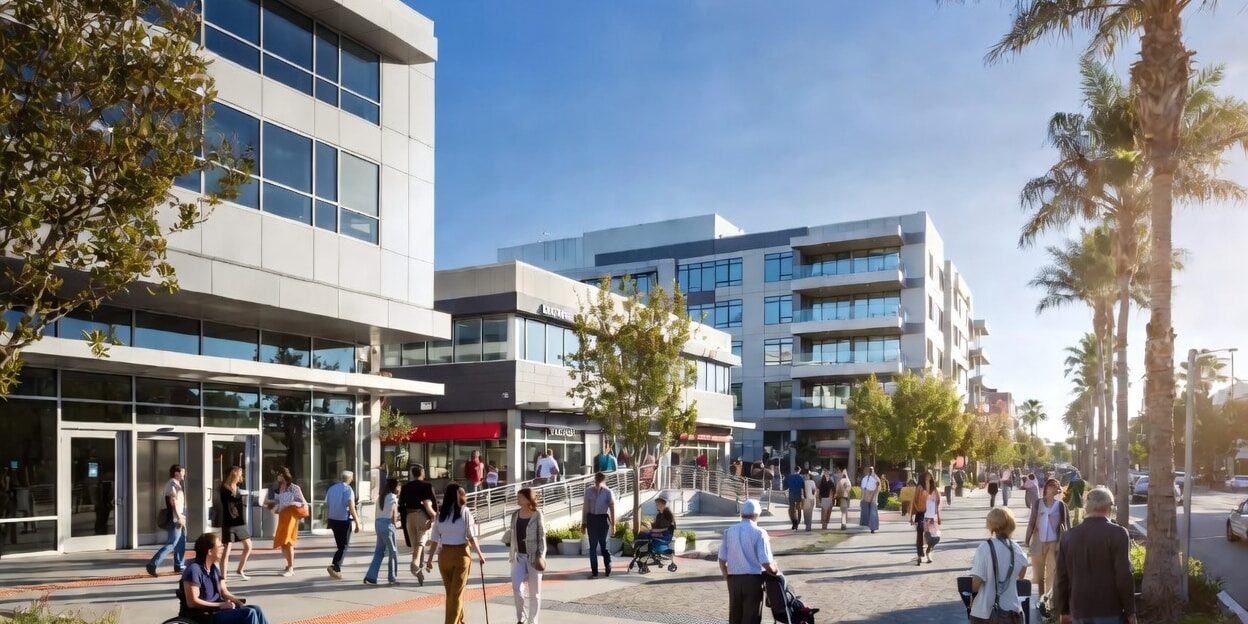
In the dynamic real estate landscape of Anaheim, Orange County, mixed-use developments represent a powerful strategy for creating vibrant, walkable communities that blend residential, commercial, retail, and entertainment spaces. Projects like the ambitious OC Vibe—a 100-acre master-planned campus around the Honda Center featuring over 2,500 residences, dining, entertainment venues, and 20 acres of open space with accessible trails—highlight how integrated developments can drive economic growth while serving diverse populations.
However, success in these projects hinges on more than prime location near attractions like Angel Stadium, ARTIC transit hub, or Disneyland-adjacent areas. Accessibility compliance—rooted in the Americans with Disabilities Act (ADA), California Building Code (CBC) Chapter 11B, Fair Housing Act (FHA), and state laws like the Fair Employment and Housing Act (FEHA)—emerges as a critical driver of long-term Return on Investment (ROI). Far from being a mere regulatory burden, proactive accessibility integration reduces legal risks, broadens market appeal, enhances tenant retention, and can unlock financial incentives, ultimately boosting property values and operational profitability.
This comprehensive guide explores why accessibility compliance is essential for mixed-use developments in Anaheim, details key requirements, quantifies risks of non-compliance, outlines strategies to maximize ROI, and provides actionable insights for developers, investors, and property managers operating in Orange County.
Understanding Accessibility Compliance in California Mixed-Use Projects
Mixed-use developments in Anaheim combine residential units with commercial spaces (retail, offices, restaurants) and public amenities. Each component triggers specific accessibility obligations:
- Federal ADA (Titles II and III): Applies to public accommodations and commercial facilities. New construction and alterations must follow the 2010 ADA Standards for Accessible Design. Existing facilities require barrier removal when “readily achievable.” Public areas like retail storefronts, lobbies, and common spaces must provide accessible routes, parking, entrances, restrooms, and signage.
- California Building Code (CBC) Chapter 11B: Often stricter than federal ADA, this governs accessibility for public buildings, commercial facilities, and public housing. It mandates detailed technical requirements for paths of travel, detectable warnings, elevators, ramps, doorways, and more. For alterations, “path of travel” upgrades may be required up to 20% of the project cost in certain cases.
- Fair Housing Act (FHA) and FEHA: Cover multifamily residential portions. “Covered multifamily dwellings” (buildings with 4+ units, or ground-floor units in non-elevator buildings) built after specific dates must include adaptable features like accessible routes into units, usable kitchens/bathrooms, reinforced walls for grab bars, and accessible common areas. In California, new multifamily construction typically requires at least 5% of units fully accessible for mobility disabilities and 2% for hearing/vision impairments, with additional state mandates for parking, pools, and paths of travel.
In Anaheim, local zoning (e.g., Mixed-Use Zone standards and Objective Design Standards for multifamily/mixed-use) layers on requirements for site planning, pedestrian circulation, and landscaping that support accessibility. Orange County’s Housing Elements emphasize provisions for accessible housing for persons with disabilities, including in urban activity centers designated for high-intensity mixed-use.
For mixed-use projects, residential and commercial components must each comply independently, while shared elements (parking, entrances, plazas) require integrated accessible design. Projects near transit like ARTIC or in areas like the Platinum Triangle benefit from “complete streets” approaches that enhance multimodal accessibility.
The High Cost of Non-Compliance: Why Ignoring Accessibility Erodes ROI
Non-compliance poses severe financial and reputational risks, particularly in litigious California. Anaheim and Orange County properties face the same pressures as the broader state.
-
Lawsuits and Penalties: Under the ADA, the Department of Justice can impose civil penalties up to $75,000 for a first violation and $150,000 for subsequent ones. California’s Unruh Civil Rights Act treats ADA violations as state law breaches, allowing statutory damages of $4,000 per violation (potentially per visit or instance), plus attorney fees and costs. Plaintiffs need not prove actual damages or provide pre-litigation notice, leading to “drive-by” or serial lawsuits targeting minor issues like improper slopes, faded signage, or inadequate parking.
Defense costs, settlements (often $5,000–$20,000+ per case, or far more for complex projects), retrofits, and lost revenue during disputes can total hundreds of thousands or millions. Joint and several liability means owners, developers, managers, architects, and contractors all share risk.
-
Operational Impacts: Inaccessible properties deter a significant market segment. Approximately 26% of U.S. adults have disabilities; in California and Orange County, this includes large populations with mobility, sensory, or cognitive needs. Non-compliant mixed-use developments suffer higher vacancy rates, lower rental/sales premiums, and reduced foot traffic in commercial spaces. Tenant turnover increases, and negative reviews or word-of-mouth harm branding.
-
Missed Opportunities in Anaheim’s Market: With booming mixed-use activity (e.g., proposals converting office space to housing in OC Vibe or infill projects near Metrolink), non-compliance can delay entitlements, increase holding costs, and undermine competitiveness against compliant peers that command higher rents and property values.
Studies and industry analyses show that accessibility lawsuits have proliferated in California, with some plaintiffs and firms filing hundreds of cases. For mixed-use projects involving public accommodations, the exposure multiplies across retail, residential common areas, and amenities.
How Accessibility Compliance Drives ROI in Anaheim Mixed-Use Developments
Proactive compliance transforms potential costs into strategic advantages, directly enhancing financial returns through several mechanisms:
-
Risk Mitigation and Cost Avoidance: Early integration during design prevents expensive change orders or post-construction retrofits. A Certified Access Specialist (CASp) inspection provides legal protections in California, such as potential stays in litigation or reduced damages if good-faith efforts are documented. Planning for compliance from the outset is far cheaper than remediation—barrier removal in existing facilities can be “readily achievable” but scales up dramatically in large mixed-use sites.
-
Market Expansion and Higher Demand: Accessible designs appeal to a broader demographic, including aging Baby Boomers, families with strollers, and tourists visiting Anaheim’s attractions. In multifamily portions, fully accessible or adaptable units command premium rents or faster leasing. Commercial spaces (retail, dining) see increased patronage from disabled consumers and their companions. Inclusive properties often achieve lower vacancy rates and stronger tenant retention due to perceived quality and community focus.
-
Property Value and Rental Premiums: Mixed-use projects with strong accessibility often realize 8.5%–17% price premiums over single-use properties in urban settings, partly due to walkability and inclusivity synergies. Transit proximity (common in Anaheim developments near ARTIC) amplifies this when paired with accessible paths. Investors favor compliant assets for their resilience against regulatory changes and lawsuits, potentially lowering cap rates and increasing exit values.
-
Operational Efficiencies and Tenant Satisfaction: Features like wider doorways, lever handles, automatic doors, and accessible routes benefit all users, reducing maintenance complaints and liability from slips/falls. In mixed-use settings, seamless integration (e.g., accessible plazas and trails in OC Vibe-style projects) fosters vibrant “live-work-play” environments that boost overall occupancy and ancillary revenue from retail/entertainment.
-
Financial Incentives and Tax Benefits:
- Federal Disabled Access Credit: Small businesses (≤30 employees or ≤$1M revenue) can claim 50% of eligible expenses (up to $10,250, max $5,000 credit annually) for accessibility improvements.
- Barrier Removal Deduction (IRC §190): Up to $15,000 annual deduction for qualified architectural barrier removal.
- Anaheim-specific incentives: Density bonuses, gap financing, and prioritization for affordable housing projects that incorporate accessibility. State programs and Low-Income Housing Tax Credits (LIHTC) often favor inclusive designs.
These can offset upfront costs significantly, improving net ROI.
-
Reputation and Community Relations: In Orange County, where housing elements stress accommodations for persons with disabilities, compliant developers build goodwill with local governments, residents, and advocacy groups. This can expedite approvals and attract partnerships for large-scale projects like those in the Platinum Triangle.
Industry experts note that accessible multifamily and mixed-use properties enhance long-term profitability through diversification of income streams, reduced legal exposure, and alignment with evolving consumer preferences for inclusive spaces.
Strategies for Maximizing ROI via Accessibility in Anaheim Projects
Developers can turn compliance into a competitive edge with these best practices:
- Early Planning and Expert Involvement: Engage CASp inspectors, accessibility consultants, and architects familiar with CBC 11B and ADA during conceptual design. Conduct accessibility audits for any existing structures on-site. Integrate universal design principles (e.g., zero-step entrances, adaptable kitchens) that exceed minimums for broader appeal.
- Holistic Site and Building Design: Prioritize accessible routes connecting parking, entrances, residential units, commercial spaces, and amenities. Ensure parking meets or exceeds ratios (with van-accessible spaces), restrooms comply with fixture clearances, and signage uses high-contrast tactile elements. In mixed-use, separate secure residential open space from public plazas while maintaining overall connectivity.
- Phased Implementation and Budgeting: Allocate 1–5%+ of project costs for accessibility (varies by scale). Use value engineering that preserves compliance. For alterations, calculate path-of-travel obligations carefully to avoid disproportionate costs.
- Leverage Technology and Materials: Incorporate smart features like automatic doors, adjustable counters, and audio/visual alarms. Select durable, slip-resistant materials for high-traffic areas.
- Ongoing Maintenance and Monitoring: Post-construction, implement regular CASp re-inspections and staff training. Document compliance efforts to strengthen legal defenses.
- Marketing Accessibility as a Feature: Highlight inclusive design in leasing/sales materials. Target niche markets (e.g., seniors, veterans with disabilities) while appealing to mainstream buyers seeking modern, thoughtful developments.
- Partnerships and Incentives: Work with Anaheim’s Housing and Community Development Department for density bonuses or financing when including affordable accessible units. Explore state/federal tax credits to reduce effective costs.
For projects like Anaheim/Ball Mixed Use or Canyon-specific plans, embedding accessibility supports goals of sustainable, transit-oriented growth.
Challenges and Considerations Specific to Anaheim/Orange County
Anaheim’s booming entertainment and transit hubs create unique opportunities but also constraints: high land costs, seismic considerations, noise from freeways/airports, and integration with existing infrastructure. Mixed-use in areas like Katella Avenue Corridor or near the Santa Ana River requires careful coordination for accessible pedestrian networks.
Housing Elements in Orange County and Anaheim emphasize special needs housing, including for developmental disabilities, underscoring the demand for barrier-free designs. Developers must navigate local objective design standards that complement state/federal accessibility rules.
While upfront costs may rise slightly, the long-term avoidance of litigation (prevalent in California) and enhanced market positioning in a competitive Southern California market deliver superior ROI.
Conclusion: Accessibility as a Smart Investment in Anaheim’s Future
In Anaheim and Orange County, mixed-use developments thrive when they create inclusive environments that welcome everyone. Maximizing ROI through accessibility compliance is not just about meeting legal minimums—it’s about future-proofing investments against lawsuits, capturing broader demand, securing incentives, and building resilient, high-value assets in a region defined by innovation and tourism.
By prioritizing early compliance, universal design, and ongoing vigilance, developers can transform regulatory requirements into differentiators that drive higher occupancy, premium pricing, lower risk, and stronger community impact. As projects like OC Vibe reshape Anaheim into a year-round destination, those embracing accessibility will lead in both profitability and livability.
For developers eyeing opportunities in the Platinum Triangle, Anaheim Canyon, or beyond, consulting local experts in CASp inspections and California accessibility law is a prudent first step. In a market where inclusivity equals opportunity, accessibility-compliant mixed-use developments don’t just comply—they excel.