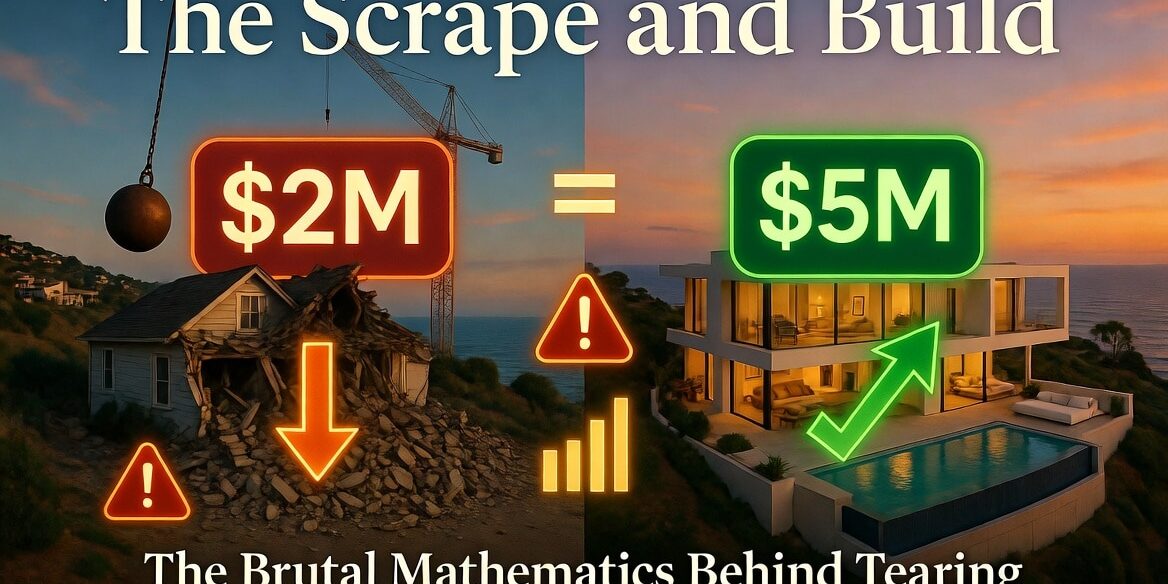
In the highest tiers of Orange County real estate, the most intoxicating fantasy is the “Scrape and Build.”
An ambitious buyer or novice investor locates a dilapidated, 1950s teardown sitting on an incredible parcel of coastal or suburban dirt. They pull out a napkin and run the amateur mathematics: “I buy the dirt for $2,000,000. I spend $1,500,000 to build a brand-new, 4,000-square-foot house. I sell it for $5,000,000. I just made a $1,500,000 profit.”
This napkin math is exactly what drives amateur developers into catastrophic bankruptcy.
In the reality of Southern California custom construction, you are never just paying for dirt and lumber. You are paying for bureaucratic friction, hazmat abatement, holding costs, and a massive, invisible network of “soft costs” that will violently drain your liquidity before the first shovel ever hits the ground.
At The Malakai Sparks Group, we view ground-up development not as a construction project, but as a high-risk financial model. Here is the definitive, institutional-grade guide to underwriting a teardown, decoding the true cost per square foot, and surviving the brutal mathematics of the Scrape and Build.
1. The Cost of “Zero” (Demolition and Abatement)
The first mathematical error the amateur makes is assuming that buying a $2,000,000 property means they are starting at zero. You are not starting at zero; you are starting in the negative.
Before you can build, you must physically and legally erase the existing structure.
-
The Hazmat Tax: If you purchase a value-add duplex in Costa Mesa or a historic, walkable cottage in Seal Beach built prior to 1980, you cannot simply bring in a bulldozer. State law mandates a forensic environmental inspection. You will almost certainly find asbestos in the drywall mud, lead in the paint, and toxic mastics under the flooring. You must hire specialized Hazmat abatement teams to surgically dismantle the interior at a staggering premium before general demolition can begin.
-
The Haul-Off: Demolishing the home, ripping up the 60-year-old concrete slab, disconnecting the city sewer laterals, and trucking hundreds of tons of debris to the landfill will routinely cost $40,000 to $70,000. You are burning massive amounts of capital simply to acquire a flat patch of dirt.
2. The Soft Cost Hemorrhage (Before the Shovel Hits)
Amateur developers budget exclusively for “Hard Costs” (wood, concrete, plumbing, paint). They completely ignore the “Soft Costs”—the intellectual and bureaucratic capital required to legally build in Orange County.
If you want to build a sweeping architectural masterpiece in Laguna Beach or an ultra-luxury, guard-gated compound in Newport Beach, your Soft Costs will frequently consume 15% to 20% of your total construction budget.
-
The Entitlement Gauntlet: You must hire elite architectural firms, structural engineers, and Title 24 energy consultants. You must pay for geotechnical soil boring to prove the dirt can support the weight of the new mega-mansion.
-
City Impact Fees: Orange County municipalities weaponize new construction. To pull your permits, the city and local school districts will levy massive “Impact Fees” to offset the burden your new, massive home places on their infrastructure. Soft costs can easily exceed $150,000 to $250,000 before a single piece of lumber is delivered to the site.
3. The “Cost Per Square Foot” Illusion
When the amateur buyer asks a general contractor, “How much to build?” they are often quoted an enticingly low figure like “$300 per square foot.”
This is builder-grade fiction.
If you are scraping a sprawling suburban legacy hold in Fountain Valley or a master-planned corporate estate in Irvine to build a $5,000,000 exit, the market absolutely will not tolerate a $300/sqft build. That budget buys you vinyl windows, fiberglass showers, and hollow-core doors.
-
The Luxury Reality: To command a premium, eight-figure valuation, you must execute at a true Coastal Contemporary or custom spec standard. You need Fleetwood pocketing doors, Sub-Zero appliances, Level 5 smooth drywall, and wide-plank European Oak. In the post-2020 supply chain landscape, a true high-end custom build easily commands $500 to $800+ per square foot. Your $1.5M construction budget just violently escalated to $2.8M.
4. The Carrying Cost Timebomb (Time is Debt)
The silent killer of the Scrape and Build is the clock.
A massive, ground-up custom build in a highly regulated coastal city is not a 6-month flip. From the day you close escrow on the teardown to the day the city issues the final Certificate of Occupancy, you are realistically looking at a 24-to-36-month timeline.
-
The Burn Rate: During those two to three years, the property is generating zero income. If you purchased a harbor-centric vacation asset in Dana Point or a bluff-top retreat in San Clemente with a hard-money or construction loan, you are paying 9% to 12% interest only. You are paying $25,000 a year in property taxes on the dirt. You are paying exorbitant Builder’s Risk insurance premiums.
-
A 24-month hold can easily vaporize $300,000 to $400,000 in pure liquid carrying costs—money that the amateur investor never factored into their napkin math.
5. The Neighborhood Appraisal Ceiling
The final, fatal mistake is overcapitalizing the dirt.
Suppose you successfully navigate the permits, build a flawless 5,000-square-foot estate, and manage the supply chain perfectly. You are all-in for $4.5 million, expecting a $5.5 million exit.
However, if you executed this project on a high-density, surf-side asset in Huntington Beach or a multi-acre equestrian compound in San Juan Capistrano where the absolute highest recorded sale in the history of the neighborhood is $4,000,000, you are mathematically bankrupt.
You cannot force an institutional appraiser to validate a $5.5 million price tag simply because that is what it cost you to build it. The neighborhood dictates the ceiling, not your construction invoices. Elite developers strictly enforce the 70% Rule—the total cost of acquisition, demolition, hard costs, soft costs, and carrying costs must never exceed 70% to 75% of the ultra-conservative, deeply researched After Repair Value (ARV).
Conclusion: Underwrite the Friction, Protect the Margin
In the high-stakes world of custom Orange County development, the dirt is merely the entry fee; the execution is the entire investment.
Amateur real estate agents look at an old house and casually tell their clients, “You should just tear it down and build your dream home!” They sell the romance of a blank canvas while completely ignoring the crushing, multi-million-dollar math required to paint on it.
Elite real estate advisors underwrite the reality.
Over 14 years of operating in the trenches, we have guided the capitalization of Orange County’s most ambitious ground-up developments. At The Malakai Sparks Group, we are your financial architects. We calculate the soft costs, we project the carrying-cost burn rate, and we ensure that before you ever dispatch the bulldozers, your exit multiple is mathematically, aggressively, and permanently secured.