
In the high-stakes arena of Orange County commercial real estate, the industrial sector is the undisputed king. However, a dangerous misconception has taken root among independent landlords: the belief that all industrial square footage is created equal.
If you own a 50,000-square-foot concrete tilt-up in Anaheim or Irvine, you might assume that simply sweeping the floors and painting the office is enough to attract a premium tenant. Ten years ago, you would have been right. Today, you will be left with a vacant, obsolete building.
The most lucrative, highly coveted tenants in the market are 3PLs (Third-Party Logistics) companies. These are the logistical powerhouses that handle the warehousing, picking, packing, and shipping for massive e-commerce brands.
A modern 3PL does not operate with clipboards and manual pallet jacks. They operate multi-million-dollar ecosystems of autonomous robotics, automated sorting conveyors, and real-time inventory tracking software. If your physical building cannot support their digital infrastructure, they will not lease your space.
Here is the definitive guide to understanding the PropTech revolution in industrial real estate, auditing your asset’s infrastructure, and upgrading your Orange County warehouse to capture the 3PL whales.
1. The Power Prerequisite (3-Phase and Beyond)
The most immediate disqualifier for a legacy industrial building is its electrical capacity.
A 1980s warehouse in Fullerton was typically engineered with 400 to 800 amps of standard power. That was perfectly adequate to run the overhead fluorescent lights and a few forklift charging stations.
The Modern 3PL Requirement: Today’s logistics operators deploy fleets of Autonomous Mobile Robots (AMRs), massive automated sorting carousels, and high-velocity HVAC systems to keep their warehouse workers cool during the California summer.
-
To support this heavy machinery, a 3PL tenant absolutely mandates heavy-duty, 3-Phase power, often requiring 1,200 to 2,000+ amps.
-
If your building lacks this infrastructure, the tenant will demand that you, the landlord, pay for the massive electrical panel upgrade and the heavy trenching required to pull new lines from the local Southern California Edison transformer.
At L3 Real Estate, we audit the power capacity of your asset before we take it to market, allowing us to accurately underwrite the Capital Expenditure (CapEx) required to land a high-credit tenant.
2. The Floor Slab Specifications (FF/FL Ratings)
To an amateur landlord, a concrete floor is a concrete floor. To a 3PL deploying a fleet of autonomous forklifts in a Santa Ana distribution center, the concrete slab is the most critical piece of engineering in the building.
Modern robotics operate with millimeter precision. They navigate narrow aisles and lift pallets 30 feet into the air. If the concrete floor is warped, wavy, or uneven, the autonomous forklift will physically lean, crashing the mast into the racking system and destroying hundreds of thousands of dollars of inventory.
The Institutional Standard: When a 3PL’s representation broker tours your property, they will demand to see the slab’s FF (Floor Flatness) and FL (Floor Levelness) ratings.
-
Standard, legacy warehouses usually have an FF rating of 25.
-
A modern, tech-enabled 3PL requires a “Super Flat” floor with an FF rating of 50 or higher.
If your slab is inadequate, an elite asset manager will oversee the remediation process—deploying specialized contractors to laser-grind the high spots and apply epoxy self-leveling compounds to bring the floor up to the strict tolerances demanded by robotic infrastructure.
3. Connectivity and the “Dead Zone” Killer
A modern logistics operation is entirely data-driven. Every single barcode scan, every robotic movement, and every shipping label generation relies on instant, uninterrupted cloud connectivity.
If your Huntington Beach warehouse is built like a Faraday cage—with heavy concrete walls and a steel roof that block cellular signals—it is operationally worthless to a 3PL.
The Tech Upgrade: You cannot market a massive industrial shell today without verifying its telecommunications backbone.
-
Fiber Optics: The building must be pre-wired for redundant, high-speed fiber optic internet.
-
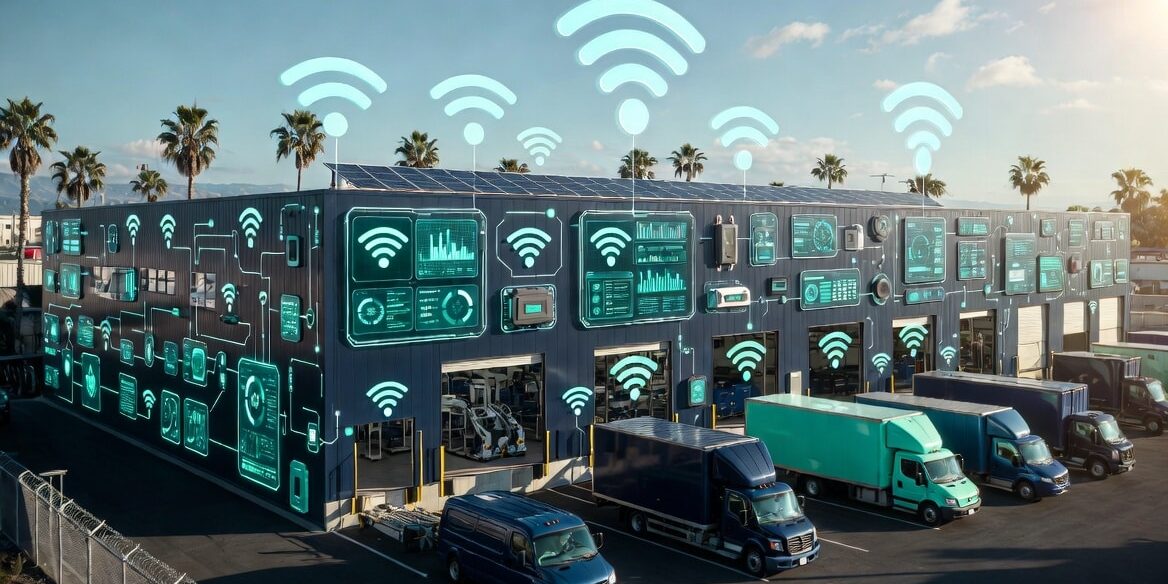
The Mesh Network Infrastructure: We frequently advise landlords to install structural mounting points and dedicated conduit lines along the ceiling trusses. This allows the incoming tenant to effortlessly drop in their enterprise-grade Wi-Fi mesh networks and RFID (Radio Frequency Identification) scanners, guaranteeing zero “dead zones” across the massive square footage.
4. Clear Height: Selling Cubic Feet, Not Square Feet
When an e-commerce brand hires a 3PL, the 3PL charges them based on how much inventory they can store. Therefore, a 3PL does not view your real estate in two dimensions; they view it in three dimensions. They do not lease square feet; they lease cubic feet.
-
The Obsolescence Trap: A legacy industrial building in Brea often features a “Clear Height” (the distance from the floor to the lowest hanging steel truss) of 16 to 18 feet. You can only stack inventory two or three pallets high.
-
The Premium Standard: Modern 3PLs mandate a minimum clear height of 28 to 36 feet. This allows them to install massive, six-tier vertical racking systems, mathematically doubling or tripling the amount of inventory they can store within the exact same footprint.
While you cannot easily raise the roof of an existing building, understanding the clear height allows L3 Real Estate to strategically position the asset. If your building has a lower clear height, we pivot our marketing strategy away from high-volume 3PLs and target manufacturing tenants or R&D firms who prioritize heavy power over vertical storage.
5. The ESG Mandate (Environmental, Social, and Governance)
Finally, securing a corporate 3PL tenant requires checking their corporate compliance boxes. Publicly traded logistics companies are under massive pressure from Wall Street to reduce their carbon footprint.
When they select a facility in San Clemente or Lake Forest, they actively prioritize buildings that help them meet their ESG goals.
-
Skylights and LEDs: Warehouses flooded with natural light via modern skylights and outfitted with motion-sensor LED fixtures drastically reduce the tenant’s electrical consumption.
-
EV Fleet Infrastructure: As delivery fleets transition to electric vehicles (EVs), landlords who proactively install heavy-duty EV charging conduit in the truck courts instantly jump to the top of the 3PL’s shortlist.
Conclusion: Don’t Market a Concrete Box
In the modern industrial market, the gap between “obsolete” and “institutional” is defined entirely by technology and infrastructure. If you are marketing a massive Orange County warehouse without aggressively highlighting its power capacity, its slab ratings, and its telecommunications backbone, you are leaving millions of dollars of Net Operating Income (NOI) on the table.
Over 14 years of operating in the trenches and overseeing a portfolio of more than 350 commercial properties, we have watched the logistics industry evolve from manual labor to autonomous robotics.
At L3 Real Estate, we speak the exact technical language of the 3PL tenant. We audit your building’s infrastructure, we execute the strategic CapEx upgrades, and we market the true, cubic-foot capabilities of your asset. We do not just lease your concrete; we position your property as the critical infrastructure required to power the global e-commerce machine.
Are you struggling to lease a large industrial vacancy, or are you preparing to bring a massive warehouse asset to the Orange County market? Contact our expert team today to discover how our specialized Costa Mesa property management and Newport Beach commercial strategies can definitively capture the most lucrative tenants in the industry.