In the hierarchy of Orange County commercial real estate, there are landlords who manage buildings, and there are institutional investors who simply hold the earth.
If you own a multi-tenant retail plaza in Costa Mesa or a sprawling industrial complex in Anaheim, you are constantly battling depreciation. Every single day, your roof is aging, your HVAC units are degrading, and your asphalt is cracking. You must constantly deploy Capital Expenditures (CapEx) to keep the physical structure alive.
But what if you could extract a massive, six-figure Net Operating Income (NOI) from your real estate without ever paying for a single repair, pouring a single yard of concrete, or even owning the building itself?
Welcome to the Commercial Ground Lease.
Historically reserved for massive banking conglomerates, elite university endowments, and aristocratic families, the ground lease is the ultimate vehicle for generational wealth transfer. Here is the definitive guide to understanding how ground leases work, protecting your “fee simple” interest from aggressive corporate developers, and engineering absolute, risk-free passive income across your Orange County portfolio.
1. The Mechanics of the Absolute NNN Ground Lease
A standard commercial lease dictates that the landlord provides the physical building, and the tenant pays to occupy it. A ground lease completely inverts this relationship.
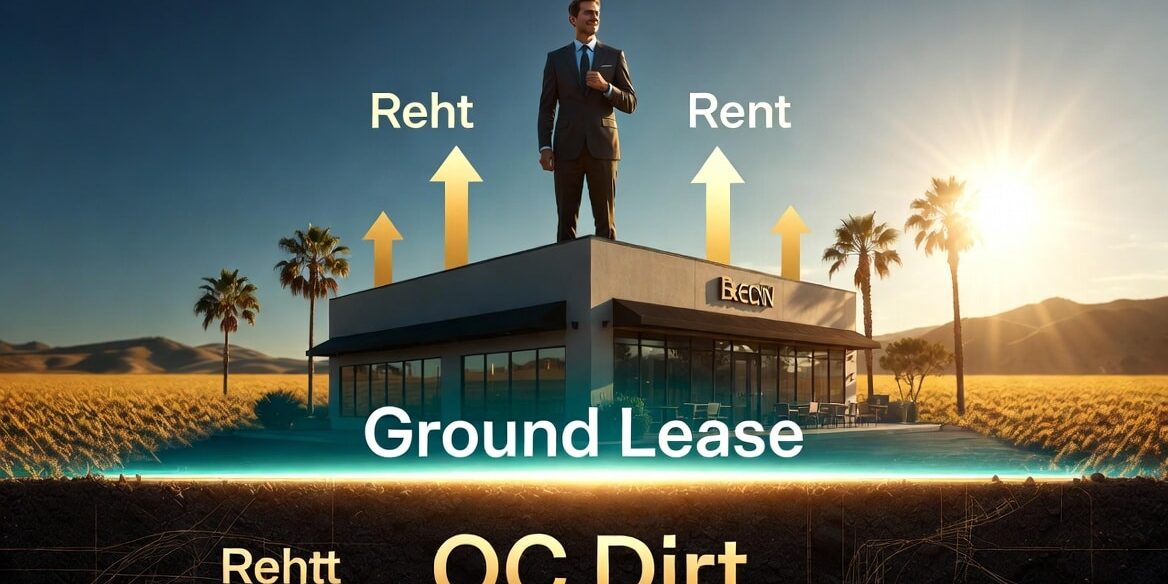
In a ground lease, the landlord provides nothing but the raw, unentitled dirt.
How the Transaction Works: Imagine you own a highly visible, vacant one-acre parcel on a major intersection in Irvine.
-
A national corporate tenant (such as a Chase Bank, a CVS Pharmacy, or an In-N-Out Burger) approaches you.
-
Instead of selling them the dirt, you execute a 20-to-99-year Ground Lease.
-
The tenant assumes 100% of the financial burden to entitle the land, trench the utilities, pour the foundation, and construct their multi-million-dollar corporate building on your dirt.
-
Every single month for the next half-century, they pay you a massive rent check simply for the privilege of sitting on your earth.
Because the corporate tenant built and owns the physical structure, the lease is classified as an Absolute NNN (Triple Net) agreement. The tenant pays all the property taxes directly to the county, carries all the insurance, and is 100% responsible for every single maintenance item. The landlord’s only operational responsibility is cashing the rent check.
2. The Reversionary Value (The Generational Wealth Transfer)
The most powerful financial mechanic of a ground lease is not the monthly rent; it is what happens when the lease finally expires.
In California real estate law, any permanent structure built on the land eventually becomes the legal property of the landowner. This is known as the Reversionary Interest.
When a 25-year ground lease with a national pharmacy chain in Newport Beach reaches its expiration date, the tenant has two choices:
-
They can aggressively negotiate a lease renewal at a new, top-of-market rental rate.
-
They can vacate the property.
If they vacate, they cannot take the building with them. Under the terms of the ground lease, the multi-million-dollar physical structure reverts entirely to the landlord, free and clear of any debt. You (or your heirs) just inherited a flawless, fully depreciable commercial building that you paid absolutely nothing to construct. You can immediately lease that existing building to a new tenant at a massive premium, skyrocketing the property’s capitalization rate.
3. The “Unsubordinated” Firewall (Protecting the Dirt)
While the financial upside of a ground lease is staggering, the legal execution is a notorious minefield. The single most critical negotiation point is the concept of Subordination.
To build a $3 million bank branch on your Fullerton dirt, the corporate tenant will likely need to secure a massive construction loan from a commercial lender. The lender will demand collateral. The tenant’s attorney will inevitably ask the landlord to “subordinate” their fee simple interest in the dirt to the tenant’s bank.
This is the ultimate trap. If you agree to subordinate the ground lease, you are allowing the tenant’s bank to place a mortgage lien directly on your dirt. If the tenant goes bankrupt halfway through construction and defaults on their loan, the bank will foreclose on the property, and you will lose your land entirely.
The Institutional Mandate: At L3 Real Estate, we operate under a strict, non-negotiable mandate: We never subordinate the fee simple interest. We draft strictly “Unsubordinated” ground leases. If the tenant defaults on their construction loan, the bank can repossess the half-built building, but they cannot touch the underlying dirt. If the project fails, the landlord legally evicts the tenant, terminates the lease, and keeps the land—along with whatever structural improvements the tenant managed to build before going bankrupt.
4. Structuring the Rent Escalations (Defeating Inflation)
A ground lease is a marathon, often lasting 40, 50, or even 99 years. If you lock into a flat rental rate today, inflation will completely destroy the purchasing power of that income over the next half-century.
A $10,000 monthly rent check might sound lucrative in Huntington Beach right now, but in the year 2060, it might barely cover a grocery bill.
Amateur landlords sign generic ground leases with weak, predictable 10% rent bumps every five years. Elite asset managers deploy highly aggressive, compounded Rent Escalation Clauses designed to outpace macro-economic inflation.
-
The CPI Hedge: We frequently tie the rent bumps directly to the Consumer Price Index (CPI). If hyperinflation hits the United States economy, your ground rent automatically skyrockets to match it, permanently protecting your NOI.
-
The Fair Market Value (FMV) Reset: For ultra-long-term leases (50+ years), we engineer an absolute “FMV Reset” at the 20-year or 25-year mark. We force an independent appraisal of the San Clemente land, ensuring that if Orange County real estate values have quadrupled over the last two decades, your rent instantly adjusts to reflect the new, massive value of your dirt.
5. The Casualty and Condemnation Clauses
When you do not own the building, you must legally dictate what happens if the building is destroyed.
If a catastrophic fire burns the tenant’s drive-thru restaurant to the ground in your Lake Forest property, who is responsible? If the lease is silent, the tenant might just take their insurance payout and abandon the rubble on your dirt.
The Operational Shield: We draft ironclad Casualty Clauses. The ground lease legally mandates that the tenant must carry massive replacement-cost insurance policies, naming the landlord as an additional insured. If the building burns down, the lease explicitly forces the tenant to use the insurance proceeds to immediately rebuild the structure, and they must continue paying their monthly ground rent without interruption while the construction is taking place.
Conclusion: Elevate Your Asset Class
In commercial real estate, there is a distinct evolution of an investor. You start by managing residential properties, you graduate to managing multi-tenant commercial buildings, and if you are highly sophisticated, you ultimately transcend management entirely and simply lease the dirt.
A commercial ground lease is not a landlord-tenant relationship; it is a high-level financial partnership with a corporate entity. It requires flawless legal drafting, a deep understanding of construction finance, and an unyielding defense of your fee simple equity.
Over 14 years in the trenches, managing a portfolio of more than 350 properties, we have learned that the greatest wealth is often generated by doing the least amount of physical work. At L3 Real Estate, we engineer these zero-stress, high-yield assets. We negotiate the unsubordinated terms, we structure the inflation-crushing rent escalations, and we ensure your Orange County dirt produces absolute, generational wealth for decades to come.
Are you sitting on vacant commercial land, or are you looking to execute a Pad-Crash and transition into a passive, ground-lease structure? Contact our expert team today to discover how our specialized Mission Viejo property management and Brea commercial strategies can definitively optimize your legacy.