If you own a sprawling retail center built in Orange County during the 1980s or 1990s, you likely possess a hidden, highly lucrative asset that is currently generating zero revenue.
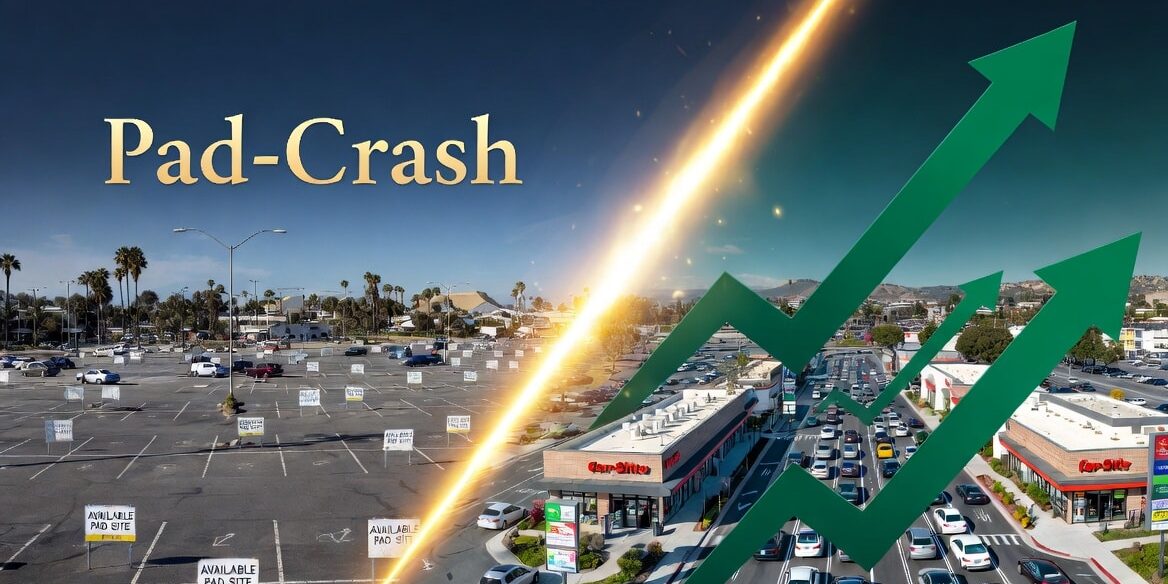
Take a drive through your own property in Huntington Beach or Fullerton. Look at the vast “sea of parking” situated closest to the main street. Decades ago, municipal zoning codes mandated massive parking ratios—often 5 or 6 spaces per 1,000 square feet of retail. Today, driven by the rise of e-commerce and ridesharing, consumer habits have drastically shifted. That massive asphalt footprint is fundamentally obsolete; it sits half-empty, doing nothing but racking up sweeping and slurry-seal expenses.
To an amateur landlord, that empty asphalt is a sunk cost. To an institutional asset manager, it is a blank canvas for a multi-million-dollar development strategy known as “The Pad-Crash.”
By legally carving out a small “pad” from your excess parking lot, you can execute a highly aggressive, high-yield ground lease with a national Quick Service Restaurant (QSR) or drive-thru coffee chain. Here is the definitive guide to understanding the drive-thru gold rush, navigating the entitlement minefields, and engineering pure, unadulterated Net Operating Income (NOI) out of your existing Orange County real estate.
1. The Drive-Thru Gold Rush
The commercial real estate landscape was permanently altered by the events of 2020. The restaurant industry realized that dining rooms are expensive liabilities, while drive-thru lanes are unshakeable, recession-proof profit centers.
Today, national corporate tenants—such as Starbucks, Dutch Bros, Raising Cane’s, and Chick-fil-A—are engaged in a brutal bidding war for premium drive-thru dirt in Orange County.
-
The Supply Squeeze: Ground-up development of a brand-new drive-thru in Costa Mesa or Newport Beach is incredibly difficult because there is simply no vacant land left.
-
The Landlord’s Leverage: Because the QSRs are desperate for high-visibility street frontage, they are willing to pay astronomical ground-lease rates. They do not need your existing retail suites; they just need 25,000 square feet of your underutilized parking lot facing the main arterial road.
2. The Financial Alchemy (Infinite Yield)
The financial beauty of a Pad-Crash is that it breaks the traditional rules of real estate acquisition.
Normally, to add $150,000 of NOI to your portfolio, you have to go out and buy a new $3 million building. With a Pad-Crash, your land acquisition cost is zero. You already own the dirt.
The Ground Lease Execution: You do not even have to build the restaurant. We execute an absolute Triple Net (NNN) Ground Lease.
-
You lease the raw asphalt to the national coffee chain for 15 to 20 years.
-
The corporate tenant spends $1.5 million of their own money to trench the utilities, pour the foundation, and build the physical drive-thru structure.
-
You collect $100,000+ in annual rent for dirt that was previously generating nothing.
Because you acquired the land years ago and invested zero CapEx into the vertical construction, the return on your invested capital is practically infinite. When it comes time to sell or refinance the Irvine center, you have mathematically forced millions of dollars of newly created equity into the total valuation of the property.
3. The Entitlement War: Queuing and Traffic
While the financial theory is flawless, the physical execution of a Pad-Crash is an engineering and bureaucratic gauntlet. You cannot simply paint a drive-thru lane onto your parking lot.
When we submit a Pad-Crash development plan to the city planners in Anaheim or San Clemente, their immediate, primary objection is always Traffic Queuing.
City governments are terrified of the “In-N-Out Effect”—where a highly successful drive-thru causes a line of cars to spill out of the parking lot and block a major city intersection.
The L3 Engineering Defense: We preemptively crush this objection. Before we ever approach the city, we hire specialized civil and traffic engineers to design an internal, high-capacity “stacking lane.” We mathematically prove to the Planning Commission that our pad design can comfortably queue 15 to 20 vehicles entirely within the boundaries of the private parking lot, ensuring zero impact on the municipal roadways. We turn a traffic liability into a highly controlled, entitled Conditional Use Permit (CUP).
4. Navigating the REA / CC&R Minefield
The city planner is not your only obstacle. The most dangerous threat to a Pad-Crash development usually comes from your own existing tenants.
If your Lake Forest shopping center is anchored by a massive national grocery store, their original 20-year lease likely includes a highly restrictive Reciprocal Easement Agreement (REA) or a set of CC&Rs (Covenants, Conditions, and Restrictions).
These legal documents often grant the anchor tenant absolute veto power over any modifications to the parking lot. The grocery store will argue that building a new coffee shop will steal their parking spaces and create annoying traffic for their shoppers. They will threaten to sue to stop the development.
The Institutional Negotiation: Amateur landlords surrender at the first threat of a lawsuit. Elite asset managers negotiate the carve-out.
-
We deploy a forensic parking demand study to mathematically prove to the anchor tenant that the center is currently over-parked and that the loss of 25 spaces will not violate their legal parking ratio minimums.
-
Furthermore, we sell the synergy. We prove that a high-volume morning coffee drive-thru generates massive cross-traffic for the grocery store’s morning bakery and floral departments.
We do not let legacy lease language paralyze your future wealth creation; we negotiate the waivers required to break ground.
5. Managing the “Construction Friction”
Building a new structure in the middle of an active, operating shopping center is a logistical nightmare. If the construction trenches block the main entrance to your Brea property for three months, your inline tenants will suffer massive drops in sales and immediately demand rent abatements.
A successful Pad-Crash requires military-grade operational phasing. We strictly mandate the general contractor’s staging areas. We force all heavy utility trenching and asphalt cutting to occur exclusively between the hours of 11:00 PM and 5:00 AM. We ensure that when your retail tenants open their doors for business the next morning, the drive aisles are plated, the dust is mitigated, and the center is fully operational. We construct the new asset without ever bleeding the cash flow of the existing rent roll.
Conclusion: Manufacture Your Own Equity
In commercial real estate, you cannot always wait for the market to hand you appreciation; sometimes, you have to manufacture it yourself.
Allowing prime, street-facing asphalt to sit empty while national corporate tenants are actively hunting for drive-thru locations is a massive operational failure. The dirt is already yours; you simply lack the tactical blueprint to monetize it.
Over 14 years in the trenches, overseeing a portfolio of more than 350 properties across Southern California, we have learned that the highest-yielding opportunities are often hidden in plain sight. At L3 Real Estate, we operate as both asset managers and ground-up developers. We underwrite the QSR ground leases, we battle the city planners for the queuing entitlements, and we negotiate the complex anchor-tenant waivers. We transform your empty parking spaces into permanent, high-yielding pillars of generational wealth.
Are you sitting on a massive, underutilized retail parking lot, or are you looking to aggressively add new NOI to a stabilized property? Contact our expert team today to discover how our specialized Mission Viejo property management and Orange commercial strategies can definitively execute your Pad-Crash development.