

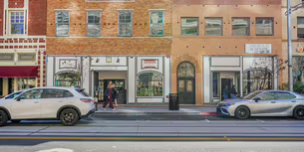
The City of Orange is a market defined by extremes. On one end of the spectrum, it is home to Old Towne Orange—the largest National Register Historic District in California, frozen in the 1920s and fiercely protected by local preservationists. On the other end, it houses the most advanced, high-density medical and technological corridor in the county, anchored by UCI Medical Center, St. Joseph Hospital, and CHOC.
For commercial property investors in 2026, this dichotomy creates incredible wealth-building opportunities, provided you have the operational bandwidth to manage them. You can acquire a 100-year-old brick restaurant in the Plaza, a state-of-the-art medical office building (MOB) on Main Street, and a heavy manufacturing facility on Batavia Street—all within the same city limits.
However, a “one-size-fits-all” approach to property management will fail spectacularly here. You cannot use standard retail leases in a historic district, and you cannot use standard HVAC vendors for a surgical center. Whether you are navigating the strict Design Review Committee in Old Towne or managing hazardous bio-waste protocols in the medical district, here is your definitive guide to maximizing your Net Operating Income (NOI) in the City of Orange.
Understanding Orange Commercial Zoning (Title 17)
The City of Orange utilizes a highly specific zoning code (Title 17) to ensure its massive medical and industrial engines do not cannibalize its historic residential and commercial core.
-
The Old Towne Historic District (O-T): This is the most heavily scrutinized zoning overlay in the city. If your commercial property sits within the one-square-mile radius of the Plaza, you are subject to extreme architectural and use limitations. The city actively curates the tenant mix here to preserve its “antique capital” and culinary reputation, meaning securing a Conditional Use Permit (CUP) for high-impact uses (like late-night bars) requires navigating intense neighborhood pushback.
-
Commercial Professional (C-P) & Public Institution (P-I): These zones dominate the southwestern edge of the city (The Medical Corridor). They are designed to support hospitals, clinics, and specialized medical offices. Properties here are heavily regulated regarding parking ratios and emergency vehicle access.
-
Industrial (M-1 & M-2): Stretching along the western border near the 57 Freeway and the Anaheim border, these zones accommodate heavy manufacturing, logistics, and automotive uses.
-
General Commercial (C-2 & C-3): Found primarily along the massive Tustin Street corridor, these zones support large-scale, daily-needs retail, shopping centers, and auto dealerships.
The Core Commercial Districts of Orange
Managing a commercial asset in Orange requires a hyper-localized strategy. The operational demands shift dramatically from neighborhood to neighborhood.
1. Old Towne Orange (The Plaza)
-
The Vibe: A bustling, incredibly charming historic center driven by Chapman University students, locals, and weekend tourists. It is famous for its independent restaurants, coffee shops, and boutique retail.
-
Management Focus: Historic preservation and intense parking logistics. Property managers must navigate unreinforced masonry (URM) seismic compliance, update century-old plumbing, and manage the city’s strict “Parking In-Lieu Fee” programs for tenants who cannot provide on-site parking.
-
2026 Outlook: As Chapman University continues its strategic expansion, the demand for student-oriented experiential retail and dining in the Plaza is at an all-time high. Landlords hold absolute pricing power here due to the zero-growth nature of the historic district.
2. The Medical Corridor (Main St & La Veta Ave)
-
The Vibe: The healthcare epicenter of Orange County. It is a dense, high-stakes environment dominated by hospital campuses and specialized outpatient facilities.
-
Management Focus: pristine ADA compliance, biomedical waste disposal logistics, and heavy HVAC load management. Medical tenants require 24/7 operational certainty; a failed air conditioning unit in a surgical suite can result in millions of dollars in liability.
-
2026 Outlook: With the ongoing multi-billion-dollar expansions of UCI Health and CHOC, the demand for specialized Medical Office Buildings (MOBs) in the immediate vicinity is staggering. Converting older, standard office spaces in this corridor into fully compliant medical suites is the most lucrative value-add play in the city.
3. West Orange Industrial (Batavia & Katella)
-
The Vibe: The gritty, highly functional industrial engine bordering the Honda Center and Anaheim’s Platinum Triangle.
-
Management Focus: Managing 18-wheeler supply chain logistics, executing complex Triple Net (NNN) reconciliations, and overseeing heavy power upgrades for advanced manufacturing tenants.
-
2026 Outlook: This sector is experiencing massive “spillover” demand from the nearby Anaheim and Fullerton industrial markets. Vacancy is functionally zero, allowing landlords to push aggressive lease renewals and pass all structural maintenance costs to the tenants.
4. The Tustin Street Corridor
-
The Vibe: A legacy arterial retail strip heavily populated by drive-thrus, big-box stores, and automotive services.
-
Management Focus: High-frequency CAM (Common Area Maintenance) repairs, security, and facade modernizations.
-
2026 Outlook: To meet State housing mandates, the city has identified aging retail centers along Tustin Street as prime targets for high-density, mixed-use residential redevelopment.
2026 Market Trends: The Historic vs. Modern Clash
Commercial owners in Orange are currently navigating two massive, opposing municipal forces.
| The Catalyst | Impact for Commercial Owners |
| The Chapman University Engine | The university’s footprint continues to expand, driving massive economic activity. Commercial owners near the campus are highly incentivized to pivot their retail mixes toward Gen Z consumer habits or utilize mixed-use zoning to provide off-campus student housing above ground-floor retail. |
| Strict Historic Enforcement | The city’s Design Review Committee (DRC) is fiercely protective. If you buy a building in Old Towne, you cannot simply change the paint color, swap out the window frames, or install modern signage without a grueling approval process. Your property manager must have established relationships at City Hall to get Tenant Improvements (TIs) approved without months of delays. |
| The “Med-Tech” Integration | The medical corridor is no longer just for doctors; it is attracting massive life science and health-tech startups. Managing these assets requires specialized infrastructure, including clean rooms, upgraded fiber-optic networks, and enhanced security protocols. |
Compliance: Navigating the DRC and Seismic Realities
In the City of Orange, code enforcement is not a suggestion; it is an active, aggressive reality.
-
Seismic Retrofitting (URM): If you own a historic brick building in the Plaza, the city and state mandate rigorous unreinforced masonry retrofitting. You must ensure your building’s structural supports are fully permitted and up to 2026 code, or risk massive liability and uninsurability.
-
ADA Upgrades in Historic Spaces: Converting a 1920s retail storefront into a modern, high-capacity restaurant triggers massive Americans with Disabilities Act (ADA) upgrades. Your property manager must know how to navigate the city’s building department to achieve compliance (like ramping and bathroom expansions) without destroying the historic fabric of the building that the DRC protects.
Why Local Management in Orange is Non-Negotiable
A generic property manager will fail in Orange because the city’s districts are too specialized. The vendor you hire to fix a roof on a Tustin Street strip mall is not legally qualified to work on a 1910 historic registry building, nor are they equipped to service a pressurized clean room on La Veta Avenue.
Partnering with a local Orange County commercial property manager provides:
-
The Dual-Vendor Network: We maintain active relationships with specialized historic preservation contractors and cutting-edge medical/bio-tech vendors, ensuring your asset is maintained flawlessly, regardless of its zoning.
-
DRC & Permitting Agility: We know exactly what the Design Review Committee expects. We prepare architectural renderings and TI plans that get approved the first time, keeping your tenants on schedule and minimizing vacancy downtime.
-
Medical Office Expertise: We have the operational bandwidth to manage the high-stakes demands of healthcare tenants, maximizing your NOI in the city’s most lucrative commercial corridor.
Protect your historic charm, capitalize on the massive medical boom, and maximize your cash flow by partnering with a team that truly understands the City of Orange commercial real estate market.