
Huntington Beach, California, often celebrated for its iconic pier, surf culture, and coastal lifestyle, also serves as a vital hub for logistics and industrial operations in Orange County. With approximately 16 million square feet of industrial inventory, the city has become an attractive location for warehouse and distribution centers. Its strategic position near the Interstate 405, proximity to the Ports of Los Angeles and Long Beach, and relatively affordable industrial rents compared to neighboring cities make it ideal for e-commerce fulfillment, third-party logistics (3PL), food distribution, and manufacturing support facilities.
In this competitive environment, effective signage and branding have emerged as more than aesthetic choices. They are powerful operational tools that enhance safety, boost productivity, improve wayfinding, ensure regulatory compliance, and strengthen corporate identity. For warehouse operators in Huntington Beach, well-designed signage systems can reduce picking errors, speed up truck loading/unloading, lower accident rates, and even help attract and retain talent in a tight labor market.
Unlike retail or office environments, warehouse signage must withstand heavy use, forklift traffic, dust, and the corrosive coastal salt air prevalent in Huntington Beach. At the same time, it must comply with the City of Huntington Beach’s strict signage regulations under the Zoning and Subdivision Ordinance (Chapter 233), which limit freestanding monument signs to 32–50 square feet depending on site size, require inclusion of street addresses, and emphasize clean, professional designs.
This article examines four compelling case studies from Huntington Beach warehouse and distribution centers that have successfully implemented advanced signage and branding strategies. These real-world examples (with names anonymized where necessary for privacy) demonstrate measurable returns on investment and offer valuable lessons for facility managers across Orange County.
The Strategic Role of Signage and Branding in Modern Warehouses
Before diving into the case studies, it’s important to understand why signage matters so deeply in distribution centers. Poor wayfinding can waste 20-30% of worker time as employees search for locations. Inadequate safety signage contributes to thousands of warehouse injuries annually. Meanwhile, strong corporate branding on buildings and interiors reinforces company culture and helps 3PL providers market their capabilities to potential clients.
Modern approaches combine traditional durable signage (vinyl, aluminum, reflective materials) with digital solutions, floor graphics, rack labeling, and integrated systems connected to Warehouse Management Software (WMS). In Huntington Beach’s coastal climate, material selection focuses on corrosion-resistant coatings and UV protection.
Case Study 1: Pacific Coast E-Commerce Fulfillment Center (450,000 sq ft Facility)
Located in the Huntington Commerce Center area near Bolsa Chica, this large e-commerce fulfillment operation faced significant challenges when it expanded in 2022. With over 400 employees across multiple shifts and peak season volumes exceeding 15,000 orders daily, the facility suffered from inefficient navigation, high new-hire onboarding times, and occasional safety incidents.
The management team partnered with a specialized industrial signage provider to implement a comprehensive “Smart Navigation System.” Exterior branding featured a large but code-compliant monument sign at the main entrance, incorporating the company logo, facility name, and address in bold, reflective lettering visible from the arterial road. Building facades received large-scale vinyl graphics with the company’s signature colors, creating strong brand presence without violating Huntington Beach height and size restrictions.
Inside the warehouse, the transformation was dramatic. High-visibility aisle and bay signage used oversized, color-coded hanging signs with large numerals and letters readable from 150 feet away. Rack labeling combined barcode, QR codes, and human-readable text, synchronized with the WMS. Floor markings included heavy-duty epoxy-based directional arrows, zone identifiers, and safety striping around high-traffic forklift paths.
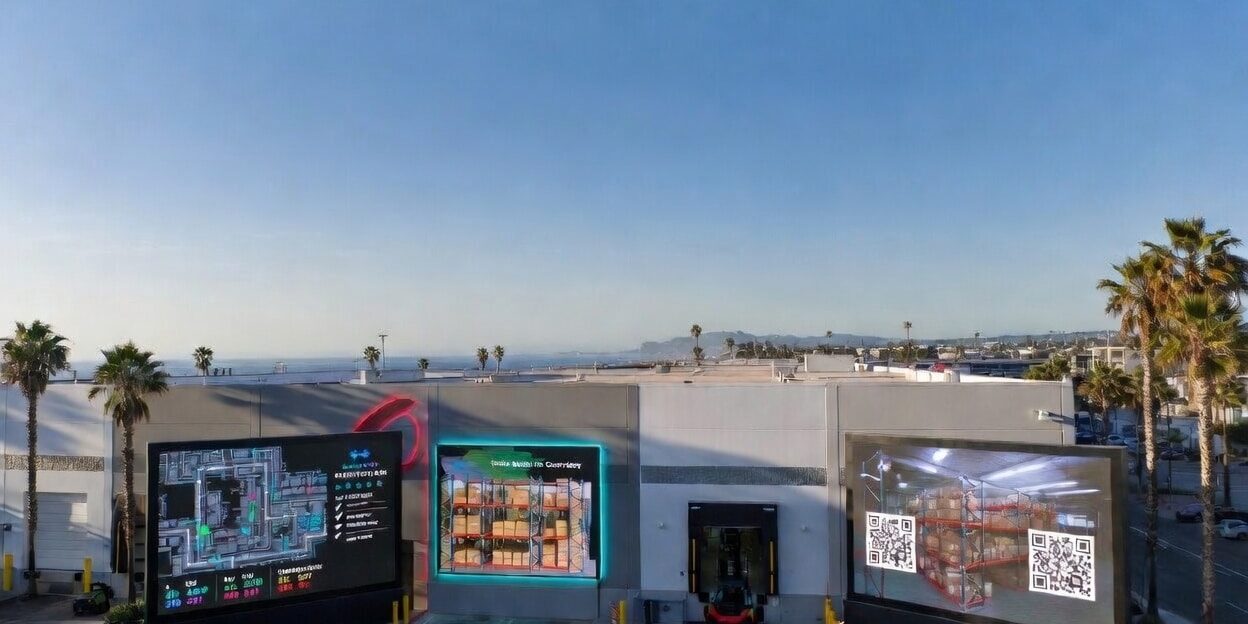
The most innovative element was the deployment of 45 digital signage screens strategically placed at major intersections and break areas. These screens displayed real-time inventory maps, shift-specific instructions, safety alerts, and even motivational branding messages.
Results after 18 months:
- Picking accuracy improved by 28%
- New employee onboarding time reduced by 45%
- Forklift-related near-misses dropped by 52%
- Employee satisfaction scores related to facility navigation rose from 61% to 89%
The project also enhanced brand perception among delivery drivers and visiting executives, turning the facility into a showcase for the company’s operational excellence.
Case Study 2: HB Logistics Partners – Multi-Tenant 3PL Campus (Multi-Building Complex)
HB Logistics Partners operates a 280,000 square foot multi-tenant 3PL campus in the Oak View-Newland submarket. Managing storage and distribution for over a dozen different clients presented unique branding challenges: each client wanted clear identification of their dedicated zones without creating visual chaos.
The solution involved a modular and flexible signage system. Exterior monument signage followed city code precisely – one primary sign per building cluster with neutral branding for the 3PL company, supplemented by smaller directional signs for major clients.
Internally, they installed a “Zone Branding Program.” Each client’s storage area received custom color schemes, logo accents on rack ends, and dedicated wayfinding pylons. These were designed as interchangeable panels, allowing rapid reconfiguration when client contracts changed. Safety signage remained consistent across the facility in high-visibility yellow and red, meeting OSHA and local fire code requirements.
Digital elements included interactive kiosks near employee entrances where temporary workers could scan badges and receive personalized maps showing their assigned client zone for the shift.
Key Outcomes:
- Client onboarding time for new accounts cut from 3 weeks to 4 days
- Cross-client picking errors reduced by 67%
- The professional, organized appearance helped the company win two major new contracts in 2024 and 2025, directly attributed to facility tours showcasing the branding system.
This case perfectly illustrates how thoughtful signage can turn a potential operational headache into a competitive advantage in the 3PL sector.
Case Study 3: Coastal Fresh Foods Distribution Center (Temperature-Controlled Facility)
Food distribution requires the highest standards of organization and safety. This 175,000 sq ft refrigerated and frozen warehouse near Goldenwest Street specializes in fresh produce and dairy products for regional grocery chains.
Prior to the signage upgrade, workers frequently entered incorrect temperature zones, leading to product quality issues and food safety concerns. Exterior branding used durable, marine-grade materials resistant to salt air, with clean white and blue tones reflecting the fresh product focus.
The interior solution emphasized clear temperature zoning. Large, illuminated signs marked “Refrigerated Zone,” “Frozen Section,” and “Dry Storage” with prominent temperature indicators and color coding (blue for cold, red for frozen). Floor graphics used specialized anti-slip coatings with directional arrows and hazard warnings. Aisle markers included both overhead hanging signs and ground-level reflective tape.
Special attention was given to hygiene and compliance signage – prominent handwashing stations, PPE requirements, and allergen awareness graphics met strict FDA and California food safety standards.
Measurable Improvements:
- Temperature zone compliance increased to 99.7%
- Product spoilage rates due to handling errors dropped by 41%
- Audit scores from major grocery clients improved significantly, leading to expanded contracts
The branding also created a professional, trustworthy image that reinforced the company’s reputation for quality and reliability in the competitive Southern California food supply chain.
Case Study 4: NextWave Robotics & Automation Distribution Center
One of the most forward-looking facilities in Huntington Beach, this 320,000 sq ft automated distribution center integrated robotics, autonomous guided vehicles (AGVs), and human workers. The challenge was creating signage and branding that worked for both humans and machines.
The design team created hybrid wayfinding solutions. Floor graphics featured high-contrast patterns and QR-like codes readable by both AGV cameras and human eyes. Aisle signage incorporated LED lighting that changed color based on operational status (green for normal flow, amber for maintenance).
Exterior branding featured modern, minimalist design with large building wraps using high-durability materials, making the facility stand out positively to passing traffic on major routes while remaining compliant with city regulations.
Digital integration was extensive: large screens displayed live system status, robot traffic patterns, and safety zones. The branding emphasized innovation, using futuristic fonts and dynamic visuals that reinforced the company’s tech-forward identity.
Results:
- Operational efficiency gains of 35% compared to traditional facilities
- 60% reduction in human-robot conflict incidents
- The striking visual identity helped attract top engineering talent in Orange County
Key Lessons and Best Practices from Huntington Beach Case Studies
Several common themes emerge from these Huntington Beach successes:
- Compliance First: All projects started with thorough review of Huntington Beach’s signage ordinance to avoid costly redesigns.
- Material Durability: Coastal conditions demand premium, corrosion-resistant materials.
- Hybrid Approach: Combining static, digital, and floor graphics delivers the best results.
- Data-Driven Design: Successful projects used utilization studies and employee feedback rather than assumptions.
- Brand as Experience: Strong signage turned functional spaces into brand assets that support marketing and recruitment.
Facilities that invested in professional signage saw average productivity improvements of 20-35% and significant safety gains.
Unique Challenges in Huntington Beach
Operators must navigate not only traffic from the 405 freeway but also city regulations that are stricter than some neighboring communities. Salt air accelerates material degradation, requiring more frequent maintenance. Proximity to residential neighborhoods in some industrial pockets demands visually appealing, low-glare designs that minimize light pollution.
The Future of Warehouse Signage in Orange County
Looking ahead, we can expect greater integration of IoT sensors, augmented reality wayfinding via mobile apps, and sustainable materials. As automation increases, signage will need to serve dual human-machine audiences seamlessly.
Conclusion
The case studies from Huntington Beach warehouses demonstrate that strategic signage and branding deliver far more than visual appeal. They drive measurable improvements in safety, efficiency, accuracy, and brand strength. For owners and operators of distribution centers in Orange County, investing in professional, code-compliant, and forward-thinking signage systems represents one of the highest-ROI upgrades available in today’s competitive logistics landscape.
As the industrial sector in Huntington Beach continues to grow, facilities that prioritize intelligent signage and cohesive branding will be best positioned for long-term success, operational excellence, and community integration.