
For the downsizing executive or the high-net-worth investor, acquiring a luxury condominium or townhome in Southern California is heavily romanticized.
The appeal is obvious: you want the lock-and-leave convenience. You trade the relentless upkeep of a sprawling suburban legacy hold in Fountain Valley or a multi-acre equestrian compound in San Juan Capistrano for a turn-key penthouse. You assume that by paying a $1,200 monthly Homeowners Association (HOA) fee, you are permanently insulated from structural liabilities, roof replacements, and exterior maintenance.
This is a devastating financial illusion.
When you buy into a condominium complex, you are not just buying a unit; you are legally acquiring a fractional share of a multi-million-dollar, unregulated corporation (the HOA). If that corporation has been mismanaged by a board of amateur volunteer neighbors for the last twenty years, you are actively buying their debt.
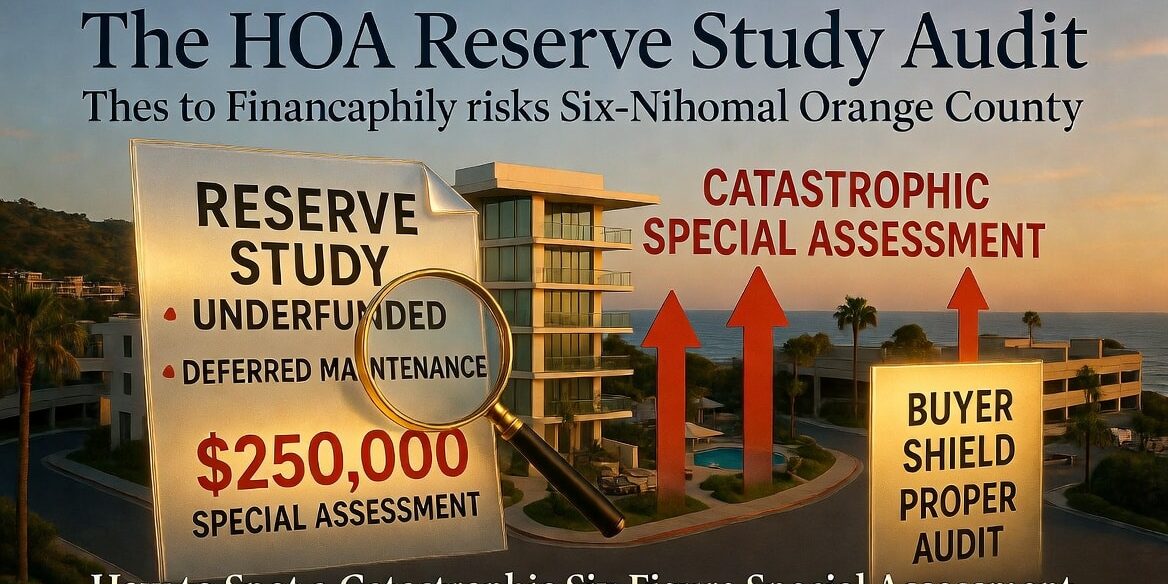
Amateur real estate agents look at an HOA’s operating budget, ensure the monthly dues fit the buyer’s debt-to-income ratio, and blindly advise their client to close escrow. Six months later, the roof fails, and the buyer is hit with a mandatory, non-negotiable $150,000 Special Assessment.
At The Malakai Sparks Group, we view condo acquisitions as corporate mergers. Here is the definitive, institutional-grade guide to decoding the HOA Reserve Study, spotting the “cheap dues” trap, and mathematically shielding your capital from corporate negligence.
1. The Percent Funded Metric (The True Health Score)
The single most critical document in a condominium acquisition is not the CC&Rs or the title report. It is the Reserve Study.
Under California law, HOAs are required to commission an independent engineering firm to assess the remaining useful life of every major component in the complex—the roofs, the elevators, the asphalt, the pool pumps, and the exterior stucco. The study then calculates exactly how much liquid cash the HOA needs in the bank today to replace those items when they inevitably fail.
-
The Safe Zone: A financially bulletproof HOA is 70% to 100% “Funded.” This means the corporation has actively hoarded enough cash to handle catastrophic repairs without ever asking the homeowners for an extra dime.
-
The Danger Zone: If you are targeting a high-density, surf-side asset in Huntington Beach or a harbor-centric vacation asset in Dana Point, and the Reserve Study indicates the HOA is only 15% or 20% funded, you are walking into a financial massacre. The HOA is mathematically insolvent. They know the roof is going to collapse in two years, and they know the bank account is completely empty.
2. The “Low HOA Dues” Trap
When amateur buyers tour a historic, walkable cottage in Seal Beach or an older attached unit, they actively celebrate when they find a complex with incredibly low monthly HOA dues.
“The unit down the street has $800 dues, but this one is only $350! What a deal!”
Elite real estate operators know that artificially low HOA dues are the loudest siren of corporate mismanagement. If a complex has not raised its dues to match inflation and construction costs over the last decade, it means the volunteer board of directors was too afraid of political backlash from their neighbors to do the right thing.
They kept the monthly dues cheap, but they systematically starved the Reserve Account. By the time you acquire your sweeping architectural masterpiece in Laguna Beach that sits within a poorly managed association, you are the one who will foot the bill for decades of their artificially cheap living.
3. The Special Assessment Strike (The Six-Figure Bill)
What happens when an HOA is 15% funded and the community’s aging plumbing system suffers a catastrophic, multi-unit failure?
The board issues a Special Assessment.
Because the reserve bank account is empty, the HOA calculates the $5,000,000 repair cost and divides it equally among the unit owners. You receive a letter in the mail demanding an immediate payment of $50,000, $100,000, or even $150,000.
-
The Legal Mandate: You cannot negotiate this bill. You cannot opt out. If you refuse or are unable to pay the assessment, the HOA possesses the legal authority to place a lien on your property and forcefully foreclose on your unit to recover the funds. We have watched amateur buyers lose their entire equity stake in a value-add duplex in Costa Mesa because their agent failed to audit the reserve study and warn them of an impending assessment.
4. The Fannie/Freddie Blacklist (Non-Warrantable Condos)
A mismanaged HOA does not just threaten your liquid cash; it threatens the fundamental resale value of your real estate.
If you are attempting to sell a master-planned corporate estate in Irvine or an ultra-luxury, guard-gated compound in Newport Beach organized as a condominium, the buyer’s lender will execute their own audit of the HOA. Institutional lenders (Fannie Mae and Freddie Mac) mandate that an HOA must allocate at least 10% of its annual operating budget directly into the reserve account.
-
The Blacklist: If the HOA fails this metric, or if there is active litigation against the builder for structural defects, Fannie Mae will label the entire complex as Non-Warrantable.
-
The Fallout: Traditional retail banks will instantly refuse to write mortgages for any unit in the building. Your buyer pool is violently restricted exclusively to all-cash buyers or hard-money loans, forcing you to liquidate the asset at a massive, punitive discount.
5. The 12-Month “Board Minutes” Interrogation
A Reserve Study tells you the math, but it does not tell you the politics. Board members frequently discuss impending, multi-million-dollar repairs months or years before they officially levy the special assessment.
How do we intercept this threat before our clients close escrow?
We demand the Trailing 12 Months of HOA Board Meeting Minutes.
If a client is acquiring a bluff-top retreat in San Clemente, we forensically read every single page of the board’s monthly executive session notes. We look for arguments about leaking roofs, quotes from elevator repair companies, or angry resident complaints regarding foundation settling. We uncover the corporate secrets the seller is desperately trying to hide, ensuring the client has the leverage to demand massive seller credits or simply walk away from a toxic liability.
Conclusion: Audit the Corporation, Then Buy the Condo
In the Orange County condo market, the paint on the walls and the view from the balcony are entirely irrelevant if the corporation governing the building is actively marching toward bankruptcy.
Amateur real estate agents act as glorified tour guides. They show the buyer the community gym, point out the new kitchen countertops, and blindly forward the HOA documents without ever reading the financial ledgers. They treat the purchase like a single-family home.
Elite real estate advisors act as forensic accountants.
Over 14 years of operating in the trenches, we have engineered the safe acquisition of Orange County’s most complex attached housing. At The Malakai Sparks Group, we are the auditors of your corporate exposure. We decode the Reserve Study, we interrogate the board minutes, and we ensure that your luxury condominium remains a true lock-and-leave asset, rather than a catastrophic financial trap.