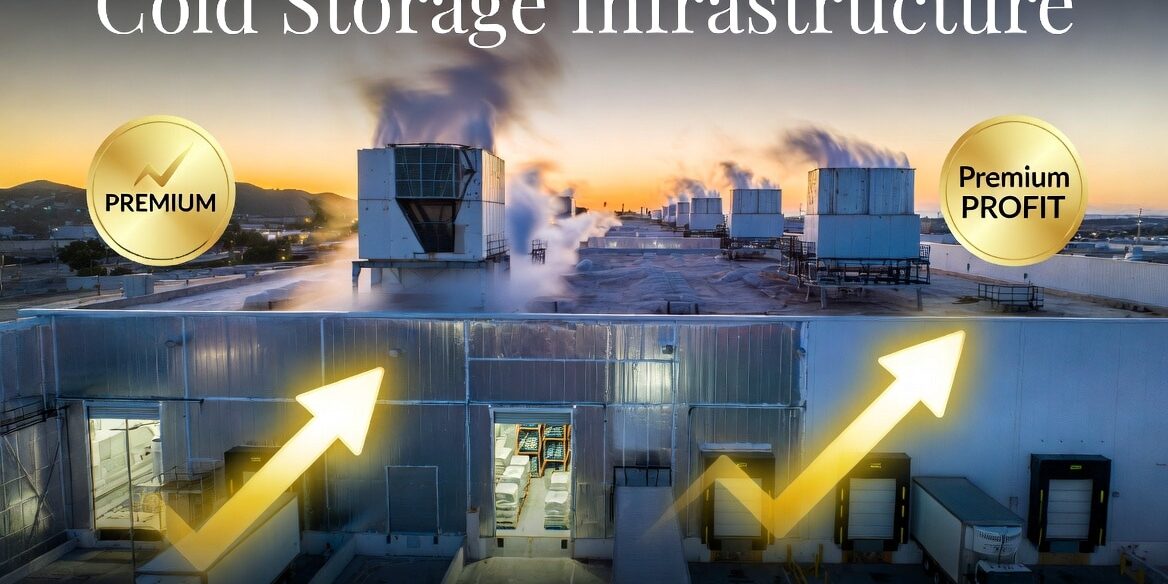
In the hyper-competitive arena of Orange County industrial real estate, amateur commercial brokers and retail investors view warehousing as a homogenous asset class. They look at a concrete tilt-up, calculate the square footage, and assume that every building operates under the same mathematical constraints. They believe that converting a standard dry warehouse into a “cold storage” facility simply requires installing a larger air conditioning unit.
This is a catastrophic, multi-million-dollar failure of engineering and underwriting.
Cold storage is not an amenity; it is a highly volatile, structurally brutal asset class that demands extreme capital expenditure. It is a building inside of a building—a massive, hermetically sealed thermal vault. When institutional capital deploys into the refrigerated supply chain, they are not buying a concrete shell. They are underwriting specialized ammonia refrigeration systems, sub-slab glycol heating loops, and the absolute physical preservation of billions of dollars in perishable global inventory.
At The Malakai Sparks Group, backed by the institutional framework of L3 Real Estate, we do not underwrite the cosmetic paint on a warehouse. We audit the R-value of the thermal envelope, we calculate the continuous electrical tonnage required for ultra-low temperature (ULT) freezers, and we execute the capital deployment. Here is the definitive, forensic guide to decoding the cold storage premium, surviving the infrastructural CapEx, and mathematically dominating Orange County’s most lucrative industrial sub-sector.
1. The Physics of the “Box-in-a-Box” Envelope
To successfully underwrite a cold storage facility, an investor must first understand the uncompromising physics of thermal dynamics. If you attempt to freeze a standard, uninsulated warehouse to -10°F, the exterior concrete walls will violently condensate, effectively raining inside the building and destroying the tenant’s inventory.
-
Insulated Metal Panels (IMPs): An institutional cold storage facility requires the construction of a complete “Box-in-a-Box.” The interior of the warehouse must be entirely lined with massive Insulated Metal Panels (IMPs). These specialized, foam-core steel panels create a continuous, unbroken thermal barrier, achieving R-values exceeding R-40 to R-50.
-
The Vapor Barrier Mandate: The envelope must be mathematically flawless. A single breach in the vapor barrier will allow warm, humid exterior air to penetrate the freezer. When this moisture hits the sub-zero interior, it instantly turns into ice, destroying the mechanical evaporators and collapsing the ceiling panels. In the heavy distribution epicenter of Anaheim: The Industrial Heart of Orange County, elite operators routinely deploy specialized thermal-imaging drones during the due diligence period to expose microscopic breaches in the vapor envelope before the capital goes hard.
2. The Permafrost Liability: Heating the Concrete Slab
The most dangerous, entirely invisible liability of a cold storage build-out lies buried directly beneath the floor.
When you operate a massive freezer room at -20°F, the extreme cold inevitably bleeds downward through the concrete slab into the underlying dirt. Over time, the moisture in the soil freezes, expanding violently in a phenomenon known as “frost heave.” This expanding permafrost will physically lift the concrete slab, shattering the foundation, destroying the high-bay racking systems, and completely condemning the building.
-
The Sub-Slab Glycol Loop: To prevent the earth from freezing, a cold storage facility must ironically feature a massive heating system. Before the final concrete slab is poured, engineers must install a sprawling grid of PEX tubing designed to circulate heated glycol directly beneath the floor insulation.
-
The Coastal Moisture Threat: This engineering is absolutely critical in coastal terminal grids. If an investor attempts to convert a last-mile delivery facility in Huntington Beach: Coastal Industrial & The Aerospace/Defense Pivot, the high localized water table accelerates the frost heave threat. If the sub-slab heating system fails, the building is mathematically destroyed.
3. The Ammonia vs. Freon CapEx
Operating a 100,000-square-foot freezer requires industrial-scale mechanical refrigeration. The choice of refrigerant entirely dictates the operational efficiency and the Capital Expenditure (CapEx) of the asset.
-
Freon (Synthetic Refrigerants): For smaller footprints—such as localized “Ghost Kitchens” or urban culinary prep centers found in the dense overlays of Santa Ana: High-Density Multi-Family & The Urban Redevelopment Core or the experiential retail grids of Costa Mesa: The Creative Office & High-Volume Experiential Retail Corridor—standard Freon systems are deployed. They are cheaper to install but highly inefficient at scale.
-
The Ammonia Advantage: For institutional, massive-scale cold storage, Anhydrous Ammonia is the undisputed king. It is mathematically the most thermodynamically efficient refrigerant on earth. However, because ammonia is highly toxic, installing an ammonia system requires millions of dollars in specialized CapEx, including rooftop engine rooms, massive 4,000-amp electrical upgrades, and rigorous compliance with federal safety mandates. When routing heavy cold-chain logistics through the 57 Freeway pipeline via Fullerton: The Northern Logistical & Academic Support Hub, ammonia is the non-negotiable institutional standard.
4. The Biopharma & Life-Sciences Cold Chain
The demand for cold storage is not driven exclusively by the global food supply. The most lucrative, high-margin sector of the refrigerated market is the biomedical and pharmaceutical cold chain.
-
Ultra-Low Temperature (ULT) Storage: Vaccines, blood plasma, biologics, and specialized pharmaceutical compounds do not simply require standard refrigeration; they require Ultra-Low Temperature (ULT) storage environments frequently operating at -80°C.
-
The Corporate Medical Pivot: This highly specialized demand dictates the commercial architecture in the most heavily fortified corporate grids in the county. In Irvine: The Master-Planned Corporate Juggernaut, elite institutional developers are building bespoke life-science facilities entirely anchored by their ULT cold-storage capabilities. We execute this exact same arbitrage when repositioning underutilized flex-industrial spaces into highly lucrative med-tech labs within Fountain Valley: The Corporate Flex Corridor & Institutional Healthcare Fortress or when supporting the massive surgical engines operating in Orange: The Institutional Healthcare & Medical Office Epicenter.
Biopharma tenants require completely redundant, dual-feed electrical grids and massive onsite diesel generators. If the power fails for 20 minutes, hundreds of millions of dollars of intellectual property and biological material are vaporized. They will aggressively overpay for a facility that guarantees unyielding thermal stability.
5. Institutional Tenant Stickiness & Asset Valuation
The single greatest financial advantage of owning a cold storage facility is the absolute, uncompromising “stickiness” of the tenant base.
The Tenant Improvement (TI) cost to build out a fully functioning, ammonia-cooled cold storage facility frequently ranges from $250 to $400+ per square foot. Because the tenant (or the landlord on their behalf) sinks massive capital into the thermal envelope, the mechanicals, and the sub-slab heating loops, the tenant is mathematically trapped in the dirt.
They cannot pack up their operation and move to a cheaper warehouse. They will sign 15-to-20-year Absolute Triple-Net (NNN) leases. This creates an impenetrable geographic monopoly, mimicking the localized scarcity found in the fiercely protected heritage grids of San Juan Capistrano: Historic Professional Office & Boutique Retail Arbitrage or the heavily restricted suburban commercial fortresses of Mission Viejo: South County Suburban Retail & High-Yield Healthcare Centers.
6. The Mathematics of Cap Rate Compression
When it is time to exit the investment, cold storage assets are valued through the uncompromising lens of institutional capital architecture.
Because the barrier to entry is so incredibly high and the cost of new construction is astronomical, existing cold storage facilities trade at violently compressed Cap Rates. The capital markets view these assets not as volatile industrial bets, but as hyper-secure, corporately guaranteed financial instruments.
Family Offices and institutional REITs execute the acquisition of these cold storage facilities using the exact same multi-generational wealth-preservation strategies deployed when acquiring sovereign coastal assets in Newport Beach: The Wealth Management & Coastal Capital Center. They gladly accept the compressed yield in exchange for the absolute guarantee that the tenant will never default and will never relocate.
Conclusion: Engineering the Thermal Vault
In the ultra-competitive tiers of Orange County commercial real estate, executing a seamless deployment of institutional capital into the cold storage sector requires completely bypassing retail-level assumptions.
Amateur brokers look at a refrigerated warehouse, check the thermostat, and tell their clients to submit an offer based on a standard dry-warehouse pro forma. They completely fail to underwrite the sub-slab heating mechanics, they ignore the massive CapEx liabilities of an aging ammonia plant, and they ultimately trap their clients’ capital inside a functionally failing thermal box.
Operating in the trenches for 14 years and overseeing the management of over 350 rental properties provides a brutal, unfiltered education in mechanical friction. A theoretical spreadsheet means absolutely nothing if the vapor barrier fails.
Elite commercial advisors execute forensic thermal audits. We underwrite the glycol loops, we measure the structural PSI required for high-density frozen racking, and we demand visual proof of the mechanical redundancies before the earnest money ever goes hard. We ensure that when your equity is deployed into the cold supply chain, it is permanently anchored by the uncompromising physical engineering required to command the Southern California market.