In the highly reactive, emotionally driven arena of commercial real estate, the amateur investor fundamentally misunderstands the concept of sustainability. They look at a LEED (Leadership in Energy and Environmental Design) Certified plaque in the lobby of a mid-rise office building, assume it is merely an expensive public relations stunt designed to save the planet, and refuse to underwrite the massive upfront Capital Expenditure (CapEx) required to achieve it.
This is a catastrophic failure of macroeconomic and institutional underwriting.
In the apex tiers of commercial capital, we do not care about the optics of “greenwashing.” We care about the uncompromising mathematics of yield expansion and risk mitigation. Pursuing LEED certification is not a moral crusade; it is a ruthless, calculated financial weapon. It operates on the exact same institutional risk-mitigation frequency as selling iron condors or covered call strategies on the SPY—you are engineering absolute downside protection while simultaneously capturing the premium. If your asset is not actively pushing toward institutional environmental standards, you are mathematically guaranteeing its eventual obsolescence.
At The Malakai Sparks Group, backed by the institutional framework of L3 Real Estate, we do not guess on capital deployment. Just as we precisely map the density of a 2,500-home farming route in downtown Huntington Beach to anticipate micro-economic shifts, or meticulously control the margins on a 10-unit multifamily asset in Garden Grove and a $3.5 million pocket listing in Huntington Harbor, we evaluate environmental certifications strictly through the lens of Net Operating Income. Scaling and protecting a portfolio requires the calculated, unyielding stamina of an Ironman. Here is the definitive, institutional-grade guide to decoding the “Green Premium,” eradicating the utility bleed, and mathematically forcing higher long-term rents through LEED certification.
1. The Corporate ESG Mandate: Forcing the “Green Premium”
To successfully deploy capital into the modern commercial sector, an investor must completely understand the legal and financial mandates governing Fortune 500 tenants.
Global corporations are no longer choosing to occupy green buildings out of goodwill; they are legally and financially forced to do so by their own internal ESG (Environmental, Social, and Governance) mandates and their institutional shareholders.
-
The Tenant Squeeze: When an elite, globally recognized tech firm or financial institution seeks space in the towering corporate bastions of Irvine: The Master-Planned Corporate Juggernaut or the sovereign wealth vaults of Newport Beach: The Wealth Management & Coastal Capital Center, their corporate charter explicitly prohibits them from signing a lease in a Class B, energy-bleeding building.
-
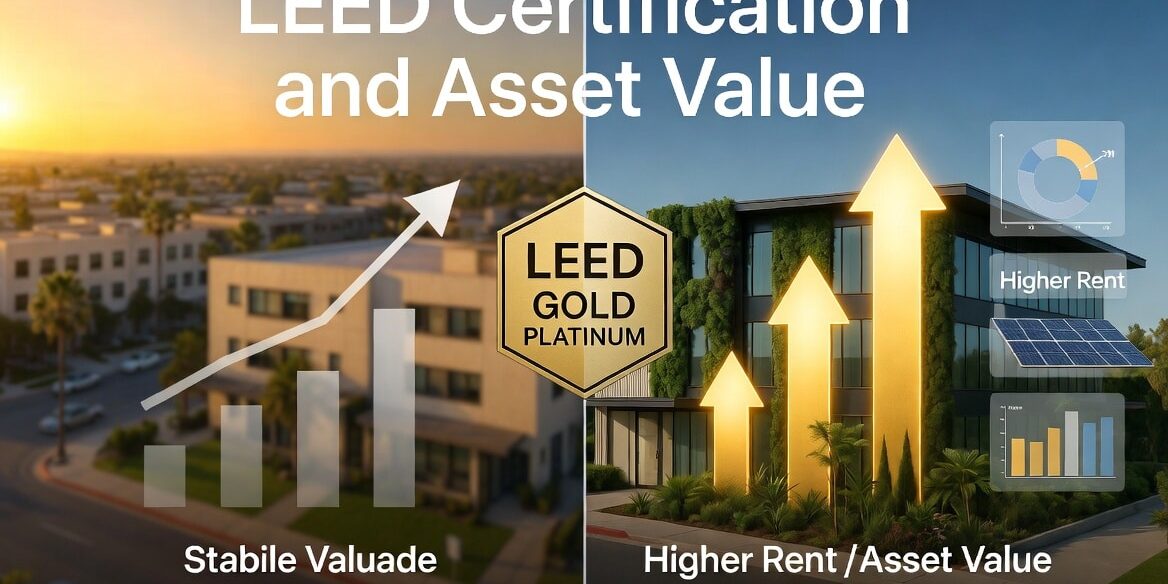
The Rent Arbitrage: Because these elite corporate tenants are mathematically restricted to leasing LEED-certified or highly efficient Class A space, they create a violent supply-and-demand imbalance. They will gladly pay a 10% to 15% rent premium—the “Green Premium”—because the real estate physically satisfies their corporate compliance requirements. If your building lacks the certification, you are entirely locked out of the highest-paying tenant pool in the global market.
2. The Mathematics of the Utility Bleed
A massive component of LEED certification involves the radical reduction of energy and water consumption. Amateur landlords ignore this, assuming that under a Triple-Net (NNN) lease, the tenant pays the utilities anyway, making building efficiency irrelevant.
-
The Total Occupancy Cost: Institutional operators understand that a tenant evaluates a lease based on their Total Cost of Occupancy (Base Rent + NNN Expenses + Utilities).
-
The NOI Expansion: If you invest heavy CapEx into high-efficiency HVAC systems, smart-glass facades, and LED grids, you violently compress the tenant’s localized utility bill. Because their monthly utility burden drops, the landlord can mathematically push the Base Rent higher without increasing the tenant’s overall financial friction.
This exact infrastructural efficiency is absolutely mandatory when underwriting the massive power requirements of advanced logistics and defense contractors operating in Huntington Beach: Coastal Industrial & The Aerospace/Defense Pivot or the heavy manufacturing lifelines in Anaheim: The Industrial Heart of Orange County. If you do not optimize the industrial grid, the tenant’s utility bleed will eventually force them into default.
3. The Clinical and Experiential Imperative
The demand for high-performance, environmentally certified dirt extends far beyond traditional corporate offices. It is becoming the absolute baseline in the specialized medical and high-touch retail sectors.
-
The Med-Tech Synergy: Healthcare providers and life-science operators inherently require pristine, hyper-efficient environments. When executing heavily capitalized clinical conversions in Orange: The Institutional Healthcare & Medical Office Epicenter or securing specialized biotech tenants in Fountain Valley: The Corporate Flex Corridor & Institutional Healthcare Fortress, LEED parameters perfectly align with the hospital-grade MERV-13 air filtration and single-pass HVAC systems these tenants already demand. The certification validates the clinical purity of the asset.
-
The Consumer Demographic: Similarly, in the highly stylized, experiential hubs of Costa Mesa: The Creative Office & High-Volume Experiential Retail Corridor and the heavily guarded retail fortresses of Mission Viejo: South County Suburban Retail & High-Yield Healthcare Centers, the affluent consumer actively filters their spending based on brand alignment. A high-end culinary concept or boutique wellness center will aggressively outbid competitors for LEED-certified dirt because it mathematically elevates their own consumer branding.
4. Avoiding the “Brown Discount”
If you choose to ignore the green real estate movement, you are not simply missing out on a rent premium; you are subjecting your asset to the devastating “Brown Discount.”
As municipalities roll out increasingly draconian carbon-emission taxes and energy compliance mandates, non-compliant buildings become mathematically toxic.
-
The Legislative Squeeze: We see this exact municipal pressure when navigating the high-density mixed-use compliance codes in Santa Ana: High-Density Multi-Family & The Urban Redevelopment Core and the student-heavy transit arteries of Fullerton: The Northern Logistical & Academic Support Hub. The state is systematically penalizing inefficient dirt.
-
The Historic Challenge: Even within the fiercely protected heritage overlays of San Juan Capistrano: Historic Professional Office & Boutique Retail Arbitrage, elite operators are executing invisible, high-efficiency mechanical retrofits behind the 1920s facades. If you fail to upgrade the unseen infrastructure, institutional buyers and massive commercial lenders will ruthlessly expand your Capitalization Rate upon exit, aggressively discounting your property’s value to account for the impending regulatory CapEx they will be forced to absorb.
Conclusion: Sustainability is a Balance Sheet Metric
In the highly capitalized tiers of Orange County commercial real estate, viewing LEED certification as an optional public relations exercise is an unforced error of massive proportions.
Amateur commercial brokers look at the upfront cost of low-flow plumbing and smart-HVAC sensors, complain about the certification fees, and advise their clients to stick to building cheap, obsolete vanilla shells. They entirely fail to underwrite the corporate ESG mandates, they ignore the utility-driven NOI expansion, and they ultimately trap their clients’ capital inside an asset that elite tenants are legally forbidden from leasing.
Elite commercial advisors are financial engineers. We calculate the utility recapture. We target the ESG-mandated corporate credit. We build the infrastructural moats before the market explicitly demands them. At The Malakai Sparks Group, we ensure that when your wealth is deployed into the commercial sector, your asset’s environmental efficiency is mathematically weaponized to extract the absolute maximum institutional yield and protect your portfolio from legislative obsolescence.