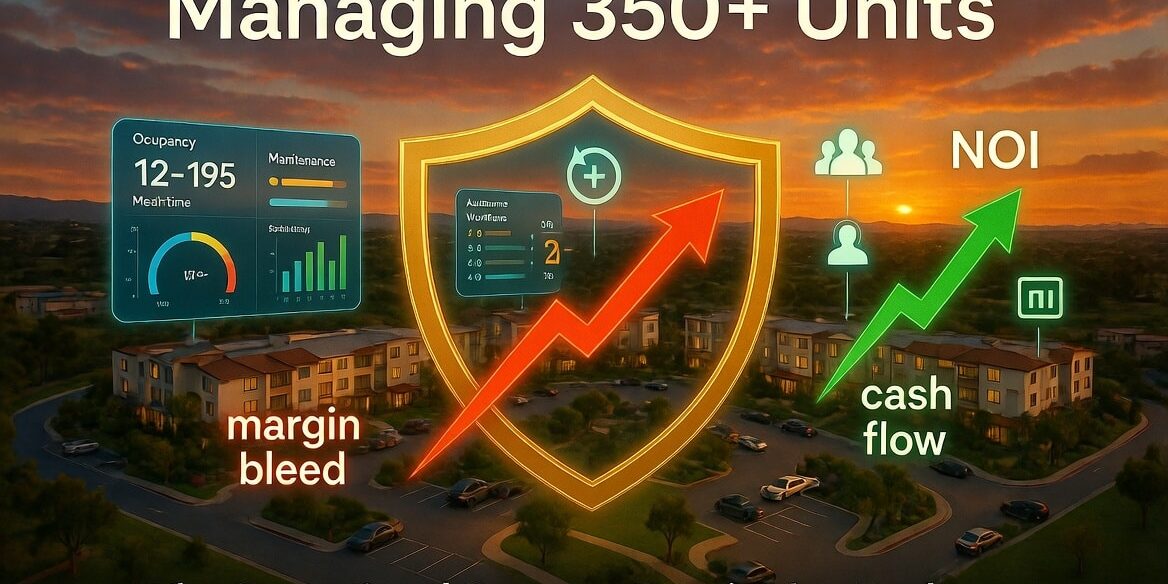
In the highly romanticized, aggressively marketed arena of commercial real estate syndication, amateur investors suffer from a fatal delusion. They believe that successfully closing escrow on a large asset is the finish line. They execute the acquisition, pop the champagne, and assume the Net Operating Income (NOI) will simply materialize on their spreadsheet.
They are entirely oblivious to the impending operational slaughter.
Acquiring the dirt is merely the starting gun. Scaling a commercial portfolio is a brutal endurance event. It demands the sustained, hyper-calculated stamina of an Ironman. Operating in the trenches for 14 years and executing the daily logistical management of over 350 rental properties provides a raw, unfiltered education in infrastructural reality: you cannot brute-force scale. If you attempt to manage 350 units using the exact same manual, duct-taped systems you used to manage 10 units, your operating margins will bleed to death, your tenant turnover will violently spike, and your equity will vaporize.
At The Malakai Sparks Group, backed by the institutional framework of L3 Real Estate, we do not view property management as a passive administrative task. We view it as an aggressive, highly engineered defense mechanism designed to permanently lock in the yield. Here is the definitive, forensic guide to constructing the operational systems required to scale an Orange County portfolio, surviving the logistical friction, and mathematically defending your margin.
1. The Mathematics of the OER Death Spiral
When amateur syndicators attempt to scale their unit count, they inevitably fall into the Operating Expense Ratio (OER) death spiral.
As their portfolio grows, their operational friction compounds. Because they lack centralized systems, they simply throw more human bodies at every problem. They hire more localized managers, more disjointed accounting clerks, and more redundant leasing agents. Consequently, their overhead scales linearly—or exponentially—alongside their unit count.
Institutional operators evaluate efficiency through a strict mathematical lens:
The entire purpose of scaling a portfolio to 350+ units is to force the OER down through economies of scale. By centralizing the leasing, maintenance, and accounting infrastructure into a single, highly automated corporate brain, the cost to manage unit #350 becomes mathematically microscopic compared to the cost of managing unit #10. If your OER is expanding as your unit count grows, you are not scaling; you are building a localized bureaucracy.
2. The Centralized Maintenance Matrix
The single greatest source of operational bleed across a massive portfolio is decentralized, reactive maintenance.
If a landlord relies on a fragmented web of localized, third-party handymen to service a sprawling portfolio, they will be financially destroyed by trip charges, retail materials pricing, and zero quality control. Managing hundreds of units requires a vertically integrated, central dispatch matrix.
-
Preventative vs. Reactive: Elite operators do not wait for the HVAC system to explode on a Friday night in July. They deploy algorithmic, calendar-based preventative maintenance.
-
The Geographic Dispatch: When servicing heavy industrial systems in Anaheim: The Industrial Heart of Orange County or mitigating the relentless coastal decay on assets located in Huntington Beach: Coastal Industrial & The Aerospace/Defense Pivot, the maintenance fleet is dispatched via localized tracking software. A technician servicing an industrial dock-high door is algorithmically routed to execute preventative roof inspections on three adjacent properties in the same zip code before they return to base. This route density slashes labor friction and drastically lowers the aggregate maintenance CapEx.
3. Geographic Clustering and Asset Synergy
You cannot efficiently manage a portfolio that is scattered randomly across completely disconnected micro-economies. The institutional operator scales by executing hyper-concentrated geographic clustering.
-
The Urban Commuter Grid: We cluster high-density workforce housing and student overflow properties in transit-oriented nodes. By dominating the multi-family overlays of Santa Ana: High-Density Multi-Family & The Urban Redevelopment Core and the localized academic commuter arteries of Fullerton: The Northern Logistical & Academic Support Hub, a single regional manager can physically oversee 150 units without spending three hours a day trapped in Southern California freeway traffic.
-
The Corporate and Creative Nodes: This same synergy applies to commercial assets. Leasing teams cross-pollinate tenant demand. A corporate tenant outgrowing a specialized creative suite in Costa Mesa: The Creative Office & High-Volume Experiential Retail Corridor can be seamlessly migrated into a larger, institutional life-science or flex-tech space within Irvine: The Master-Planned Corporate Juggernaut or Fountain Valley: The Corporate Flex Corridor & Institutional Healthcare Fortress. You retain the tenant within your proprietary ecosystem, mathematically eliminating the vacancy loss.
4. Navigating Bureaucratic and Entitlement Friction at Scale
Managing 350+ units means engaging in relentless, daily trench warfare with local municipalities. Every city in Orange County possesses its own draconian zoning codes, parking ratios, and historical preservation mandates.
Amateur landlords stumble blindly into these traps, accumulating massive municipal fines. Institutional operators build compliance firewalls.
-
The Entitlement Firewall: When executing adaptive reuse or exterior modifications, we navigate the notoriously rigid architectural review boards in San Juan Capistrano: Historic Professional Office & Boutique Retail Arbitrage with the exact same systematized precision utilized when verifying heavy electrical permits for medical facilities in Orange: The Institutional Healthcare & Medical Office Epicenter.
-
The Medical/Retail Compliance Squeeze: In massive, master-planned suburban fortresses like Mission Viejo: South County Suburban Retail & High-Yield Healthcare Centers, transitioning a standard retail pad into a specialized medical clinic instantly triggers brutal parking ratio audits from the city. At scale, you cannot track these entitlements on a whiteboard. You must deploy enterprise-level property management software that flags zoning constraints, tracks conditional use permits (CUPs), and perfectly aligns with state AB 1482 rent-control mandates before a single lease is drafted.
5. Automated Lease Administration and the NNN Reconciliation
In a sprawling portfolio containing hundreds of commercial and residential leases, manual lease administration is a guaranteed path to financial insolvency.
If you are operating premium coastal assets secured by absolute NNN leases, such as those found in Newport Beach: The Wealth Management & Coastal Capital Center, the Common Area Maintenance (CAM) reconciliation process is a high-stakes financial battlefield.
-
The Phantom Bleed: If a corporate tenant is contractually obligated to reimburse the landlord for 12.5% of the annual property tax, insurance, and roof maintenance, but the landlord’s accounting team fails to aggressively bill that exact reconciliation in January, the capital is permanently lost.
-
The Automation Moat: Scaling requires institutional lease abstraction software. The moment a lease is signed, every critical date—rent bumps, option renewals, insurance certificate expirations, and CAM caps—is extracted and digitized. The software automatically triggers the rent increases and mathematically executes the NNN pass-throughs with zero human hesitation. The revenue collection is completely decoupled from human memory.
Conclusion: Engineering the Yield Fortress
In the mathematically unforgiving environment of Orange County commercial real estate, assuming that high unit counts automatically equal high profits is a fatal error.
Amateur commercial brokers sell the acquisition dream while completely failing to build the operational reality. They advise their clients to assemble massive portfolios, yet they provide absolutely zero infrastructural blueprints, leaving the buyer to slowly drown in a rising tide of deferred maintenance, uncollected utility chargebacks, and administrative chaos.
Elite commercial advisors are not just transaction brokers; we are operational architects. We build the central dispatch systems. We engineer the geographic synergies. We deploy the compliance software. At The Malakai Sparks Group, we ensure that when your wealth is deployed to scale an Orange County portfolio, every single door is mathematically guarded by an impenetrable operational matrix, permanently protecting your Net Operating Income from the friction of scale.