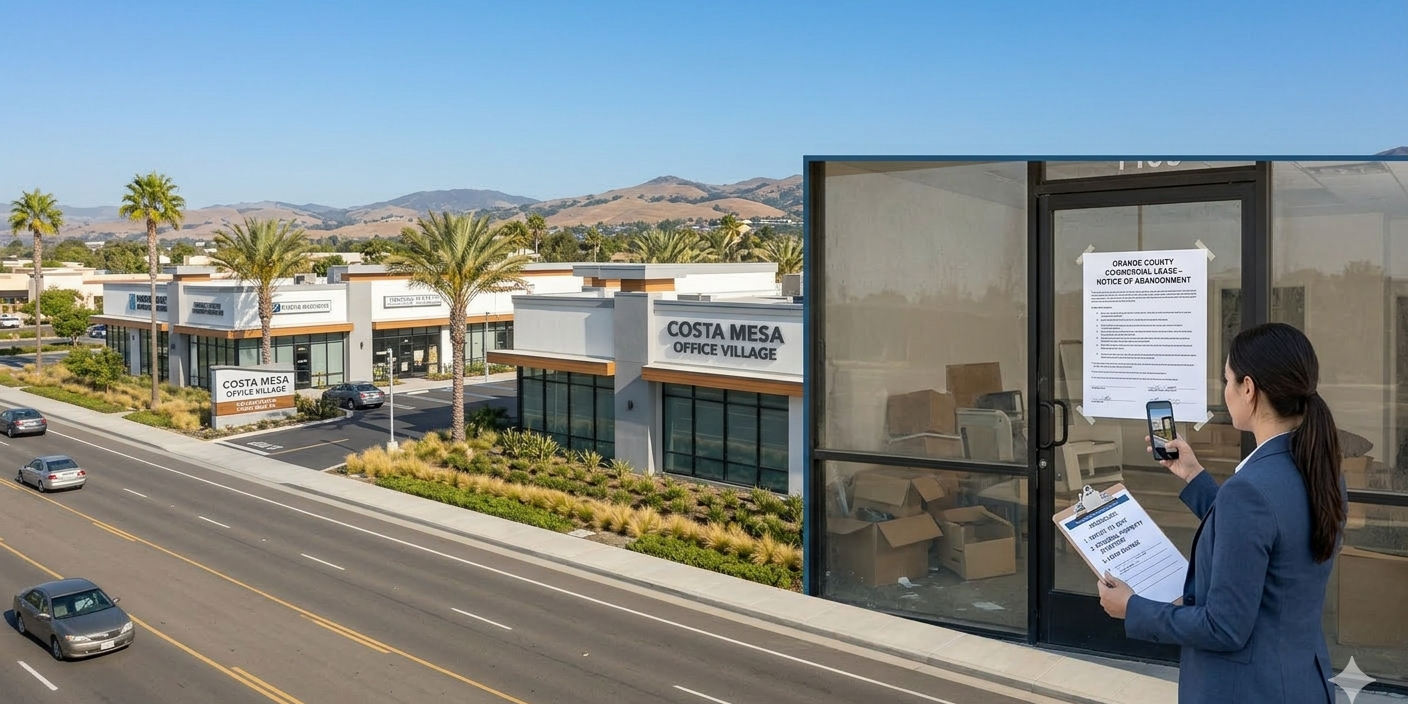
In the daily operations of Orange County commercial real estate, property managers are trained to handle a wide spectrum of tenant friction: late rent checks, unapproved tenant improvements, and CAM reconciliation disputes. However, there is one scenario that instantly triggers operational panic for an independent landlord: The Midnight Move-Out.
Imagine arriving at your multi-tenant industrial park in Anaheim or a retail strip in Costa Mesa on a Tuesday morning. A suite that was operating normally on Friday is now dark. The inventory is mostly gone, the signage has been stripped off the window, and the tenant’s phone number goes straight to voicemail. They are 10 days late on rent, and they have vanished.
The immediate instinct of a frustrated landlord is to call a locksmith, change the deadbolts, and put a “For Lease” sign in the window.
In the State of California, executing that instinct is a massive legal mistake. If you illegally reclaim a commercial suite without following the strict statutory protocols of abandonment, the “missing” tenant can reappear, sue you for wrongful eviction, and demand massive punitive damages for the loss of their business.
Reclaiming a “ghosted” commercial property requires clinical, emotionless legal execution. Here is the definitive guide to navigating commercial property abandonment, securing your Orange County asset, and mitigating your financial damages.
1. The Legal Test for Abandonment (Civil Code Section 1951.3)
You cannot assume a property is abandoned simply because the lights are off and the rent is late. The tenant might be on a three-week vacation, experiencing a medical emergency, or temporarily restructuring their business.
Under California Civil Code, a commercial landlord can only initiate the formal abandonment process if two highly specific conditions are met simultaneously:
-
The Rent Default: The tenant’s rent must be past due for at least 14 consecutive days.
-
Good Faith Belief: The landlord must have a “reasonable, good-faith belief” that the tenant has permanently abandoned the property.
Establishing Good Faith Belief: Before we take legal action, an elite property management team builds an evidentiary file. We document the signs of abandonment to justify the legal process.
-
We dispatch an inspector to the property in Fullerton to photograph the empty suite through the windows.
-
We contact the local utility providers to see if the tenant has proactively shut off the electricity or water.
-
We document all failed attempts to contact the tenant via email, certified mail, and emergency contact numbers listed in the master lease.
2. The Notice of Belief of Abandonment (NOBA)
Once the 14-day rent default has passed and the evidence is documented, the landlord must serve a formal Notice of Belief of Abandonment (NOBA).
This is the legal mechanism that protects the landlord from a wrongful eviction lawsuit. The notice formally informs the tenant: “We believe you have abandoned the premises. If you do not respond and state your intent to keep the lease active, we will terminate the lease and reclaim the property.”
The Statutory Waiting Period: Serving the NOBA triggers a strict, mandatory waiting period.
-
If the notice is personally served to the tenant, the landlord must wait 15 days.
-
If the notice is sent via certified mail (which is almost always the case in a disappearance), the landlord must wait 18 days from the date of mailing.
During this 15-to-18-day window, the landlord cannot change the locks or re-lease the space. You must wait. If the tenant responds in writing during this window stating they have not abandoned the property (even if they still haven’t paid rent), the NOBA is voided. At that point, the landlord must pivot and file a standard Unlawful Detainer (eviction) lawsuit to regain possession.
3. Reclaiming the Property and the “Duty to Mitigate”
If the statutory 18-day waiting period expires and the tenant has remained completely silent, the lease is officially terminated by operation of law.
At this exact moment, L3 Real Estate immediately dispatches vendors to the property in Irvine or Newport Beach. We change the locks, secure the mechanical rooms, and officially reclaim possession of the asset.
The Landlord’s Duty to Mitigate: While you now have the property back, the defaulting tenant is still legally on the hook for the remainder of their lease value. If they abandoned a 5-year lease in Year 2, they technically owe you 3 years of rent.
However, California law requires the landlord to proactively “mitigate their damages.” You cannot simply leave the suite empty for 3 years and then sue the former tenant for the entire balance. The landlord must make a commercially reasonable effort to re-lease the space to a new tenant as quickly as possible.
Once a replacement tenant is secured, you can sue the original tenant for the “delta”—the lost rent during the vacancy period, the broker commissions paid to find the new tenant, and any difference in the new base rent.
4. The Nightmare of Abandoned Personal Property
When a tenant disappears in the middle of the night, they rarely leave the suite in “broom-swept” condition. A restaurant in San Juan Capistrano might leave behind massive commercial ovens; an office tenant in Aliso Viejo might leave dozens of cubicles and copy machines.
You cannot drag their equipment to the dumpster. Disposing of a commercial tenant’s abandoned property is governed by an entirely separate set of strict California laws (Civil Code Section 1993).
The Notice of Right to Reclaim: The landlord must inventory all the items left behind, safely store them (either in the suite or at a storage facility), and serve the former tenant with a Notice of Right to Reclaim Abandoned Property. The tenant then has 15 to 18 days to pay the landlord the reasonable cost of storage and pick up their items.
The $2,500 Threshold (Disposal vs. Auction): If the tenant ignores the notice, the landlord’s next step is dictated by the estimated resale value of the abandoned items.
-
Under $2,500 (or one month’s rent): If the items are effectively junk (old desks, broken chairs) and the total value is under $2,500 or the equivalent of one month’s rent (whichever is greater), the landlord can legally throw the items away or keep them for the property’s use.
-
Over $2,500: If the tenant abandoned high-value equipment (like a forklift or medical imaging machines), the landlord is legally prohibited from keeping or throwing away the property. The landlord must hire a licensed auctioneer, publish a notice in a local newspaper of general circulation, and sell the items at a Public Auction. The proceeds of the auction (minus the costs of storage and the auctioneer’s fee) can be applied to the tenant’s unpaid rent judgment.
5. Securing the Asset During the “Ghost Period”
The most dangerous phase of an abandonment is the 30-to-40-day window between the tenant stopping operations and the landlord officially reclaiming the suite. We call this the “Ghost Period.”
An empty, unsecured commercial suite in a bustling retail plaza in Orange or Tustin is a massive liability. It attracts vagrancy, copper-wire theft, and vandalism.
While the landlord cannot legally change the locks to evict the tenant during the NOBA waiting period, the landlord always retains the right to enter the premises to protect the asset from damage.
-
We routinely execute “wellness checks” on the suite.
-
If a window is broken or a door is left unlocked by the fleeing tenant, we immediately dispatch vendors to board the window or temporarily secure the door. This protects the physical asset from third-party destruction while strictly adhering to the tenant’s remaining legal rights.
Conclusion: Do Not Let Frustration Dictate Your Actions
When a commercial tenant disappears and abandons your multi-million-dollar asset, frustration is inevitable. However, allowing that frustration to drive you into an illegal, “self-help” lockout will transform a simple rent-collection issue into a devastating wrongful eviction lawsuit.
Navigating a commercial abandonment requires absolute administrative precision. You must document the default, serve the statutory notices flawlessly, and manage the disposal of the abandoned inventory by the book.
At L3 Real Estate, we serve as the ultimate legal and operational firewall for your Orange County portfolio. We do not panic when a tenant ghosts. We immediately initiate the Notice of Belief of Abandonment, secure your physical asset, and rapidly prepare the suite for a high-credit replacement tenant, ensuring your Net Operating Income is restored as quickly as legally possible.
Are you currently dealing with a non-responsive commercial tenant, or are you concerned about the liability of abandoned property in your building? Contact our expert team today to discover how our high-precision Brea property management and Lake Forest commercial strategies can definitively protect your wealth.