

In the high-stakes environment of Orange County commercial real estate, a landlord’s greatest financial enemy is not necessarily a broken roof or a spiked interest rate. It is Tenant Turnover.
When a reliable corporate tenant vacates a 10,000-square-foot office suite in Irvine or an industrial warehouse in Brea, the landlord’s Net Operating Income (NOI) plummets to zero. Furthermore, securing a replacement tenant requires a massive capital injection: paying a 5% broker commission, suffering through three to six months of “dark” vacancy time, and writing a six-figure check for a new Tenant Improvement (TI) allowance.
Amateur property managers view lease expirations with quiet panic, crossing their fingers and hoping the tenant decides to stay. They deploy a passive “Wait and See” strategy.
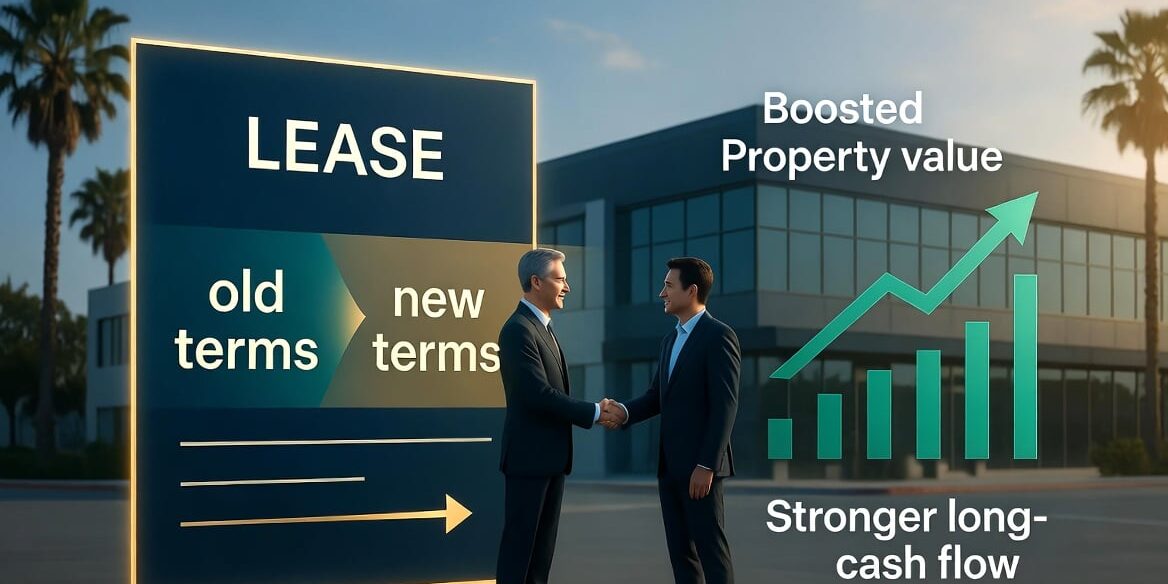
Institutional asset managers operate on offense. We do not wait for a lease to expire to secure the rent roll. Instead, we deploy one of the most powerful, mutually beneficial financial instruments in commercial real estate: The “Blend and Extend” Lease Renewal.
Here is the definitive guide to understanding the mechanics of the Blend and Extend strategy, securing tenant loyalty, and mathematically forcing the appreciation of your Orange County portfolio.
1. The Mechanics of the “Blend and Extend”
The Blend and Extend is a proactive lease restructuring strategy executed long before the current lease actually expires. It is designed to solve two conflicting problems: the landlord’s desire for higher market rents and a longer lease term, and the tenant’s desire to control their immediate overhead costs.
How the Math Works: Imagine you have a highly successful medical tenant in a Newport Beach clinic. They have two years remaining on their original lease, currently paying a legacy rate of $2.50 per square foot.
However, the current Orange County market has exploded, and the true market value of that suite is now $3.50 per square foot.
-
If the landlord waits two years for the lease to expire, the tenant will face massive “sticker shock” when asked to pay the new $3.50 rate, highly increasing the risk that they pack up and leave.
-
To prevent this, the landlord approaches the tenant today.
The Offer: The landlord offers to extend the lease for an additional five years (creating a new seven-year total term). In exchange for the tenant committing to this long-term extension, the landlord immediately increases the rent, but not all the way to $3.50. Instead, they “blend” the current $2.50 rate with the future $3.50 market rate, creating a new, immediate Base Rent of $3.00 per square foot.
2. The Landlord’s Advantage: Forcing Immediate Appreciation
Why would a landlord voluntarily accept $3.00 a square foot when the market dictates they could eventually get $3.50? Because institutional investors value certainty and capitalization rates over hypothetical future income.
1. Immediate NOI Expansion: By executing the Blend and Extend today, the landlord instantly increases the cash flow of the building by $0.50 per square foot, two full years earlier than they legally had the right to.
2. The Valuation Multiplier: In commercial real estate, Property Value = NOI / Cap Rate. By immediately permanently raising the NOI, the landlord instantly forces massive equity into the building’s valuation. This is the ultimate strategy if the landlord is preparing to execute a Cash-Out Refinance or sell the Costa Mesa property in the next 12 to 24 months.
3. Compressing the Cap Rate (Risk Reduction): When an appraiser or a commercial lender evaluates a property, they look at the Weighted Average Lease Expiry (WALE). If a building is full of tenants with only two years left on their leases, the bank views the asset as high-risk. By extending the medical tenant out to seven years, the landlord drastically lowers the risk profile of the rent roll, qualifying the asset for premier, lower-interest institutional debt.
3. The Tenant’s Advantage: Capital Preservation
A Blend and Extend is not a one-sided negotiation. The tenant must be heavily incentivized to tear up their current, cheap lease and sign a more expensive one.
When L3 Real Estate approaches a corporate tenant in Anaheim or Fullerton, we frame the negotiation entirely around their capital preservation and operational security.
-
Avoiding the Relocation Nightmare: Moving a commercial business is catastrophically expensive. The tenant must pay for moving trucks, print new marketing materials, suffer operational downtime, and potentially lose local customers. A Blend and Extend guarantees they avoid this trauma.
-
Overhead Predictability: By locking in the blended $3.00 rate for the next seven years, the tenant protects themselves from future inflationary spikes. They know exactly what their overhead will be for the better part of a decade.
-
The Mid-Lease TI Allowance: Often, a tenant’s space is starting to look worn out after five years. To sweeten the Blend and Extend, the landlord can offer a targeted Tenant Improvement (TI) allowance—such as paying for new flooring or fresh paint. The tenant gets a newly modernized workspace without spending their own capital, and the landlord effectively amortizes the cost of those upgrades into the new, higher rental rate.
4. The Threat of the “Wait and See” Approach
If a landlord chooses to ignore this strategy and ride their leases out to the bitter end, they surrender all of their negotiating leverage to the tenant.
When you wait until month 58 of a 60-month lease to initiate a renewal conversation for your San Juan Capistrano retail suite, the tenant has already spoken to competing brokers. They have already toured three brand-new properties down the street that are offering them massive move-in specials and six months of free rent.
At that point, the landlord is no longer negotiating from a position of strength; they are negotiating out of desperation. The tenant will use the competing offers to force the landlord to keep the rent artificially low, or they will demand massive concessions just to stay in the building.
5. Execution: The 18-Month Audit Window
A successful Blend and Extend requires extreme proactivity. It cannot be executed if the property manager does not have a relentless grip on the rent roll.
The Institutional Standard: At L3 Real Estate, we do not let leases passively age. We execute a comprehensive forensic market audit 18 to 24 months prior to any major lease expiration in your Lake Forest or Orange portfolio.
-
The Arbitrage Check: We analyze the exact delta between the tenant’s current Base Rent and the current Orange County market reality.
-
The Tenant Health Audit: We review the tenant’s payment history and gross sales reporting (if applicable). We only extend high-credit, flawless operators.
-
The Proactive Pitch: We bring the financial modeling to the tenant, proving to them mathematically why securing their space today at a blended rate is superior to risking the open market in two years.
Conclusion: Actively Engineer Your Rent Roll
In the highly competitive Orange County commercial real estate market, hoping a tenant decides to stay is a recipe for catastrophic vacancy. You must actively engineer their loyalty by structuring financial agreements that make staying the only logical option.
A passive property manager simply deposits rent checks until the lease expires. An elite asset manager constantly evaluates the rent roll for optimization opportunities, treating every lease as a living, malleable financial instrument.
At L3 Real Estate, we deploy the Blend and Extend strategy to eliminate your rollover risk, modernize your tenant spaces, and mathematically force the appreciation of your commercial portfolio. We secure the cash flow long before it is ever in danger.
Are you sitting on commercial leases that are set to expire in the next 12 to 24 months, or are your legacy tenants currently paying severely below-market rents? Contact our expert team today to discover how our specialized Tustin property management and Huntington Beach commercial strategies can definitively maximize your Net Operating Income.