In Orange County commercial real estate, investors love to focus on the numbers. You obsess over the capitalization rate of a Costa Mesa retail center and the price-per-square-foot of an Irvine industrial park.
However, all the brilliant financial modeling in the world is completely worthless if your building cannot keep the water out.
The commercial roof is the single most expensive, high-stakes physical component of your asset. When a massive, flat commercial roof fails, it does not just cause a minor leak. It destroys suspended ceilings, ruins hundreds of thousands of dollars of tenant inventory, triggers toxic mold litigation, and gives your high-credit corporate tenants the legal right to instantly abate their rent.
Amateur landlords treat the roof reactively, endlessly paying for cheap silicone patches until the entire system collapses. Institutional asset managers treat the roof proactively. We forecast its lifecycle, strictly audit its warranty, and engineer the lease clauses required to legally pass the replacement costs through to the tenants.
Here is the definitive guide to understanding commercial roofing systems, navigating California’s brutal energy codes, and executing a multi-million-dollar CapEx replacement without destroying your Net Operating Income (NOI).
1. The High Cost of the “Band-Aid” Strategy
Commercial roofs are out of sight and, therefore, out of mind. When a tenant in a Huntington Beach warehouse calls about a leak, the instinct of a discount property manager is to send a local handyman with a bucket of mastic sealant.
This “Band-Aid” strategy is a massive financial illusion.
-
The Moisture Trap: When a flat roof fails, water penetrates the top membrane and saturates the heavy insulation underneath. Once that insulation is soaked, it never dries. It rots the underlying steel or wood decking.
-
The Catastrophic Failure: By the time you finally decide to replace the roof five years later, you cannot simply lay a new membrane over the top. Because the decking is rotting, you must tear the entire roof off down to the structural framing, mathematically doubling or tripling the cost of the project.
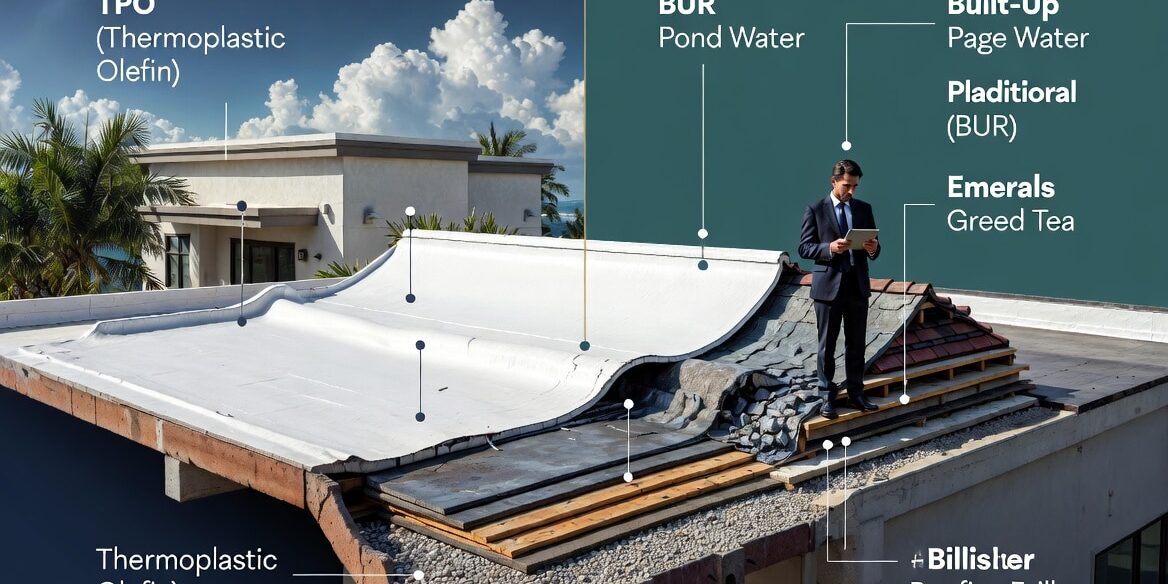
At L3 Real Estate, we execute bi-annual, drone-assisted and physical roof audits. We do not wait for the tenant to call. We identify ponding water, failing seams, and blistered membranes before they breach the insulation, saving our clients hundreds of thousands of dollars in structural repairs.
2. The Dominant OC Roofing Systems
If you are acquiring or managing an asset in Anaheim or Fullerton, you will primarily encounter two types of flat commercial roofing systems. Understanding the difference is critical to your CapEx underwriting.
1. Built-Up Roofing (BUR) / Tar and Gravel: This is the legacy, old-school method found on aging Class-B and Class-C buildings. It consists of multiple layers of asphalt and roofing felt, topped with heavy river rock or gravel to protect it from the UV rays.
-
The Reality: BUR is incredibly durable, but it is brutally heavy and incredibly difficult to patch. Finding the exact source of a leak under three inches of gravel is nearly impossible. If you own a building with an aging BUR system, you are staring down a massive, impending replacement.
2. TPO (Thermoplastic Polyolefin): This is the modern, institutional standard. TPO is a single-ply, highly reflective white rubber membrane that is heat-welded at the seams.
-
The Reality: TPO is lightweight, highly resistant to chemical exposure (perfect for restaurant grease traps), and its bright white, reflective surface drastically lowers the building’s HVAC cooling costs. When an institutional investor buys a legacy building, tearing off the BUR and installing a fresh TPO membrane is often step one of their repositioning strategy.
3. The California Title 24 Trap
Replacing a commercial roof in Orange County is not just an engineering challenge; it is a brutal regulatory hurdle.
California enforces Title 24, some of the strictest building energy efficiency standards in the world. If you are tearing off and replacing an aging roof on a Santa Ana office building, you cannot just replace what was there.
-
The “Cool Roof” Mandate: The state legally mandates that the new roof must be highly reflective (a “Cool Roof”) to reduce the urban heat island effect.
-
The Insulation Shock: More importantly, if your old roof had no insulation (which is common in 1970s OC industrial buildings), Title 24 forces you to install massive, expensive blocks of rigid polyiso insulation to bring the building up to modern thermal codes.
Amateur landlords frequently underwrite a roof replacement for $100,000 based on old bids, only to get hit with a $150,000 reality check because their discount roofer failed to factor in the mandatory Title 24 compliance upgrades.
4. Making the Tenant Pay: The “Amortized CapEx” Clause
The most painful part of a $250,000 roof replacement is writing the check. However, an elite asset manager knows how to legally recover that capital.
If you drafted a standard, generic Triple Net (NNN) lease, capital expenditures (like a brand-new roof) are explicitly excluded from the Common Area Maintenance (CAM) charges. The landlord has to eat the entire cost.
The L3 Execution: We draft highly specialized, institutional-grade NNN leases. We include an Amortized CapEx Clause.
-
This clause legally states that if the landlord replaces a capital item (like the roof) that reduces the tenants’ operating expenses (by lowering their HVAC utility bills due to the new TPO insulation), the landlord is allowed to bill the tenants for it.
-
The Math: We do not hand the tenant a $250,000 bill on day one. We amortize (divide) the cost over the useful lifespan of the roof (e.g., 15 years). If the amortized cost is $16,000 a year, we legally pass that $16,000 through the annual CAM reconciliations, systematically recovering the landlord’s massive equity injection while keeping the tenants’ overhead predictable.
5. The NDL Warranty: Why Your Roofer’s Guarantee is Worthless
When you solicit bids for a roof replacement in Brea, the cheapest contractor will usually promise a “20-Year Warranty.”
This is almost always a trap. The contractor is offering a Contractor’s Workmanship Warranty. If that local roofing company goes out of business in three years, your 20-year warranty instantly evaporates into thin air.
At L3 Real Estate, we only authorize multi-million-dollar roofing projects that include a Manufacturer’s NDL (No Dollar Limit) Warranty.
-
With an NDL, the warranty is held by the massive, multi-billion-dollar corporation that manufactured the TPO membrane (e.g., Carlisle or Firestone).
-
When the installation is complete, the manufacturer sends their own corporate inspector to the roof to verify it was installed flawlessly before they issue the certificate.
-
If the roof fails in year 10, the manufacturer covers the entire cost of the materials and the labor to fix it, with absolutely no financial cap, completely insulating the landlord from future liability.
Conclusion: Manage the Dirt, Protect the Cash
A commercial property is a highly complex physical machine designed to generate financial yield. If you allow the physical machine to decay, the financial yield will inevitably follow.
Waiting for a roof to leak before you assess its health is not asset management; it is operational negligence. The cost of a proactive CapEx replacement is always vastly lower than the cost of a catastrophic, litigation-triggering failure.
At L3 Real Estate, we operate at the intersection of heavy construction and high-level finance. We execute the bi-annual drone audits, we navigate the brutal Title 24 compliance codes, and we draft the forward-looking leases required to amortize your massive capital expenditures. We protect the physical perimeter of your Orange County asset so you can flawlessly protect your Net Operating Income.
Are you currently dealing with chronic roof leaks, or are you preparing to acquire an asset and need a forensic physical assessment of the CapEx liabilities? Contact our expert team today to discover how our specialized Lake Forest property management and Newport Beach commercial strategies can definitively protect your equity.