

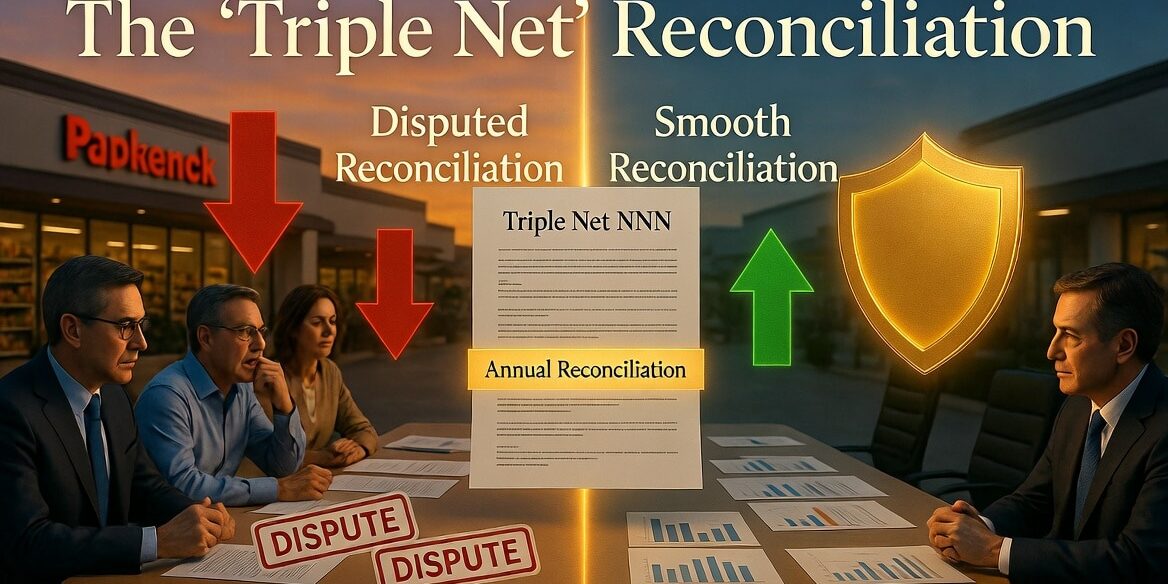
In the highly reactive, top-line-obsessed arena of commercial real estate syndication, the amateur landlord navigates the end of the fiscal year with a fatal sense of entitlement. They acquired a premium retail center, successfully executed Triple Net (NNN) leases with massive, high-credit anchor tenants, and blindly assumed their Net Operating Income (NOI) was permanently insulated. In late January, the amateur landlord hands their generic, off-site property manager a stack of unorganized invoices, generates a basic spreadsheet, and sends a demand letter to a Fortune 500 anchor tenant for a year-end Common Area Maintenance (CAM) shortfall.
Thirty days later, the landlord’s operating account is frozen. The corporate tenant’s multi-billion-dollar legal and forensic accounting team violently descends upon the ledger. They discover the amateur illegally billed structural capital improvements as operating expenses, mathematically butchered the pro-rata share denominators, and completely ignored the cumulative expense caps buried on page 42 of the lease. The tenant legally rejects the demand, files an injunction to claw back in historical overpayments, and halts all base rent payments pending a third-party audit. The landlord’s cash flow is mathematically eradicated.
This is a catastrophic, multi-million-dollar failure of financial underwriting and operational governance.
In the apex tiers of institutional capital, we do not view a Triple Net lease as a license to passively collect money; we view it as a highly restrictive, weaponized legal framework that demands absolute accounting supremacy. NNN is not an assumption; it is a mathematical reconciliation. If your year-end ledger is not forensically perfect, your corporate tenants will tear your capital stack apart.
At The Malakai Sparks Group, backed by the institutional framework of L3 Property Management, we do not hope for accounting compliance; we legally engineer it. Defending an eight-figure commercial rent roll requires the exact same ruthless, fiduciary discipline deployed when steering the La Cuesta Racquet Club board through complex, multi-million-dollar municipal assessments—you strip the emotion from the table, govern the localized risk, and mathematically enforce the governing documents. You do not survive this industry by winging your ledgers; you endure the market with the relentless, compounding structural momentum of a heavy 48KG kettlebell progression, possessing the unyielding physical and mental stamina of an Ironman—every single repetition, every single parsed invoice, must be mechanically flawless over the long haul. Just as we precisely canvas every microscopic demographic shift across our exact 2,500-home farming route in the Numbered Streets of Huntington Beach to unearth unyielding localized equity, we forensically audit the CAM matrix to permanently secure your NOI. Here is the definitive, institutional-grade guide to decoding the Triple Net Reconciliation, surviving the corporate audit, and mathematically guaranteeing your year-end yield.
1. The Mathematics of the Reconciliation Matrix
To successfully survive the first quarter of the fiscal year, an investor must completely dismantle the mechanics of the CAM true-up.
Throughout the year, a NNN tenant pays an estimated monthly charge for their share of property taxes, insurance, and Common Area Maintenance (CAM). At the end of the year, the landlord must mathematically reconcile the exact total of the actual expenses against the estimated funds collected.
-
The CapEx vs. OpEx Slaughter: The single most lethal trap in the reconciliation equation is the misclassification of expenses. A tenant is legally obligated to pay for maintenance (OpEx), but they are strictly protected from paying for replacements (CapEx). If an amateur landlord repaves the entire parking lot for and attempts to slide that invoice into the year-end CAM pool, the tenant’s auditors will immediately flag it, violently reject the charge, and legally classify it as a capital improvement that must be amortized over the 15-year useful life of the asphalt.
2. The Experiential Aesthetic Bleed and Subjective CAM
The reconciliation matrix becomes highly volatile when governing heavily stylized, consumer-facing assets where “maintenance” is heavily curated.
-
The Culinary Ambience Trap: When executing heavy adaptive-reuse projects within the hyper-experiential retail grids of Costa Mesa: The Creative Office & High-Volume Experiential Retail Corridor or navigating the fiercely guarded historic preservation overlays of San Juan Capistrano: Historic Professional Office & Boutique Retail Arbitrage, the operating expenses are astronomical. You are paying for specialized day-porters, ambient lighting maintenance, valet parking management, and high-end landscaping.
-
The “Reasonableness” Clause: A Michelin-star anchor tenant will intensely scrutinize these line items. Their lease will contain a “commercially reasonable” clause regarding CAM charges. If your generic property manager overpays a boutique landscaping vendor by 40% without securing multiple institutional bids, the tenant will legally refuse to pay the delta. Elite landlords deploy localized, portal-driven management to mathematically prove every single vendor contract was rigorously bid out to the open market, permanently defending the pass-through expense.
3. The “Gross Up” Provision in High-Density Commuter Arteries
The legal calculus of a reconciliation shifts from vendor auditing to strict volumetric geometry when dealing with mixed-use properties carrying variable vacancy rates.
-
The Denominator Contamination: When operating massive residential complexes with ground-floor commercial space within the transit-oriented commuter grids of Santa Ana: High-Density Multi-Family & The Urban Redevelopment Core or the student-heavy logistical networks of Fullerton: The Northern Logistical & Academic Support Hub, landlords frequently miscalculate the Pro-Rata Share.
-
The Variable Expense Warfare: If the building drops to 70% occupancy, certain expenses (like trash removal and utilities) drop, but fixed expenses (like landscaping and security) do not. Amateurs attempt to bill the remaining 70% of the tenants for 100% of the fixed expenses. This is legally catastrophic. Elite operators execute a “Gross Up” Provision, which mathematically simulates the operating expenses as if the building were 95% to 100% occupied, legally shielding the remaining tenants from subsidizing the landlord’s vacant dirt, and entirely preventing a multi-tenant class-action lawsuit.
4. Controllable vs. Uncontrollable Caps in Heavy Industrial
In the massive logistical and manufacturing sectors, the reconciliation is governed by weaponized contractual caps designed to restrict the landlord’s management capabilities.
-
The Infrastructural Audit: When managing massive distribution hubs within Anaheim: The Industrial Heart of Orange County or specialized terminal logistics centers in Huntington Beach: Coastal Industrial & The Aerospace/Defense Pivot, the tenants demand absolute predictability.
-
The Cumulative Cap Defense: Massive defense contractors will enforce a 3% to 5% cumulative cap on “Controllable” expenses (management fees, generic maintenance), while allowing “Uncontrollable” expenses (property taxes, insurance, municipal utilities) to pass through without limits. If the amateur landlord’s generic property management software fails to perfectly segregate these two categories, the year-end invoice mathematically defaults. The tenant rejects the entire bill. Institutional operators utilize segregated, highly secure digitized ledgers that automatically apply the compounded cumulative caps in real-time, executing a flawless, un-rejectable year-end invoice.
5. Shielding the Clinical and Corporate Moats
Institutional capital deploys elite reconciliation architecture to mathematically lock down the multi-generational value of absolute corporate credit.
-
The Medical Base Year: If you are securing advanced biomedical footprints within Fountain Valley: The Corporate Flex Corridor & Institutional Healthcare Fortress or entitling corporately backed clinical engines in Orange: The Institutional Healthcare & Medical Office Epicenter, healthcare networks frequently operate on “Base Year” Modified Gross leases rather than absolute NNN. The tenant only pays the increases in operating expenses over their first year of occupancy. If the landlord fails to legally verify and document that initial Base Year ledger, they mathematically lose the ability to bill for expense escalations for the next 15 years, bleeding millions in unrecovered inflation.
-
The Corporate Audit Window: This same absolute alignment is executed within the towering corporate bastions of Irvine: The Master-Planned Corporate Juggernaut and the heavily restricted suburban fortresses of Mission Viejo: South County Suburban Retail & High-Yield Healthcare Centers. Fortune 500 tenants insert strict “120-Day Audit Windows.” If the landlord fails to deliver the reconciliation package within 120 days of the fiscal year-end, the tenant is legally absolved from paying the shortfall. Elite management mandates localized, automated dispatch of all reconciliation packages by day 60, permanently insulating the landlord’s cash flow.
6. The Sovereign Exit: The “Clean” Disposition Ledger
The ultimate, multi-million-dollar consequence of elite CAM reconciliation is realized exclusively upon the terminal disposition of the asset.
-
The Due Diligence Slaughter: When transitioning multi-generational equity into the absolute sovereign wealth vaults of Newport Beach: The Wealth Management & Coastal Capital Center, institutional buyers execute a forensic audit of your historical NNN reconciliations.
-
The Valuation Multiplier: An institutional buyer will demand the last three years of CAM true-ups. If they discover you have been illegally overbilling tenants by miscategorizing CapEx as OpEx, they know those tenants are ticking legal time bombs. The buyer will violently compress the Cap Rate and demand a massive price reduction to offset the impending tenant litigation. Conversely, a mathematically pristine history of uncontested, flawlessly documented reconciliations proves the building is an impenetrable, zero-friction machine. The accounting architecture is the exact mechanism that justifies the premium exit valuation.
Conclusion: You Do Not Hope They Pay, You Mathematically Prove It
In the highly capitalized, completely unforgiving arena of Southern California commercial real estate, relying on a generic spreadsheet and an off-site bookkeeper to govern an eight-figure expense ledger is an unforced error of massive proportions.
Amateur commercial brokers sell the NNN illusion. They push the landlord to ignore the granular mechanics of the lease, completely disregard the corporate audit windows, and trap their clients inside a legally vulnerable accounting framework that mathematically detonates the moment the anchor tenant pushes back.
Elite commercial advisors are operational actuaries and forensic accountants. We audit the Base Year formulations. We mathematically enforce the cumulative caps. We execute the capital expenditure amortization schedules before the fiscal year even closes. At The Malakai Sparks Group and L3 Property Management, we ensure that when your wealth is deployed into a commercial asset, your year-end reconciliation is not a negotiation; it is a mathematically bulletproof, institutionally executed, and legally unassailable mandate engineered to permanently secure your legacy.