

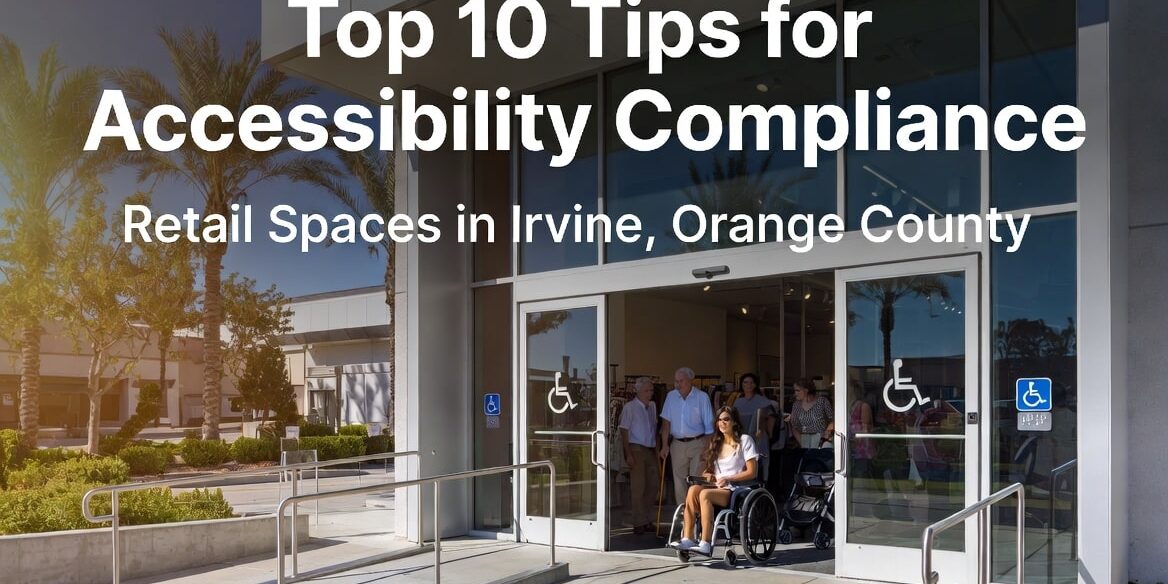
As a business owner or property manager operating a retail space in Irvine, California, ensuring accessibility compliance is not just a legal requirement—it’s a smart business decision that opens your doors to a wider customer base and protects you from costly lawsuits. Orange County, and specifically Irvine, has seen a surge in accessibility-related claims under the Americans with Disabilities Act (ADA) and California’s Unruh Civil Rights Act. Retail spaces—from boutique stores in The Market Place to larger shopping centers near Irvine Spectrum—must prioritize inclusive design to serve all customers, including those with disabilities.
Irvine’s vibrant retail scene, with its mix of indoor malls, outdoor plazas, and high-traffic shopping districts, demands proactive compliance. Failing to meet accessibility standards can result in expensive litigation, fines, and reputational damage. This comprehensive guide outlines the Top 10 Tips for Accessibility Compliance in Retail Spaces in Irvine, Orange County, providing practical, actionable advice tailored to local conditions, regulations, and enforcement trends.
Whether you manage a small storefront in Woodbridge or a flagship store in Irvine Company properties, these tips will help you create welcoming, compliant environments while minimizing legal risks.
Tip 1: Understand the Key Laws Governing Accessibility in California Retail Spaces
The foundation of any compliance program starts with knowing the applicable laws. In California, retail businesses must adhere to both federal and state regulations.
The Americans with Disabilities Act (ADA) Title III covers public accommodations, including retail stores. It requires businesses to remove architectural barriers where readily achievable and ensure effective communication for customers with disabilities.
California’s Unruh Civil Rights Act (Civil Code §51) incorporates ADA standards and allows for statutory damages of $4,000 per violation, plus attorney’s fees. This “stacking” effect makes California one of the most litigious states for accessibility claims. Additionally, the California Building Code (CBC), based on the 2022 or later editions (with amendments), often imposes stricter requirements than the 2010 ADA Standards for Accessible Design.
In Irvine, local enforcement through the City of Irvine’s Building Division and Planning Department adds another layer. Recent Orange County court cases have highlighted issues like insufficient accessible parking and non-compliant entrances in retail plazas. Businesses should regularly review the California Division of the State Architect (DSA) resources and consult with certified access specialists (CASp) familiar with Irvine-specific zoning and building permits.
Pro tip: Schedule an annual legal audit with an attorney experienced in Orange County accessibility litigation to stay ahead of updates, such as potential changes from the 2025 CBC cycle.
Tip 2: Conduct a Thorough CASp Inspection Early and Often
One of the most effective ways to protect your retail space in Irvine is by hiring a Certified Access Specialist (CASp). California law provides legal benefits, often called “CASp protection,” for businesses that obtain an inspection before a lawsuit is filed. A CASp report can limit liability and demonstrate good-faith efforts toward compliance.
In Orange County, demand for qualified CASp inspectors is high due to the volume of retail developments in areas like Irvine Spectrum Center, The District at Tustin (nearby), and local Irvine shopping centers. Look for inspectors certified by the California Division of the State Architect who understand local nuances, such as slope requirements on sidewalks along Jamboree Road or University Drive.
A comprehensive CASp inspection should cover:
- Parking lots and accessible parking spaces
- Paths of travel from parking to entrances
- Entrance doors and thresholds
- Interior circulation, including aisles and checkout areas
- Restrooms, fitting rooms, and service counters
For retail spaces, prioritize high-impact areas where customers interact most: entrances, point-of-sale counters, and merchandise displays. Many Irvine retailers have faced claims over protruding objects or inadequate maneuvering clearances in tight store layouts.
Recommendation: Budget for a CASp inspection every 2–3 years or after any renovation. The cost (typically $1,500–$5,000 depending on size) is far less than defending a single Unruh claim, which can exceed $20,000–$50,000 even for minor issues.
Tip 3: Ensure Accessible Parking and Pathways in Your Retail Property
Parking is one of the most common sources of ADA complaints in Irvine retail spaces. California requires a higher percentage of accessible parking than federal ADA standards in many cases.
Key requirements:
- Accessible parking spaces must be located on the shortest accessible route to the entrance.
- Van-accessible spaces need 8 feet of access aisle (plus 5 feet for passenger loading in some configurations) and an 8-foot-wide aisle.
- In Irvine, surface parking lots near retail centers must maintain slopes no steeper than 1:50 (2%) in any direction for accessible spaces and aisles.
- Signage must be mounted at least 60 inches above the ground, with the International Symbol of Accessibility.
Pathways from parking to the store entrance must be firm, stable, and slip-resistant. Common issues in Orange County include cracked sidewalks, excessive cross-slopes (over 2%), or changes in level greater than ½ inch without proper beveling or ramps.
For multi-tenant retail complexes in Irvine, coordinate with property management to ensure shared parking complies. Outdoor shopping areas near the Irvine Regional Park or along Alton Parkway often face challenges with uneven paving due to tree roots or settling.
Actionable step: Measure your parking lot’s accessible spaces and routes using a digital level and tape measure. If gradients exceed limits, plan for asphalt repairs or concrete grinding—common fixes in Irvine’s variable climate.
Tip 4: Design Compliant Entrances and Automatic Door Operators
Entrances are the “front door” to compliance. In retail, a non-compliant entrance can deter customers and invite lawsuits.
Requirements include:
- Minimum 32-inch clear width when the door is open 90 degrees.
- Thresholds no higher than ½ inch (or ¾ inch with bevel on both sides).
- Door hardware that is operable with one hand and does not require tight grasping, pinching, or twisting.
- Maneuvering clearances on both sides of the door.
Many Irvine retail spaces benefit from automatic door openers, especially for heavy glass doors common in modern storefronts. The activator button must be placed at least 60 inches from the door (or farther for swinging doors) and allow sufficient time for passage.
In high-wind areas or outdoor-facing stores in Irvine’s business parks, ensure power-assist or low-energy operators meet ANSI A156.19 standards. For historic or older retail buildings repurposed in areas like Old Towne Irvine, variances may be available but require documentation of technical infeasibility.
Best practice: Install signage indicating “Automatic Door” and maintain operators with regular servicing to prevent breakdowns that could create temporary barriers.
Tip 5: Optimize Interior Circulation, Aisles, and Display Layouts
Once inside, customers with mobility aids need adequate space to navigate. Retail stores in Irvine often pack merchandise tightly to maximize sales per square foot, which can create accessibility problems.
Key standards:
- Accessible routes must be at least 36 inches wide (60 inches preferred for two-way traffic).
- Turning spaces of 60-inch diameter or T-shaped configurations for 180-degree turns.
- Protruding objects (e.g., displays, signage) must not reduce clear width below 36 inches and must not protrude more than 4 inches into the path between 27 and 80 inches above the floor.
For clothing retailers or home goods stores popular in Irvine, ensure aisles between racks allow wheelchairs or scooters to pass comfortably. Seasonal displays during holidays or back-to-school periods should not obstruct primary paths.
Checkout areas deserve special attention: at least one accessible counter per register line with a maximum height of 36 inches and knee clearance underneath. Self-checkout machines must have accessible interfaces.
Tip for Irvine retailers: In strip malls or power centers along Bake Parkway or Culver Drive, measure aisle widths during peak stocking times to ensure temporary displays don’t create violations.
Tip 6: Make Restrooms and Fitting Rooms Fully Accessible
Public restrooms are frequent targets in accessibility litigation, especially in food-adjacent or service-heavy retail in Orange County.
Compliance checklist:
- At least one accessible stall per gender (or unisex/family restroom) with 60-inch turning space.
- Grab bars mounted at 33–36 inches high, 42 inches long on the side wall, and 36 inches on the rear.
- Toilet seat height 17–19 inches.
- Sink with knee and toe clearance, faucets operable without tight grasping.
- Mirror lowered to 40 inches maximum above the floor (or tilted).
Fitting rooms must provide a 60-inch turning space inside or adjacent, with benches and hooks at accessible heights. Doors should swing outward or provide adequate clearance if inward-swinging.
In Irvine shopping centers with shared restroom facilities (e.g., near food courts), ensure signage uses high-contrast, raised characters and Braille, with pictograms.
Maintenance is critical: Keep restrooms clean and stocked to prevent “out of order” situations that effectively remove accessibility.
Tip 7: Provide Effective Communication and Auxiliary Aids
Accessibility isn’t only physical. Retailers must ensure effective communication for customers who are deaf, hard of hearing, blind, or have low vision.
Requirements:
- Auxiliary aids and services, such as qualified interpreters, note-takers, or assistive listening devices when needed.
- For point-of-sale, provide accessible payment terminals or alternative methods.
- Websites and digital kiosks must comply with WCAG 2.1 AA standards (increasingly enforced via ADA Title III claims).
- Large-print menus, product information, or staff training on reading labels aloud.
In Irvine’s diverse customer base, including international visitors to nearby John Wayne Airport and tech professionals, multilingual signage and staff sensitivity training add value.
For visually impaired customers, maintain consistent layouts and avoid clutter. Tactile signage and high-contrast color schemes (70% contrast minimum) help significantly.
Tip 8: Train Staff on Accessibility Awareness and Customer Service
Even the most compliant physical space can fail if staff are unprepared. Lawsuits often arise from “attitude barriers” or denial of service.
Implement regular training covering:
- How to assist customers with disabilities without making assumptions.
- Proper use of wheelchair transfers, guide dog etiquette, and service animal policies (only dogs and miniature horses are recognized under ADA).
- Responding to requests for reasonable modifications, such as bringing merchandise to a customer unable to reach high shelves.
- Emergency evacuation procedures for people with disabilities.
In Orange County retail, where customer service is competitive, well-trained staff can turn compliance into a competitive advantage. Document all training sessions with sign-in sheets and materials for legal protection.
Partner with local organizations like the Dayle McIntosh Center for the Disabled in Orange County for customized workshops.
Tip 9: Maintain Ongoing Compliance Through Regular Audits and Documentation
Accessibility is not a one-time project—it requires continuous effort, especially in Irvine’s dynamic retail environment with frequent tenant improvements and seasonal changes.
Create a compliance program that includes:
- Quarterly self-audits using a checklist based on 2010 ADA Standards and 2022 CBC.
- Detailed records of repairs, inspections, and customer accommodation requests.
- Policy for barrier removal when “readily achievable” (considering cost relative to resources).
- Integration into lease agreements for multi-tenant properties.
For Irvine businesses, track weather-related damage (e.g., after heavy rains affecting outdoor paths) and schedule immediate repairs. Use facility management software to log maintenance tickets related to accessible features.
Consider joining local business associations, such as the Irvine Chamber of Commerce, which sometimes offers resources or seminars on compliance topics.
Tip 10: Budget for Accessibility Upgrades and Seek Available Resources
Financial planning is essential. While full compliance can seem expensive, spreading costs over time and leveraging incentives makes it manageable.
Strategies:
- Prioritize high-impact, low-cost fixes first (e.g., signage, door hardware, protruding object removal).
- Explore tax credits and deductions: Federal Disabled Access Credit (up to $5,000) and Barrier Removal Deduction (up to $15,000 annually).
- California-specific grants or low-interest loans through the California Department of Rehabilitation or local Orange County programs.
- When renovating, allocate 20–30% of the budget for accessibility features to avoid future retrofits.
In Irvine, work with architects and contractors experienced in adaptive reuse projects common in the area. For larger retail developments, early integration during design phases saves money compared to post-construction fixes.
Long-term view: Compliant spaces attract loyal customers from the disability community, which represents a significant market segment—over 25% of U.S. adults have some form of disability according to CDC data. In affluent Irvine, this group includes high-spending professionals and families.
Conclusion: Building Inclusive Retail Spaces in Irvine Benefits Everyone
Implementing these Top 10 Tips for Accessibility Compliance will help your retail business in Irvine, Orange County, not only avoid legal pitfalls but also foster goodwill and expand your customer base. From CASp inspections to staff training and ongoing maintenance, a proactive approach demonstrates commitment to inclusion.
Start today by scheduling a CASp inspection or reviewing your current parking and entrance configurations. Consult with local experts familiar with Irvine’s building department and Orange County court trends to tailor solutions to your specific space.
An accessible retail environment is good for business, good for the community, and the right thing to do. In a competitive market like Irvine—with its tech-driven economy, family-friendly neighborhoods, and growing tourism—inclusive design sets your store apart.
If you operate a retail space in Irvine or anywhere in Orange County and need personalized guidance, consider reaching out to a qualified CASp inspector, accessibility consultant, or attorney specializing in disability rights law. Compliance today prevents headaches tomorrow.