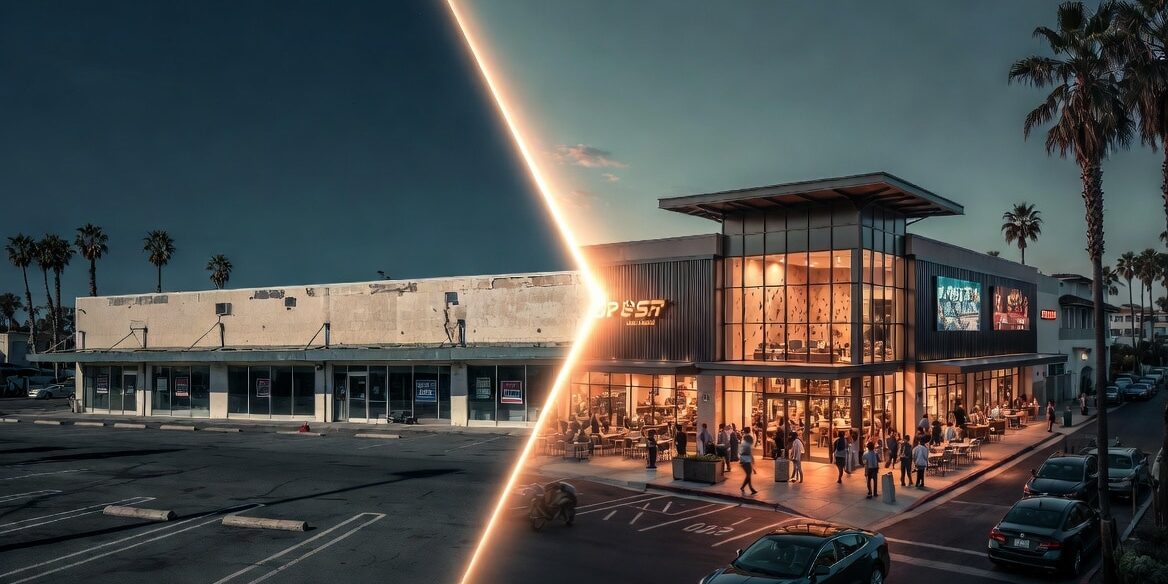
In the commercial real estate industry, the “Retail Apocalypse” has been the dominant media narrative for the better part of a decade. We have watched iconic, massive national brands—from Sports Authority and Toys “R” Us to Bed Bath & Beyond and Sears—succumb to the relentless efficiency of e-commerce.
For an Orange County landlord, a Big Box bankruptcy is a terrifying event. If you own a power center in Costa Mesa or a community plaza in Brea, losing a 40,000-square-foot anchor tenant doesn’t just blow a hole in your Net Operating Income (NOI); it severely damages the foot traffic that your smaller, inline tenants rely on to survive.
The immediate instinct of a traditional property manager is to put a “For Lease” sign in the window and wait for another massive, dry-goods retailer to absorb the space.
This is a losing strategy. The era of the 40,000-square-foot apparel or home-goods store is over. E-commerce has permanently altered the footprint of modern retail. To save the valuation of your asset, you must stop looking for a replacement and start looking for a reinvention.
Here is the definitive guide to navigating the death of the Big Box, executing complex “demising” strategies, and repositioning your Orange County retail shell for high-yield, experiential tenants.
1. The Experiential Pivot (What Amazon Can’t Deliver)
To fill a massive vacancy in today’s market, you must curate tenants that offer an experience that is completely immune to digital disruption. You cannot put a golf simulator, a luxury fitness club, or a massive culinary food hall inside an Amazon delivery box.
Institutional asset managers are actively pivoting dying Big Box shells in hubs like Irvine and Huntington Beach toward “Experiential Retail.”
The Target Avatars:
-
Upscale Indoor Athletics: Concepts like massive indoor pickleball clubs, high-end bouldering/rock-climbing gyms, and premium athletic country clubs (like Equinox or Life Time).
-
“Eatertainment”: Venues that combine dining with social activities, such as upscale bowling alleys, high-tech mini-golf, and massive, multi-vendor culinary food halls.
-
Medical and Wellness (Med-Tail): Converting a portion of the box into regional dialysis centers, orthopedic surgery hubs, or sprawling preventative wellness clinics.
These experiential tenants inherently require massive square footage (20,000 to 50,000 sq. ft.) and feature soaring ceiling heights—making them the perfect, plug-and-play replacements for a dead department store.
2. The “Demising” Strategy: Carving Up the Box
If an experiential “whale” tenant cannot be secured, the most profitable alternative is to execute a Demising Strategy. This involves physically carving up the massive 40,000-square-foot shell into three or four smaller, highly desirable suites (e.g., four 10,000-square-foot units).
The Financial Arbitrage: Why carve it up? Because of the inverse relationship between square footage and the price per square foot.
-
A legacy Big Box tenant may have been paying a mere $1.25 per square foot due to their massive size and corporate leverage.
-
If you demise that space into 10,000-square-foot suites, you can lease those smaller units to regional specialty retailers, boutique grocers, or national pet supply chains at $3.50 to $4.50 per square foot.
By investing the capital to carve up the box, you can mathematically double or even triple the total NOI generated by that exact same footprint, forcing a massive appreciation of the property’s overall Cap Rate.
3. The CapEx Reality of Demising
Carving up a Big Box is a highly lucrative development project, but it is not cheap. It requires an institutional-grade property management partner capable of overseeing heavy Capital Expenditures (CapEx).
When you demise a massive shell in Anaheim or Fullerton, you are not just putting up drywall. You are structurally separating the building’s infrastructure.
-
Utility Separation: A single Bed Bath & Beyond has one massive electrical panel and one water meter. To demise the space into four suites, you must trench the concrete to lay new plumbing and work with Southern California Edison to pull new, separate electrical meters for each tenant.
-
HVAC Zoning: The colossal 20-ton rooftop HVAC units that cooled the entire department store cannot efficiently cool four separate businesses with different operational hours. You will need to crane off the old units and install independent, localized RTUs for each newly demised suite.
-
Facade Renovation: A Big Box has one grand entrance. You must structurally alter the facade of the building to create four distinct, branded storefronts with separate ADA-compliant entryways.
4. Surviving the Municipal Parking Code
The single greatest hurdle to repositioning a Big Box into an experiential hub is the local City Planning Department.
When your building was originally permitted as “Dry Goods Retail,” the city likely required 4 parking spaces per 1,000 square feet. If you attempt to lease that exact same shell to a massive indoor trampoline park or a high-end food hall, the city will instantly reclassify the use case as “Assembly” or “High-Density Dining.” These use cases often require 10 to 15 parking spaces per 1,000 square feet.
If your parking lot in San Juan Capistrano does not mathematically have the spaces to support this new ratio, the city will deny the tenant’s business license, and the multi-million-dollar deal will collapse.
The L3 Solution: We do not sign leases and cross our fingers. We pre-empt the city. Before the lease is executed, we hire elite traffic engineers to conduct a Shared Parking Demand Study. We mathematically prove to the city that the peak hours of your new experiential tenant (e.g., Friday nights) do not conflict with the peak hours of your existing retail tenants (e.g., Tuesday mornings). We secure the necessary Conditional Use Permits (CUPs) and parking variances before a single dollar of construction capital is deployed.
Conclusion: Reinvention Requires an Operator
The death of a Big Box anchor tenant is the ultimate test of a commercial landlord. If you rely on a passive “rent collector” to solve a 40,000-square-foot vacancy, your building will languish on the market for years, bleeding carrying costs and destroying the equity you spent decades building.
Reinventing a massive retail shell requires a firm that operates at the intersection of property management, architectural development, and municipal lobbying.
At L3 Real Estate, we view massive vacancies as blank canvases for aggressive NOI expansion. We underwrite the Demising CapEx, we navigate the brutal Orange County parking codes, and we aggressively curate the internet-resistant, experiential tenants that will define the next generation of retail.
Are you currently staring down a massive Big Box vacancy, or are you concerned about the financial health of your existing anchor tenant? Contact our expert team today to discover how our specialized Mission Viejo commercial strategies and Lake Forest property management can definitively reinvent your asset.