

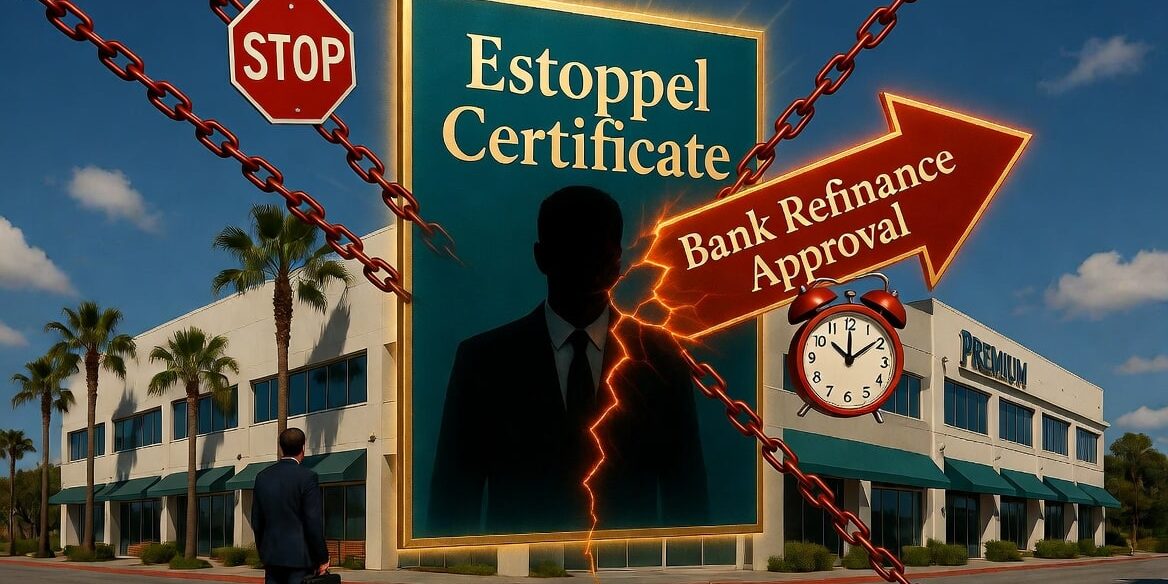
You have successfully navigated the most brutal phases of a commercial real estate transaction. You found an institutional buyer for your Irvine office building, you survived the buyer’s physical inspections, and the lender has given the green light. You are 14 days away from closing a massive, multi-million-dollar escrow.
Then, the buyer’s attorney requests the final piece of due diligence: The Tenant Estoppel Certificates.
You email the blank certificates to the tenants in your building, asking them to sign and return them. Your anchor tenant ignores the email. Your secondary tenant writes back, refusing to sign unless you give them two months of free rent. Another tenant signs the document but scribbles in the margins that you “verbally promised to replace their HVAC unit next year.”
Instantly, the buyer panics, the lender freezes the loan, and your entire multi-million-dollar transaction grinds to a catastrophic halt.
Amateur landlords view the Estoppel Certificate as a minor administrative formality. Institutional asset managers view it as a highly volatile legal weapon that tenants frequently use to hold landlords hostage. Here is the definitive guide to understanding the Estoppel Certificate, neutralizing the “Phantom Grievance” trap, and engineering the lease clauses required to legally force your tenants’ compliance.
1. The Legal Anatomy of an Estoppel
Why does Wall Street care so much about a single piece of paper?
Because commercial leases are incredibly complex, and buyers (and their lenders) are terrified of inheriting hidden liabilities. When a buyer acquires your Costa Mesa retail center, they are not just buying the dirt; they are buying the legal contracts attached to the dirt.
An Estoppel Certificate is a sworn legal document signed by the tenant. It forces the tenant to verify, under penalty of perjury, the exact current facts of their tenancy:
-
The exact amount of their Base Rent.
-
The exact amount of the Security Deposit currently held by the landlord.
-
The exact expiration date of the lease.
-
The ultimate question: A confirmation that the landlord is not currently in default of any lease obligations, and that the tenant has no outstanding claims against the landlord.
Once a tenant signs an Estoppel stating everything is fine, they are legally “estopped” (prevented) from later suing the new buyer, claiming they were secretly owed $50,000 in Tenant Improvement allowances. The Estoppel is the buyer’s ultimate legal shield.
2. The “Hostage” Negotiation
Savvy corporate tenants—and their aggressive representation brokers—understand exactly how much leverage the Estoppel gives them.
They know that your $5 million refinance of your Huntington Beach plaza is entirely contingent upon their signature. If they delay, your interest rate lock might expire, costing you hundreds of thousands of dollars.
The Sabotage: The tenant will weaponize this urgency. They will withhold their signature and demand immediate concessions. They will tell the property manager, “I’ll sign the Estoppel today, but only if you waive next month’s CAM charges,” or “I’ll sign it if you give me three additional reserved parking spaces.”
If you do not have the proper legal mechanics drafted into their original lease, you are completely at their mercy. You will be forced to pay the ransom to save your multi-million-dollar escrow.
3. The “Phantom Grievance” Trap
Even if a tenant agrees to sign the document, they can still destroy the deal by altering the text.
Imagine you are selling a Fullerton industrial park. A tenant signs their Estoppel, but in the “Landlord Defaults” section, they write: “The roof has been leaking for six months, and the landlord refuses to fix it.”
It doesn’t matter if the tenant is completely lying. The moment the buyer’s lender reads that sentence, they will instantly halt the loan funding. The buyer will immediately demand that you, the seller, place $100,000 of your own equity into a holdback escrow account to cover the cost of a potential new roof. A single, unverified sentence written by a disgruntled tenant just blew a massive hole in your Net Operating Income (NOI).
4. The L3 Drafting Solution: The 10-Day Mandate
You cannot solve an Estoppel crisis during a 30-day escrow. The legal architecture to defeat tenant sabotage must be poured years in advance, the day the original lease is signed.
Amateur landlords use generic leases that loosely request the tenant to sign an Estoppel “upon request.”
The Institutional Mandate: At L3 Real Estate, our commercial leases contain a brutal, uncompromising Estoppel Compliance Clause.
-
The Hard Timeline: The lease explicitly dictates that the tenant has exactly 10 business days to sign and return the Estoppel upon receiving it.
-
The Material Default: If the tenant fails to return it by Day 11, they are in immediate, material default of their lease. We have the legal right to instantly begin eviction proceedings against their business.
-
The “Power of Attorney” Failsafe: Most importantly, we include an irrevocable Power of Attorney clause. The lease states that if the tenant ignores the 10-day deadline, the landlord is legally granted the Power of Attorney to sign the Estoppel on the tenant’s behalf.
If a tenant in your Newport Beach property attempts to hold your escrow hostage, we do not negotiate. We simply cite the lease, execute the Power of Attorney, sign the document for them, and deliver the pristine, fully compliant Estoppel to the buyer’s lender. The escrow closes on time, every time.
5. Execution: The “White Glove” Extraction
While having the “nuclear option” drafted into the lease is mandatory, elite property management is about securing the signatures without triggering a legal war.
Over our 14 years in the trenches, overseeing a portfolio of more than 350 properties across Southern California, we have learned that you cannot simply email an Estoppel Certificate to a tenant and hope for the best. Emails get lost in spam folders, and corporate legal departments take weeks to review PDFs.
The Tactical Rollout: When a client enters escrow on a San Clemente asset, we execute a “White Glove” extraction.
-
We pre-fill every single data point on the Estoppel (rent, dates, deposit amounts) so the tenant does not have to look up their own lease. All they have to do is sign.
-
We do not rely on the post office. Our property managers physically walk the documents into the tenants’ suites, sit down with the business owners, explain exactly what the document is, and wait for the signature.
We remove all administrative friction, eliminating the tenant’s ability to delay the process.
Conclusion: Command the Escrow
In commercial real estate, an asset is only as liquid as the cooperation of its rent roll. If you allow your tenants to dictate the timeline and terms of your financial exit, you are actively surrendering the control of your generational wealth.
Amateur property managers beg their tenants for signatures, helplessly watching their clients’ escrows collapse. Institutional asset managers engineer the legal leverage required to force compliance, completely neutralizing the threat of tenant sabotage.
At L3 Real Estate, we operate your Orange County portfolio with absolute authority. We draft the 10-day mandates, we secure the Power of Attorney failsafes, and we execute the physical extraction of the documents. We ensure that when it is time to sell or refinance your multi-million-dollar asset, the only person controlling the closing date is you.
Are you preparing to list a commercial property or execute a massive cash-out refinance? Contact our expert team today to discover how our specialized Anaheim property management and Lake Forest commercial strategies can definitively secure your transaction.






