

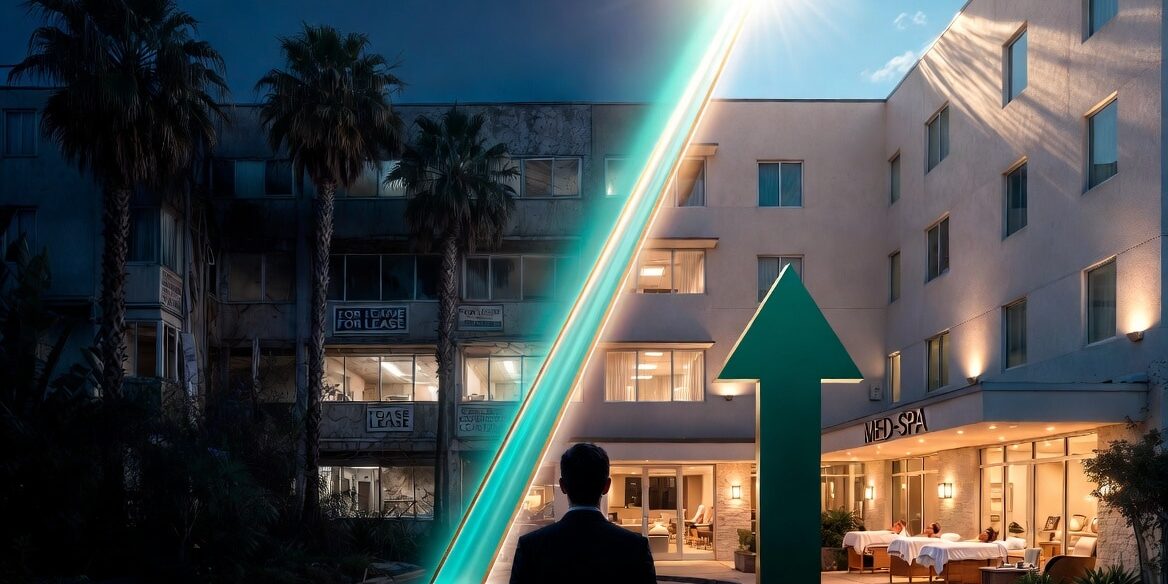
If you own a Class-B or Class-C multi-tenant office building built in Orange County between 1980 and 2005, you are currently fighting a war of attrition.
The traditional 3,000-square-foot suite in Irvine or Fullerton—filled with gray carpet, drop ceilings, and cubicles—is fundamentally obsolete. Accounting firms, mortgage brokers, and tech startups have permanently downsized their physical footprints in favor of hybrid remote work. If your building relies on these traditional tenants, your vacancy rates are climbing, and your Net Operating Income (NOI) is in a freefall.
Amateur landlords respond to this crisis by panicking and slashing their rental rates, completely destroying their Capitalization Rate and property valuation.
Institutional asset managers execute a strategic pivot. They stop trying to lease dead office space to office workers. Instead, they reposition the dirt to capture the explosive, recession-proof wealth of the “Med-Spa” and wellness industry.
Boutique aesthetics—Botox clinics, IV hydration lounges, laser hair removal centers, and longevity clinics—are completely internet-proof. They require physical footprints, they sign 10-year leases, and they pay premium rental rates. Here is the definitive guide to executing the “Zombie Office” conversion, navigating the intense CapEx requirements, and transforming your dying Orange County asset into a high-yield medical powerhouse.
1. The Zoning and Parking Arbitrage
You cannot simply sign a lease with a Med-Spa and hand them the keys to a former CPA office. The very first hurdle in a medical conversion is municipal bureaucracy.
When a city planner in Costa Mesa or Newport Beach looks at your property, they categorize it by its “Use.” Traditional office space is usually parked at a ratio of 4 spaces per 1,000 square feet.
Because Med-Spas see a high volume of patients cycling through every hour, the city legally reclassifies the suite as “Medical.” Medical uses almost always require a higher parking ratio, typically 5 spaces per 1,000 square feet.
-
The Entitlement Trap: If your building is tightly parked, the city will deny the Med-Spa’s business license.
-
The Institutional Solution: Before we ever market a dead suite to medical tenants, L3 Real Estate executes a forensic parking audit of the entire property. We mathematically prove to the city that because your remaining traditional office tenants are working remotely three days a week, the building is practically over-parked, allowing us to secure the highly coveted Conditional Use Permit (CUP) required for the medical conversion.
2. The Plumbing Paradox (Trenching the Slab)
The single largest physical difference between a corporate office and a Med-Spa is the plumbing infrastructure.
A traditional office suite only requires plumbing in the common area restrooms and perhaps a single breakroom sink. A high-end Med-Spa in Huntington Beach requires a “wet sink” in every single treatment room to comply with strict health department sanitization codes.
-
The CapEx Reality: You cannot route plumbing through the ceiling. You must bring the water and the sewer lines up through the floor. If you are converting a ground-floor suite, this requires hiring specialized concrete contractors to X-ray the foundation, saw-cut massive trenches into the concrete slab, lay the new sewer lines, and re-pour the concrete.
-
The Cost Allocation: This is a massive Capital Expenditure (CapEx). Elite landlords use this to their advantage. We offer to manage and front the capital for this heavy trenching (the “Landlord’s Work”), but in exchange, we legally trap the Med-Spa into a rigid 10-year lease at an absolute top-of-market rental rate. The landlord pays for the infrastructure, but the tenant pays for it tenfold over the life of the lease.
3. Powering the Lasers (The Electrical Upgrade)
The sleek, minimalist aesthetic of a modern Med-Spa hides a massive, industrial-level demand for electricity.
A standard office suite in San Clemente is wired to run laptops, a copy machine, and fluorescent lights. A Med-Spa operates multi-hundred-thousand-dollar medical equipment.
-
Cryotherapy chambers, advanced laser resurfacing machines, and high-capacity autoclaves draw massive amounts of amperage.
-
Furthermore, these machines generate incredible amounts of heat, requiring dedicated, heavy-duty HVAC split-systems in the specific treatment rooms to keep the expensive equipment from melting down.
If you do not audit the building’s main electrical panel before signing the lease, you will suddenly discover you need to spend $40,000 to pull new, heavy-duty power lines from the local Southern California Edison transformer just to allow the tenant to turn on their lasers. We underwrite these electrical requirements on day one, legally shifting the financial burden of the panel upgrades directly to the tenant through heavily negotiated Tenant Improvement (TI) documents.
4. The “Retail-ification” of the Office Suite
Med-Spas do not view themselves as medical clinics; they view themselves as luxury retail brands. They are selling an aesthetic experience.
If you want to land a premium, high-credit Med-Spa operator in your Lake Forest building, you have to offer them a retail experience within an office shell.
-
The Ground Floor Premium: Med-Spas heavily prefer ground-floor, street-facing suites with direct exterior entrances. They do not want their wealthy clients wandering through a dark, shared interior lobby.
-
The Signage War: They will demand maximum visibility. We actively negotiate with the city and the existing tenant base to secure premium monument signage rights for the incoming Med-Spa, transforming a quiet office suite into a highly visible, billboard-level retail location.
5. The Valuation Arbitrage (The Ultimate Payoff)
Executing a Zombie Office conversion is heavy, operationally complex lifting. But the financial payoff is one of the highest in commercial real estate.
When you successfully convert a dead, $1.75/sq ft office suite into a thriving, $3.50/sq ft Med-Spa, you are not just doubling the rent. You are fundamentally changing the risk profile of your Anaheim asset.
Medical tenants are incredibly “sticky.” Because they just spent $200,000 of their own money building out luxury reception areas and specialized treatment rooms, they will never leave. When it comes time to sell or refinance your building, Wall Street underwriters look at a 10-year Med-Spa lease and assign it a drastically lower Capitalization Rate than a standard office lease. You have manufactured millions of dollars of permanent equity out of obsolete dirt.
Conclusion: Pivot or Perish
In the modern commercial real estate landscape, hoping that the 2019 office market will eventually return is a guaranteed path to foreclosure. The market has shifted, and the dirt must shift with it.
Amateur landlords stare at their empty corporate suites and complain about remote work. Institutional asset managers look at those exact same empty suites, pull the concrete trenching permits, and build highly profitable medical ecosystems.
Over 14 years in the trenches, managing a portfolio of more than 350 properties across Southern California, we have mastered the art of the architectural pivot. At L3 Real Estate, we do not just market your vacancies; we fundamentally reposition your asset. We navigate the municipal parking variances, we manage the heavy CapEx build-outs, and we lock in the elite, recession-proof medical tenants. We ensure that your Orange County property does not just survive the death of the office market—it thrives on it.
Are you sitting on vacant, obsolete office space, or are you looking to aggressively reposition a Class-B asset? Contact our expert team today to discover how our specialized Mission Viejo property management and Brea commercial strategies can definitively execute your medical conversion.






