

In the highly reactive, sentiment-driven arena of commercial real estate syndication, the amateur investor and the obsolete seller are currently trapped in a shared, catastrophic hallucination. The seller looks at an offering memorandum from 2021, remembers when debt was virtually free, and blindly demands a 4% Capitalization Rate for an aging, heavy-friction asset. The amateur buyer, desperate for deal flow, attempts to underwrite the acquisition using 2026 commercial debt, only to realize the spreadsheet mathematically self-destructs. They freeze, entirely paralyzed by the massive chasm between the asking price and the operational reality.
This is a complete failure of macroeconomic underwriting.
In the apex tiers of institutional capital, we do not negotiate with nostalgia; we negotiate with mathematics. A commercial building does not possess an intrinsic, emotional value; its price is violently tethered to the global cost of capital. When the Federal Reserve radically shifts the interest rate environment, the foundational pricing matrix of every single commercial asset mathematically resets. If a seller refuses to acknowledge this reset, they do not have an asset for sale; they have an overpriced liability slowly suffocating on the open market.
At The Malakai Sparks Group, backed by the institutional framework of L3 Real Estate, we engineer acquisitions based exclusively on the current mathematical horizon. Operating in the trenches for 14 years and executing the daily logistical warfare of managing over 350 properties proves that capital deployment requires the uncompromising physical and mental stamina of an Ironman. You do not survive a high-rate environment by sprinting blindly into bad debt; you survive by managing the friction with the relentless, compounding structural momentum of a 48KG kettlebell progression—you must possess the raw power to lock out the heavy weight of the market and the discipline to never compromise your mechanical foundation. Just as we precisely map every localized demographic shift across our exact 2,500-home farming route in downtown Huntington Beach to secure unyielding localized equity long before it hits the MLS, we forensically audit the macroeconomic debt stack to permanently eradicate the seller’s valuation fantasy. Here is the definitive, institutional-grade guide to decoding the high-rate pricing reset, surviving the negative leverage slaughter, and mathematically forcing the yield.
1. The Death of the ZIRP Delusion and The Risk Premium
To successfully deploy capital in a high-rate environment, an investor must first dismantle the psychological anchor of the Zero Interest Rate Policy (ZIRP) era.
For over a decade, artificial macroeconomic stimulus allowed amateur operators to buy mediocre real estate at astronomical prices, simply because the cost of borrowing the money was nearly zero. The market was not pricing the quality of the dirt; it was pricing the availability of the debt. That era is dead.
-
The Risk-Free Baseline: Commercial real estate valuation is entirely dictated by the “Risk-Free Rate” (typically the 10-Year US Treasury yield). Institutional capital mathematically mandates that commercial real estate—an illiquid, management-intensive asset—must offer a significant yield premium over a risk-free government bond.
-
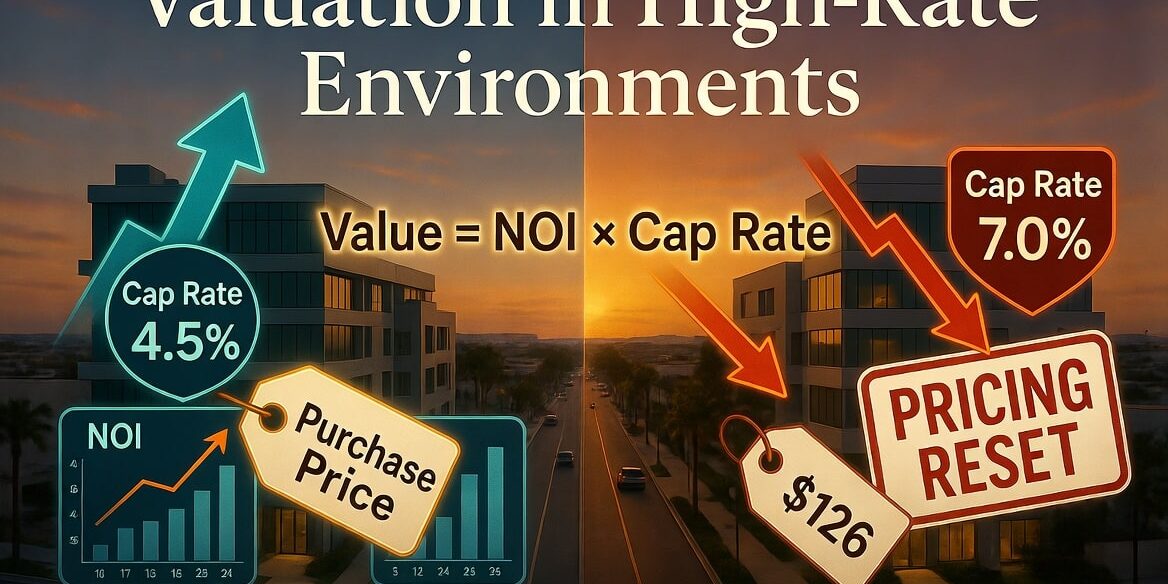
The Valuation Collapse: If the 10-Year Treasury surges to 4.5%, an institutional investor will not acquire a commercial building at a 4.5% Cap Rate. Why would they absorb the violent operational friction of tenant defaults, roof leaks, and municipal taxes for the exact same yield they could get sitting completely passive in a treasury bond? They mathematically demand a 6.5% to 7% Cap Rate to justify the risk. When Cap Rates violently expand to meet this requirement, the underlying physical value of the asset mathematically collapses.
2. The “Negative Leverage” Slaughter
The most lethal mathematical trap awaiting the amateur investor in a high-rate environment is the execution of Negative Leverage.
Amateur syndicators are so obsessed with acquiring doors that they will blindly sign a loan term sheet without calculating the exact relationship between the asset’s yield and the bank’s interest rate.
-
The Mathematical Bleed: If you acquire a massive residential complex within the transit-oriented commuter grids of Santa Ana: High-Density Multi-Family & The Urban Redevelopment Core or the student-heavy logistical networks of Fullerton: The Northern Logistical & Academic Support Hub at a 5% Cap Rate, but your institutional commercial loan carries a 7% interest rate, you are operating in a state of violent Negative Leverage.
-
Subsidizing the Seller: The building does not generate enough Net Operating Income (NOI) to satisfy the cost of the money you borrowed to buy it. You are mathematically writing a personal check every single month to subsidize the seller’s overpriced exit. Elite institutional operators absolutely refuse to underwrite negative leverage. If the cost of debt is 7%, the entry Cap Rate must be mathematically forced higher, or the purchase price must be violently slashed until the leverage turns positive.
3. The Bid-Ask Spread and The Industrial Standoff
The direct consequence of this mathematical reset is the massive “Bid-Ask Spread” gridlocking the open market. Sellers demand 2021 pricing; buyers demand 2026 debt underwriting.
This standoff is brutally apparent within the heavy industrial sectors.
-
The CapEx Reality Check: When underwriting massive distribution hubs within Anaheim: The Industrial Heart of Orange County or specialized, marine-layer-resistant terminal logistics centers in Huntington Beach: Coastal Industrial & The Aerospace/Defense Pivot, the seller points to the massive tenant demand and demands a premium.
-
The Buyer’s Override: The institutional buyer ignores the seller’s demands and forensically audits the cost of capital required to maintain the 3-phase power grids and specialized infrastructural moats. Because bridge debt and construction loans have become astronomically expensive, the buyer mathematically forces the seller to absorb the increased cost of capital by dramatically lowering the purchase price. If the seller refuses, the institutional buyer simply walks away, leaving the seller trapped in an illiquid asset as their own adjustable-rate debt slowly detonates.
4. Squeezing the Experiential and Creative Premiums
High-rate environments ruthlessly punish speculative, capital-intensive business models.
-
The Capital Squeeze: When executing adaptive-reuse projects within the hyper-experiential retail grids of Costa Mesa: The Creative Office & High-Volume Experiential Retail Corridor or navigating the draconian preservation overlays of San Juan Capistrano: Historic Professional Office & Boutique Retail Arbitrage, the required Tenant Improvement (TI) allowances are massive.
-
The Repricing: In a low-rate environment, landlords easily borrowed cheap money to fund $150-per-square-foot boutique retail build-outs. In a high-rate environment, the cost of that TI capital violently erodes the landlord’s margins. Consequently, the value of un-renovated, creative office shells plummets. Institutional capital acquires these raw canvases at massive, distressed discounts, mathematically ensuring their entry basis is low enough to comfortably absorb the expensive construction debt required to manufacture the consumer gravity.
5. The “Flight to Quality” and Clinical Inelasticity
When the cost of capital spikes and macroeconomic uncertainty paralyzes the amateur market, elite capital does not stop acquiring; they execute a massive, violent “Flight to Quality.”
-
Abandoning the Value-Add Trap: Institutional funds immediately abandon high-friction, Class C value-add projects, refusing to take on massive CapEx exposure when debt is expensive. Instead, they route their liquid equity directly into highly specialized, corporately backed infrastructure.
-
The Medical Safe Harbor: They target the corporately backed clinical engines operating within Orange: The Institutional Healthcare & Medical Office Epicenter and secure advanced biomedical footprints in Fountain Valley: The Corporate Flex Corridor & Institutional Healthcare Fortress. While these assets command premium pricing, the 15-year leases backed by global healthcare conglomerates provide absolute, recession-proof inelasticity. The elite operator accepts a slightly compressed yield in exchange for mathematically guaranteeing their cash flow against the macroeconomic turbulence.
6. The Ultimate Defense: Cash Dominance in Sovereign Vaults
The absolute zenith of the high-rate pricing reset is the weaponization of pure liquidity.
When borrowing costs exceed 7%, the amateur syndicator who relies entirely on 75% LTV bank leverage is completely eradicated from the market. They cannot mathematically make the deals pencil. This entirely eliminates the bidding wars, clearing the battlefield for the all-cash Family Offices and sovereign institutional funds.
-
The Frictionless Capture: These elite entities deploy eight-figure, all-cash blocks directly into the towering, master-planned corporate bastions of Irvine: The Master-Planned Corporate Juggernaut and the heavily restricted suburban fortresses of Mission Viejo: South County Suburban Retail & High-Yield Healthcare Centers.
-
The Coastal Monopoly: Because they require zero bank debt, they are entirely immune to the negative leverage slaughter. They swoop into the absolute sovereign wealth vaults of Newport Beach: The Wealth Management & Coastal Capital Center, acquiring generational, Absolute NNN coastal assets at pricing levels that were completely inaccessible during the artificially inflated ZIRP era. They use the high-rate environment to permanently capture the ultimate localized monopolies while their debt-reliant competitors slowly bleed to death.
Conclusion: Do Not Wait for the Fed, Underwrite the Reality
In the highly capitalized, completely unforgiving arena of Southern California commercial real estate, waiting for the Federal Reserve to drop interest rates so your spreadsheet works is an unforced error of massive proportions.
Amateur commercial brokers sell hope. They convince their clients to overpay for mispriced assets, blindly promising that they can simply refinance into cheaper debt in 24 months, trapping their investors in a ticking time bomb of negative leverage.
Elite commercial advisors are macroeconomic actuaries. We calculate the risk premium. We underwrite the precise negative leverage thresholds. We mathematically force the seller to absorb the cap rate expansion before the LOI is ever drafted. At The Malakai Sparks Group, we ensure that when your wealth is deployed into a commercial asset, you are not speculating on the cost of debt; you are executing a mathematically impenetrable, stress-tested acquisition engineered to permanently dominate regardless of the macroeconomic climate.