If you track commercial real estate headlines, you would assume the only industrial properties that matter are the colossal, 500,000-square-foot fulfillment centers leased by Amazon or FedEx. While those mega-warehouses dominate the logistics landscape, they are exclusively the playground of massive, publicly traded Real Estate Investment Trusts (REITs).
For the independent, high-net-worth investor looking to aggressively scale their Orange County portfolio, the most lucrative, recession-proof, and highly coveted asset class is entirely different.
It is the Small-Bay “Flex-Industrial” Park. These are the unassuming, multi-tenant concrete tilt-ups found in Anaheim, Fullerton, and San Clemente. They are typically broken down into bite-sized suites ranging from 1,500 to 5,000 square feet, featuring a tiny office in the front and a roll-up door in the back.
While amateur investors chase the glamour of Newport Beach retail or the prestige of Irvine office towers, elite operators are quietly accumulating small-bay industrial dirt. Here is the definitive guide to understanding the Flex-Industrial boom, the mathematical advantages of tenant diversification, and why this specific asset class generates the most stable Net Operating Income (NOI) in Southern California.
1. The E-Commerce “Micro-Fulfillment” Squeeze
The explosion of Flex-Industrial is a direct byproduct of modern consumer demands. Today, businesses do not just need a place to store goods; they need a place to rapidly deploy them.
While massive corporations use giant warehouses out in the Inland Empire to store bulk cargo, smaller e-commerce brands, specialty distributors, and direct-to-consumer start-ups need “Last-Mile” Micro-Fulfillment Centers.
-
They cannot afford the massive footprint of a corporate distribution hub.
-
They cannot run a high-volume shipping operation out of a residential garage.
-
They need 3,000 square feet of functional, ground-floor warehouse space directly adjacent to the high-income populations of Costa Mesa and Huntington Beach.
The supply of this specific square footage in Orange County is virtually zero. Because land is so expensive, developers are not building new small-bay parks; they are only building luxury apartments and mega-warehouses. This severe supply-and-demand imbalance gives the landlord absolute pricing power, allowing for aggressive, year-over-year rent growth.
2. The Ultimate Risk Mitigation: Tenant Diversification
When you buy a 40,000-square-foot single-tenant building, your cash flow is entirely dependent on the survival of one company. If that single corporate tenant goes bankrupt or decides not to renew their lease, your property instantly goes from 100% occupied to 100% vacant. Your NOI drops to zero overnight, but your multi-million-dollar mortgage payment does not.
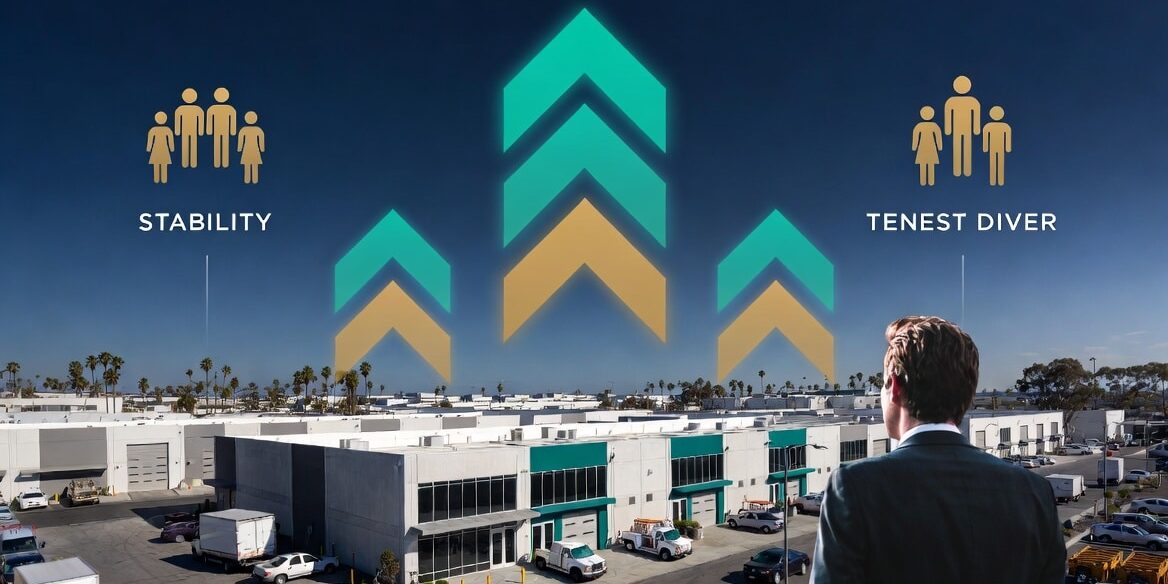
The Flex-Industrial Mathematical Shield: If you take that exact same 40,000 square feet and acquire a Flex-Industrial park with twenty individual 2,000-square-foot bays, you have fundamentally altered your risk profile.
-
You are no longer reliant on a single CEO’s business acumen.
-
If two of your tenants in your Brea park fail and move out, your property is still 90% occupied.
-
You continue to comfortably service your debt while your property management team easily backfills the two vacant, highly desirable units.
Small-bay industrial provides the cash flow stability of a multi-family apartment building, combined with the low-maintenance advantages of a commercial Triple Net (NNN) structure.
3. The “Sticky” Blue-Collar Tenant
While e-commerce is a massive driver of flex-space demand, the true backbone of this asset class is the localized, blue-collar service provider: the commercial plumbers, the specialized HVAC contractors, the custom auto-fabricators, and the high-end electricians.
These tenants are the holy grail of commercial real estate.
-
Internet-Proof: A commercial plumbing company cannot be replaced by Amazon, and they cannot run their fleet of heavy-duty trucks from a laptop on a kitchen counter. They mandate physical, industrial real estate.
-
The “Sticky” Build-Out: When a custom auto-shop or a specialized manufacturing tenant leases your Orange suite, they frequently spend their own capital upgrading the electrical panels to 3-phase power, bolting massive vehicle lifts into the concrete slab, and installing specialized air-compressor lines.
Because it is incredibly expensive to unbolt that heavy machinery and move it to a new location, these tenants become incredibly “sticky.” They will happily sign 5-year and 10-year lease renewals, absorbing annual rent bumps simply to avoid the massive logistical nightmare of relocating their heavy equipment.
4. The CapEx Advantage (Practically Indestructible)
From an operational standpoint, a Flex-Industrial property is the most landlord-friendly asset in existence.
When a traditional office tenant moves out of a Lake Forest building, the space usually looks terribly dated. To attract a new tenant, the landlord must spend $30 to $50 per square foot on cosmetic Tenant Improvements (TI)—tearing down walls, replacing carpets, and upgrading lighting.
The Industrial Turn-Over: Flex-industrial suites are essentially concrete bunkers. There is no expensive carpet to stain, no delicate drywall to dent, and no complex, multi-zone HVAC system to constantly repair. When an industrial tenant moves out, the “make-ready” process is ruthlessly efficient:
-
You sweep the concrete floor.
-
You paint the tiny 200-square-foot front office.
-
You service the roll-up door springs.
For less than $2,000 in CapEx, the suite is completely ready for the next tenant. This incredibly low capital requirement preserves your cash flow and ensures that almost every dollar of collected rent flows directly to your bottom line.
5. Managing the “Nuisance” Friction
While the financial metrics of small-bay industrial are flawless, the day-to-day operations require a highly disciplined property manager.
When you pack 20 different industrial businesses into a single San Juan Capistrano park, friction is inevitable.
-
The granite fabricator produces too much dust, aggravating the e-commerce tenant next door.
-
The auto-mechanic starts parking their overflow vehicles in the shared drive aisles, blocking the delivery trucks for the custom cabinet maker.
The Institutional Enforcement: Amateur landlords let the inmates run the asylum, turning a premium asset into a chaotic junkyard. At L3 Real Estate, we deploy aggressive “Rules and Regulations” addendums. We strictly police the common areas, issue immediate lease violations for unauthorized outdoor storage, and ensure that the environmental footprint of one tenant never cannibalizes the operational efficiency of another. We maintain the institutional aesthetics required to continually drive rental rates upward.
Conclusion: Own the Infrastructure of the Local Economy
In commercial real estate, the sexiest buildings rarely produce the safest returns. An aging, multi-tenant concrete tilt-up in a secondary submarket might not look like a trophy asset on a brochure, but when audited mathematically, it is an absolute cash-flowing juggernaut.
Small-Bay Flex-Industrial is the physical infrastructure that keeps the Orange County economy moving.
Over 14 years of managing a portfolio of more than 350 properties, we have seen economic cycles wipe out vulnerable office and retail landlords, while our industrial clients simply continued to collect rent. At L3 Real Estate, we identify these highly coveted assets, we ruthlessly manage the tenant friction, and we keep the concrete swept and the NOI climbing. We ensure your capital is anchored in the most indestructible sector of the Southern California market.
Are you looking to diversify your portfolio away from vulnerable office or retail assets, or do you currently own an industrial park that is suffering from operational chaos? Contact our expert team today to discover how our specialized Mission Viejo property management and Tustin commercial strategies can definitively protect your investment.